The Unified Commerce Playbook: Why Enterprise Leaders are Merging B2B + B2C
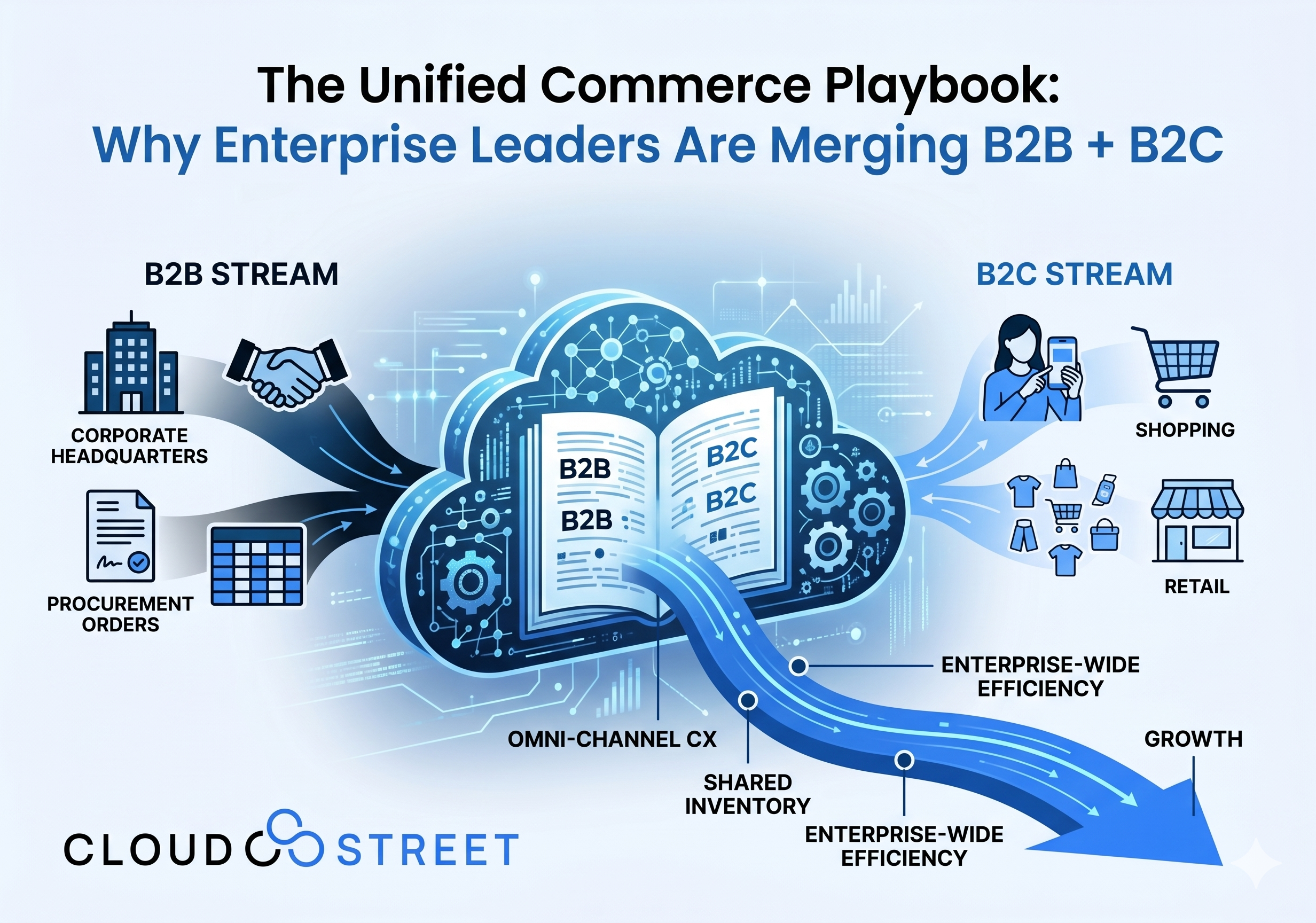
Let’s be honest for a second: the line between “I’m buying a thousand industrial-grade ball bearings for my factory” and “I’m buying a pair of sneakers for my morning run” has gotten incredibly thin.
It’s April 2026, and if your business is still treating B2B and B2C like two distant relatives who only see each other at funerals, you’re leaving money on the table. A lot of it. For years, the “Standard Operating Procedure” for enterprise-level companies was to build separate silos. One team handled the high-volume, complex B2B portal, while another team focused on the flashy, high-conversion B2C storefront.
The result? A “Franken-stack” of disconnected data, redundant licensing fees, and a customer experience that feels like it was designed by two different companies.
At CLOUDSTREET, based right here in the heart of Houston, Texas, we’ve seen this play out globally. Whether we’re helping a local energy giant or a retail titan in Europe, the goal is always the same: ROI. And in 2026, the shortest path to ROI is merging those silos into a Unified Commerce Playbook on Salesforce.
The Identity Crisis: Why B2B and B2C Are Merging
The “B” in B2B doesn’t stand for “Boring.” Your B2B buyers are the same people who go home and order groceries on their phones. They want the same ease of use, the same personalization, and the same speed they get from their favorite B2C brands.
Recent Gartner research has placed Salesforce firmly in the Leader quadrant for its ability to handle this convergence. Why? Because Salesforce doesn’t just give you a storefront; it gives you a platform. By merging B2B and B2C onto a single stack, you aren’t just saving on server costs: you’re creating a 360-degree view of your business that was previously impossible.

5 Reasons Your “Franken-Stack” Is Killing Your Margins
If you’re still running separate platforms, you’re likely suffering from what we call “The Swivel-Chair Effect.” This is where your employees have to jump between five different tabs just to figure out if a customer is eligible for a discount.
- Redundant Licensing Costs: You’re paying for two platforms, two sets of security patches, and two hosting bills. It’s expensive and unnecessary.
- Data Fragmentation: When B2B and B2C data live in different buckets, your marketing team can’t see the whole picture. How can you upsell a wholesale client if you don’t know they’re also browsing your retail site?
- Inventory Nightmares: Trying to sync inventory across two separate commerce engines is a recipe for “Out of Stock” emails that ruin customer trust.
- Training Fatigue: Your IT and support teams have to learn two different UIs and two different sets of back-end logic.
- Slow Innovation: Every time Salesforce releases a cool new feature (like the latest Einstein AI tools), you have to implement it twice.
By unifying, you eliminate these headaches and drastically lower your Total Cost of Ownership (TCO).
The TCO Math: Why One Stack is Better for the C-Suite
From a financial perspective, merging your B2B and B2C operations on Salesforce is a no-brainer. When we perform a Salesforce audit for distributors or retailers, we look at the “hidden” costs.
Maintaining a single source of truth for your product catalog, pricing engine, and customer profiles reduces maintenance overhead by up to 30-40%. Plus, with Salesforce integration services, you can hook your commerce engine directly into your ERP or Data Cloud. This means your “Available to Promise” inventory is actually accurate: in real-time.

4 Pillars of the Unified Commerce Playbook
So, how do the leaders actually do it? Here are the four pillars we use at CLOUDSTREET to help our clients dominate their markets:
1. The Unified Customer Profile (Data Cloud)
In 2026, data is the new oil (and being in Houston, we know a thing or two about oil). By connecting Snowflake and Salesforce, you can feed every B2B transaction and B2C click into Data Cloud. This gives your sales agents the context they need to close deals faster.
2. Agentforce & Generative AI
Gone are the days of basic chatbots. With Agentforce, you can deploy AI agents that handle complex B2B pricing negotiations and simple B2C returns on the same platform. Generative AI is streamlining the way businesses get things done by allowing customers to describe what they need in plain English and getting a curated cart in return.
3. Shared Product Architecture
Why manage two catalogs? With Salesforce Commerce Cloud, you can use the same product data but apply different “lenses.” Your B2B buyers see their contract pricing and bulk shipping options, while your B2C customers see MSRP and next-day delivery. Same data, different experience.
4. Cross-Channel Fulfillment
Unified commerce allows for “Buy Online, Pick Up in Warehouse” for B2B, or “Buy at Trade Show, Ship to Home” for B2C. When your Order Management System (OMS) is part of the same stack, the logistics become a competitive advantage rather than a logistical nightmare.

Gartner’s 2026 Outlook: The Rise of the “Everywhere” Customer
Gartner recently highlighted that the most successful enterprise leaders are those who have moved away from “channel-centric” thinking and toward “customer-centric” ecosystems. This is exactly what Salesforce B2C Commerce Cloud and B2B Commerce are designed to do.
Being a “Leader” in the Gartner Magic Quadrant isn’t just about having the most features; it’s about having the most integrated features. Salesforce’s commitment to the “One Platform” philosophy is why they continue to outpace competitors. At CLOUDSTREET, we help you navigate these complex implementations so you don’t just “go live”: you actually see the ROI.
3 Ways CLOUDSTREET Drives ROI for Global Enterprise
We might be a Houston-based firm, but our reach is global. We understand that an enterprise-level implementation is about more than just flipping a switch.
- Strategic Audits: We don’t just start coding. we look at your current tech debt and identify where the most significant ROI “leaks” are happening.
- Specialized Managed Services: Not every company needs a full-time in-house team. Our Salesforce managed services provide the expertise you need without the massive overhead.
- Industry-Specific Expertise: Whether you are in manufacturing or retail, we know the specific challenges of your sector.

The Bottom Line: Adapt or Get Left Behind
The “Unified Commerce Playbook” isn’t a suggestion; it’s a survival guide. As we move deeper into 2026, the gap between companies that have a unified data strategy and those that don’t will only widen.
Your customers: whether they are buying a fleet of trucks or a single t-shirt: expect you to know who they are. They expect the experience to be seamless, personalized, and fast. If you’re forcing them to deal with your internal silos, they’ll simply find someone who doesn’t.
Ready to stop managing two platforms and start managing one powerhouse? Contact us today and let’s talk about how CLOUDSTREET can help you merge your B2B and B2C worlds for maximum impact.

Whether you’re looking for a Salesforce partner to drive growth or you need to see some real-world case studies to believe the hype, we’re here to help. Let’s get your commerce strategy unified, your TCO down, and your ROI up.
Want to stay ahead of the curve? Check out our latest insights on how Salesforce is investing $500M in Generative AI startups and what that means for your future tech stack.
Category
Discover insights that drive results - explore out latest blog posts now
DealHub Salesforce Integration for Manufacturers: Connecting CPQ, Contracts, and CRM
About the manufacturer: mid-market industrial equipment company A U.S.-based, mid-market [...]
Salesforce Data 360 and Agentforce: Why Grounding Is What Makes AI Agents Dependable
An AI agent can produce a fluent answer and still [...]
Salesforce Data 360 Governance and Informatica: Managing Data Quality, Access, and Trust in the Agentic Era
Data governance becomes more consequential when business data does more [...]