The B2B Shopify Ceiling: Why Enterprise Leaders Are Scaling Up to Salesforce B2B Commerce Cloud
For many small to mid-size manufacturers, Shopify starts as a smart first step. They take a nibble at e-commerce, launch a simple online experience, and prove there is demand beyond phone calls, spreadsheets, and manual reorder processes. At that stage, Shopify feels fast, affordable, and easy enough to get moving.
But growth changes the equation. Sometimes it happens gradually as more customers ask for online ordering, negotiated terms, and self-service account access. Sometimes it happens fast after a new product line, a channel expansion, or pressure from competitors. Either way, many B2B manufacturers eventually run into the same limit: the Shopify Ceiling.
Once the business moves beyond basic wholesale ordering and into account-specific pricing, layered buyer permissions, and deeper CRM integration needs, the platform that felt simple can start turning into a patchwork of apps, workarounds, and manual effort.
At CLOUDSTREET, based in Houston, Texas, we help companies locally and globally navigate this transition. We’ve seen firsthand how growing manufacturers and enterprise B2B teams migrate to Salesforce B2B Commerce Cloud to support the next stage of scale.
Here is why more complex B2B organizations are outgrowing Shopify and choosing the power of Salesforce.
1. The 4 Hidden Dangers of the Shopify “App Tax”
Shopify’s core strength is simplicity. However, that simplicity is often achieved by stripping away the complex features that B2B enterprises need natively. To bridge the gap, Shopify users turn to the App Store.
While a few apps are fine for a small shop, an enterprise B2B operation might require 15 to 20 different third-party plugins to handle things like advanced search, custom pricing, VAT calculations, and net-payment terms. This creates what we call the “App Tax”:
- Fragile Architecture: Every time Shopify updates its core API, there is a risk that one of your third-party apps will break, potentially taking down your entire checkout process.
- Data Silos: When your subscription logic lives in one app and your volume discounts live in another, getting a single, clean view of your customer data becomes nearly impossible.
- Performance Drag: Loading dozens of third-party scripts slows down your site. In B2B, where professional buyers are looking for efficiency, a slow site is a direct hit to your ROI.
- Escalating Costs: While the base Shopify Plus fee is predictable, the monthly “rent” for 20 premium apps can quickly rival the cost of an enterprise platform.
In contrast, Salesforce B2B Commerce Cloud is built on the core Salesforce platform. Most of the functionality that requires an app in Shopify is a native, out-of-the-box feature in Salesforce.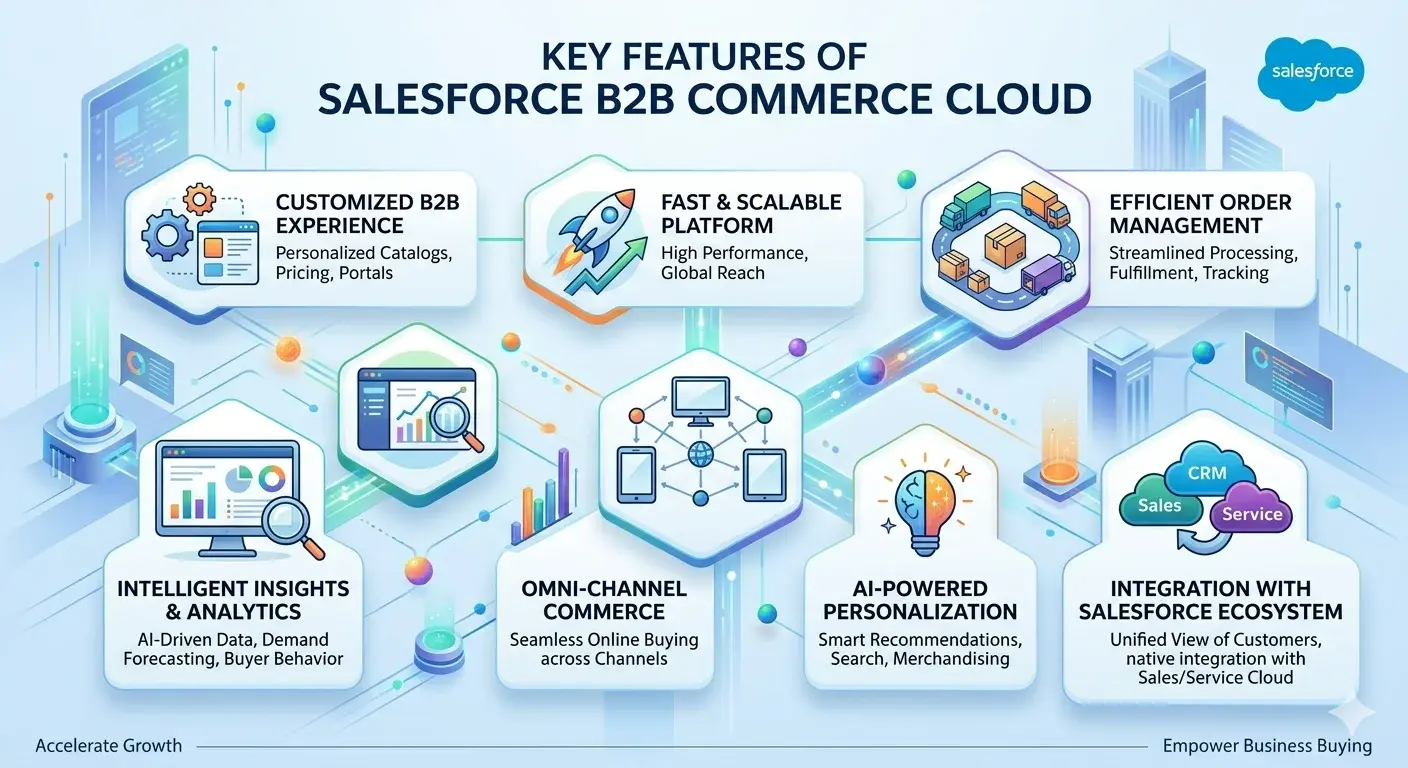
2. When Simple Wholesale Pricing Turns Into Complex Account-Specific Logic
In the early days of B2B e-commerce, pricing can look manageable. Maybe you have a standard wholesale discount, a few customer groups, and some basic volume breaks. Shopify can often support that first phase well enough.
The problem shows up as the business matures. Customers start negotiating custom terms. Certain accounts get special pricing on specific SKUs. Discounts vary by product family, reorder frequency, geography, contract commitments, shipping arrangements, or historical spend. Suddenly, pricing is no longer just a list issue. It becomes a business logic issue.
Shopify Plus has made progress with B2B catalogs, but growing manufacturers often discover that the challenge is not simply the number of price books or customer groups. It is the complexity behind them. Real B2B growth brings layered exceptions, negotiated agreements, and pricing rules that need to work reliably across sales, service, and commerce.
Salesforce B2B Commerce Cloud vs Shopify Plus on Pricing:
Salesforce was built for Account-Based Pricing and deeper customer context. Because the commerce experience runs on the same platform as your CRM data, it can understand that one account has negotiated terms, another belongs to a parent company with shared buying rules, and a third needs pricing tied to contract conditions or approvals. There is no fragile handoff between disconnected systems just to figure out what a customer should pay.
If your business is moving from basic wholesale pricing into more sophisticated negotiated pricing logic, Salesforce provides the enterprise-grade foundation to support that complexity without forcing your team into constant app stacking and manual fixes.
Are you hitting the Shopify Ceiling? Contact our team at CLOUDSTREET to see how a migration could streamline your operations.
3. The Power of Native CRM Unification: One Source of Truth
The single biggest reason enterprise leaders migrate to Salesforce B2B Commerce Cloud is the Single Source of Truth.
When you use Shopify, your commerce data is in one “cloud” and your sales/service data is in another (usually Salesforce). You then have to build and maintain expensive “middleware” (like Mulesoft or Boomi) to keep the two in sync. Even with the best integration, there is always a delay.
When a customer calls your support line to ask about an order they just placed on your Shopify store, your service agent might not see that order for several minutes: or even hours if the sync fails.
With Salesforce B2B Commerce Cloud:
- Sales Reps can see exactly what their customers have in their carts in real-time. They can even “log in as” the customer to help them finish a complex order.
- Service Agents have a 360-degree view. They can see the order history, the active quotes, and the current loyalty status on one screen.
- Marketing Teams can trigger personalized emails based on abandoned B2B carts using the same data the sales team uses.
Based in Houston, Texas, CLOUDSTREET specializes in ensuring these integrations are seamless, helping our clients realize the full ROI of a unified platform.

4. Handling 3-Tier Account Hierarchies and Complex Permissions
B2B buying is rarely a “one-person” job. In an enterprise environment, you might have:
- The Procurement Officer: Who can place orders but has a $5,000 limit.
- The Purchasing Manager: Who must approve any order over $5,000.
- The CFO: Who needs to see the aggregate spend across five different regional branches.
Shopify’s B2B features are designed for a simpler relationship. While they have introduced “Companies” and “Locations,” they lack the deep, multi-layered Account Hierarchy capabilities that come standard with Salesforce.
Salesforce allows for complex “Parent-Child” relationships between business entities. You can set specific permissions so that a junior buyer at a branch office can build a cart, but the order isn’t “live” until it’s digitally signed off by a manager at the corporate headquarters. This level of governance is a requirement for enterprise-grade B2B, and it’s where Salesforce leaves Shopify in the dust.
5. 3 Signs It’s Time to Migrate from Shopify to Salesforce
If you are wondering whether you have reached the “Shopify Ceiling,” look for these three symptoms in your business:
- The “Sync Struggle”: Your team spends more than 10 hours a week troubleshooting data discrepancies between Shopify and your CRM or ERP.
- Manual Quoting: Your sales reps are still using Excel or PDF quotes because your e-commerce platform can’t handle custom B2B negotiations or approval workflows.
- App Overload: You have more than 10 third-party apps handling core business logic (subscriptions, tiered pricing, tax, shipping, etc.), and you’re terrified of what happens if one goes bankrupt or changes their API.

Enterprise Scalability: Why “Good Enough” Isn’t Enough
Many businesses stick with Shopify because they fear the implementation time of Salesforce. While it’s true that Salesforce B2B Commerce Cloud requires a more strategic setup, the long-term TCO (Total Cost of Ownership) often favors Salesforce once you reach a certain scale.
When you factor in the cost of 20+ apps, the cost of maintaining custom integrations, and the “opportunity cost” of lost sales due to a lack of CRM visibility, Salesforce becomes the clear winner for ROI.
At CLOUDSTREET, we’ve helped businesses across the globe: from our backyard in Houston to international enterprises: migrate their operations to the Salesforce ecosystem. We don’t just build websites; we build commerce engines that fuel growth.
Ready to Scale Beyond the Ceiling?
Don’t let your e-commerce platform be the bottleneck for your B2B growth. If your business has outgrown the “startup” phase and needs a platform that can handle true enterprise complexity, it’s time to talk about Salesforce.
- Explore our Salesforce B2B Commerce Cloud Services
- Looking for experts? Check our Staff Augmentation options
- See how we’ve helped others in our Case Studies

The choice between Salesforce B2B Commerce Cloud vs Shopify Plus isn’t just about features; it’s about the future of your digital transformation. When the stakes are high and the data is complex, enterprise leaders choose the platform that was built for the challenge. Let CLOUDSTREET show you the way.
Category
Discover insights that drive results - explore out latest blog posts now
DealHub Salesforce Integration for Manufacturers: Connecting CPQ, Contracts, and CRM
About the manufacturer: mid-market industrial equipment company A U.S.-based, mid-market [...]
Salesforce Data 360 and Agentforce: Why Grounding Is What Makes AI Agents Dependable
An AI agent can produce a fluent answer and still [...]
Salesforce Data 360 Governance and Informatica: Managing Data Quality, Access, and Trust in the Agentic Era
Data governance becomes more consequential when business data does more [...]