Salesforce Winter ’27 Release: 5 Areas B2B Commerce and Experience Cloud Customers Should Review
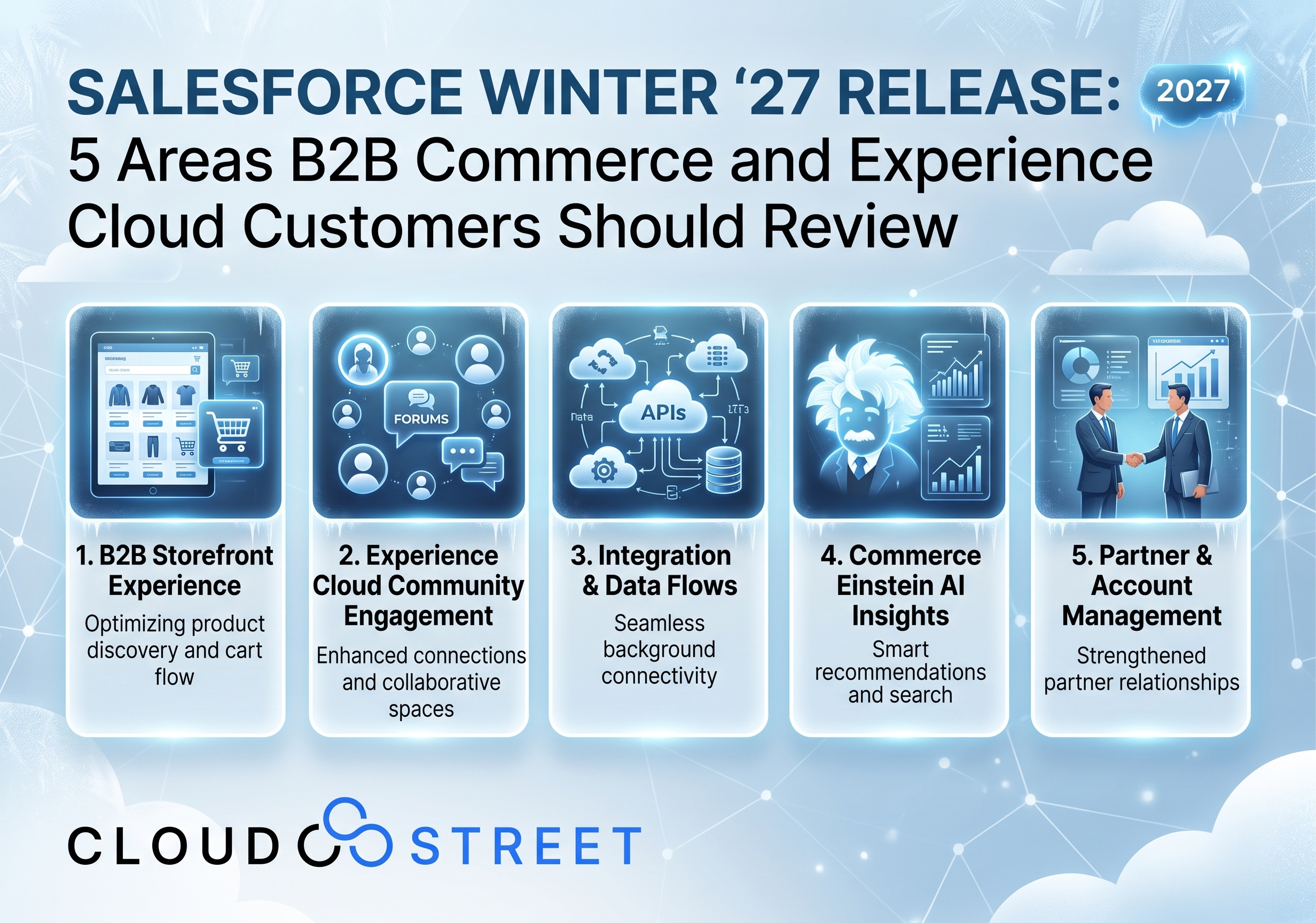
Salesforce Winter ’27 is now available in preview, giving companies time to review changes that may affect their Commerce Cloud and Experience Cloud environments.
For businesses using: or considering: a Salesforce B2B Commerce customer portal, the release is relevant across the full buying journey. B2B Commerce customer portals combine Commerce Cloud with Experience Cloud to manage account access, catalogs, pricing, carts, checkout, orders, and self-service experiences. Salesforce Payments can extend that journey into payment authorization and reconciliation.
Several Winter ’27 updates may reduce custom work or improve the buying experience. The effect on your organization will depend on your current architecture, licenses, edition, release schedule, custom components, checkout extensions, integrations, and managed packages.
We are based in Houston, Texas, and serve customers locally and globally. If you would like to discuss how the release may affect your customer portal, Schedule a Call with our team.
Preview notice: Winter ’27 release notes and features can change before general availability. Features identified as beta, pilot, or developer preview may require enablement, separate licensing, or may not become generally available on the same schedule. Review your organization’s final release notes before making investment or deployment decisions.
What Winter ’27 means for Salesforce B2B Commerce customer portals
The main question is not simply, “What features are new?” The more useful question is, “Which new capabilities change our current implementation or planned operating model?”
Winter ’27 includes release areas that touch:
- Commerce Cart, Checkout, Shipping, and repeat ordering.
- Promotions across category hierarchies.
- Configurable subscription products and bundles.
- Experience Cloud portal configuration, security, and user journeys.
- Payment methods, gateway metadata, and reconciliation.
The release applies across B2B, B2C, and D2C Commerce, although the business impact differs by use case. For a B2B customer portal, the practical focus is account-specific buying, contract pricing, buyer permissions, repeat orders, shipping rules, payment terms, and connections to ERP or order-management systems.
The Salesforce Winter ’27 release notes are the appropriate reference for final availability and product-specific requirements.
5 release areas to review
1. B2B Commerce: cart, checkout, shipping, and repeat ordering
Salesforce highlights updates across Commerce Cart, Checkout, and Shipping. The release notes also describe capabilities that can help buyers add items to a cart for repeat orders using order templates.

For B2B organizations, repeat ordering can be especially valuable when customers regularly purchase the same parts, supplies, consumables, or maintenance items. A well-designed order template can give buyers a controlled way to recreate common orders while still applying current catalog entitlements, account pricing, inventory rules, and shipping logic.
The impact depends on how your portal currently handles:
- Custom cart and checkout components.
- Checkout extensions and Apex or LWC code.
- Shipping-rate, tax, inventory, and ERP integrations.
- Order templates, quote requests, and approval workflows.
- Account-specific catalogs and pricing procedures.
A new native capability may replace part of a custom solution, but it can also introduce testing requirements. We recommend comparing the new feature with your existing code before deciding whether to maintain, modify, or retire a custom component.
2. Commerce Promotions: fewer repeated rules across category hierarchies
The Winter ’27 Commerce Promotions updates include the ability to apply a category promotion to subcategories with a single rule. Advanced rules can help control how the promotion applies throughout the category hierarchy.

This can simplify merchandising when a business manages broad product categories with many subcategories. Instead of configuring separate promotions repeatedly, a merchandising team may be able to define the category-level rule and control its reach through advanced conditions.
For B2B Commerce, potential use cases include:
- Account-specific incentives for strategic customers.
- Contract or segment-based pricing campaigns.
- Product-category discounts for distributors or franchisees.
- Volume incentives for business buyers.
- Controlled promotions for selected catalogs or buying groups.
The rule itself is only one part of the design. Promotion precedence, exclusions, eligibility, effective dates, and customer segmentation still need careful planning. A promotion that works correctly for one account may produce an unintended result when multiple promotions, price books, contracts, or entitlements apply to the same cart.
If your team spends significant time maintaining duplicate promotion rules, Contact Our Team to review whether the Winter ’27 capability fits your merchandising model.
3. Commerce Subscriptions: configurable products, bundles, and pricing controls
Commerce Subscriptions is another area to evaluate. The preview notes describe configurable subscription products and bundles, subscription terms, dynamic attributes, pricing controls, and the ability to apply contract pricing and pricing procedure plans across the subscription lifecycle.

For B2B customer portals, this may support business models such as:
- Scheduled replenishment of supplies or consumables.
- Maintenance programs for equipment or facilities.
- Service plans tied to purchased products.
- Recurring aviation parts or operational supplies.
- Bundled offerings with selectable terms or attributes.
The preview material also refers to pilot or preview capabilities involving subscription promotions. Those items should be treated as evaluation opportunities rather than committed production functionality.
Pricing deserves particular attention. Subscription pricing may interact with contract pricing, product selling models, pricing procedures, discounts, and overrides. Subscription Management may also require a separate purchase or license. Confirm the commercial and technical requirements for your org before including these capabilities in a project plan.
4. Experience Cloud: identity, domains, security, and guided processes
An Experience Cloud customer portal is not separate from Commerce Cloud in practical terms. The two need to work together across identity, account access, buyer permissions, customer-specific catalogs, portal pages, and commerce transactions.

The Winter ’27 Experience Cloud preview includes areas relevant to authenticated portals, including:
- Custom domain management and target host names.
- Authenticated users selecting from multiple processes during approvals or guided work.
- Security and sharing controls for portal data.
- Email-related controls for sites, including sender addresses and sensitive fields.
- Guest-user and portal-user visibility considerations.
Custom domains and security settings deserve release testing because they affect the way customers reach the portal and the data they can access. Review guest versus authenticated access, account sharing, buyer permissions, email configuration, and any integrations that depend on a site URL.
For companies using a third-party provider for a custom domain, the release notes also point to target host name considerations. Your deployment team should confirm that domain configuration, certificates, DNS, and Salesforce instance changes are accounted for in the release plan.
5. Salesforce Payments: payment methods and better reconciliation data
The Salesforce Payments updates may be relevant to B2B businesses that want to support more payment options through Stripe and Adyen integrations.

Depending on the gateway, region, and configuration, the preview notes describe support for additional payment methods, including direct debit options such as ACH, BECS, Bacs, PAD, and other regional methods. The release also includes:
- Custom gateway metadata in Pay Now payment flows.
- Saved payment methods such as Amazon Pay where supported through the relevant gateway integration.
- More Stripe and Adyen payment methods at checkout.
- Payment details that can support matching transactions to internal records.
Custom gateway metadata may allow a business to pass an invoice number, order number, or internal reference to the payment gateway. That information can make reconciliation more efficient when accounting teams compare gateway transactions with Salesforce and ERP records.
However, payment architecture still requires close review. Test payment intents, authorizations, captures, refunds, failed payments, gateway configuration, payment events, and accounting reconciliation. Salesforce Payments does not replace the need for appropriate ERP, tax, shipping, inventory, or order-management integrations. Licensing, regional availability, gateway requirements, and B2B limitations also apply.
10 tests existing B2B Commerce customers should run
A release-readiness inventory gives your team a practical starting point. Review these areas in a sandbox or preview environment:
- Customer login and password recovery.
- Account switching and buyer permissions.
- Account-specific catalogs, prices, and entitlements.
- Cart creation, updates, and repeat ordering.
- Checkout extensions and custom components.
- Shipping methods, rates, tax, and delivery addresses.
- Payment authorization, saved methods, refunds, and failures.
- Order creation and synchronization with ERP or order-management systems.
- Notifications, email sender settings, and portal security.
- API versions, integration error handling, guest access, and data sharing.
Use representative customer journeys rather than a single simple transaction. Test customers with different accounts, price agreements, catalogs, shipping locations, payment methods, and buyer roles.
Also compare new native capabilities with third-party applications and custom code. Continuing to maintain duplicate functionality can increase release testing, support effort, and long-term implementation cost.
7 planning considerations for a new customer portal
For companies considering a Salesforce B2B Commerce implementation, Winter ’27 may reduce custom work in selected areas. Promotions, subscriptions, payment methods, and Experience Cloud processes may offer more configuration options over time.
The release does not remove the need for sound architecture. Start by documenting:
- Customer and account structure.
- Catalog, product, and entitlement requirements.
- Contract pricing and pricing procedures.
- Order, inventory, shipping, tax, and payment processes.
- ERP, quoting, identity, and customer-service integrations.
- Buyer roles, approvals, and self-service needs.
- Launch phases, adoption targets, and operational ownership.
A phased launch can help your team validate the highest-value customer journeys before expanding the portal. Review each release capability against the way your business sells, fulfills, bills, and supports customers.
Our B2B Commerce Accelerator is one starting point for discussing that architecture.
CloudStreet’s role in release readiness and implementation
CloudStreet is a Salesforce Commerce Cloud Accredited Partner. We help customers distinguish native Salesforce capability from custom development, assess release impact, configure and test B2B Commerce, and plan the integrations needed for the operating model.
Our work includes customer-specific pricing, complex catalogs, aviation parts distribution, franchisee marketplaces, Salesforce Payments, ERP and inventory integrations, and customer self-service. We can also review how an existing customer portal is likely to interact with the Winter ’27 changes.
For broader Salesforce planning, visit our Salesforce Services page. If Agentforce Commerce is part of your longer-term roadmap, we can also help assess where it fits alongside practical portal, commerce, service, and integration requirements through our Salesforce AI and Agentforce services.
Where Oracle Fusion is part of the back-office architecture, our Salesforce Oracle Fusion integration services provide another relevant planning reference.
Conclusion
The Salesforce Winter ’27 release gives B2B Commerce customers several areas to review, particularly promotions, subscriptions, Experience Cloud configuration, repeat ordering, and payments.
The most useful next step is an org-specific assessment: not a generic feature checklist. Confirm what your org can use, identify custom and third-party dependencies, test representative customer journeys, and compare new native capabilities with the code and integrations you already maintain.
CloudStreet is based in Houston, Texas, and works with customers locally and globally. To discuss your release readiness, current customer portal, or new B2B Commerce project, Get a Quote or Contact Our Team.
Category: Blog
Category
Discover insights that drive results - explore out latest blog posts now
DealHub Salesforce Integration for Manufacturers: Connecting CPQ, Contracts, and CRM
About the manufacturer: mid-market industrial equipment company A U.S.-based, mid-market [...]
Salesforce Data 360 and Agentforce: Why Grounding Is What Makes AI Agents Dependable
An AI agent can produce a fluent answer and still [...]
Salesforce Data 360 Governance and Informatica: Managing Data Quality, Access, and Trust in the Agentic Era
Data governance becomes more consequential when business data does more [...]