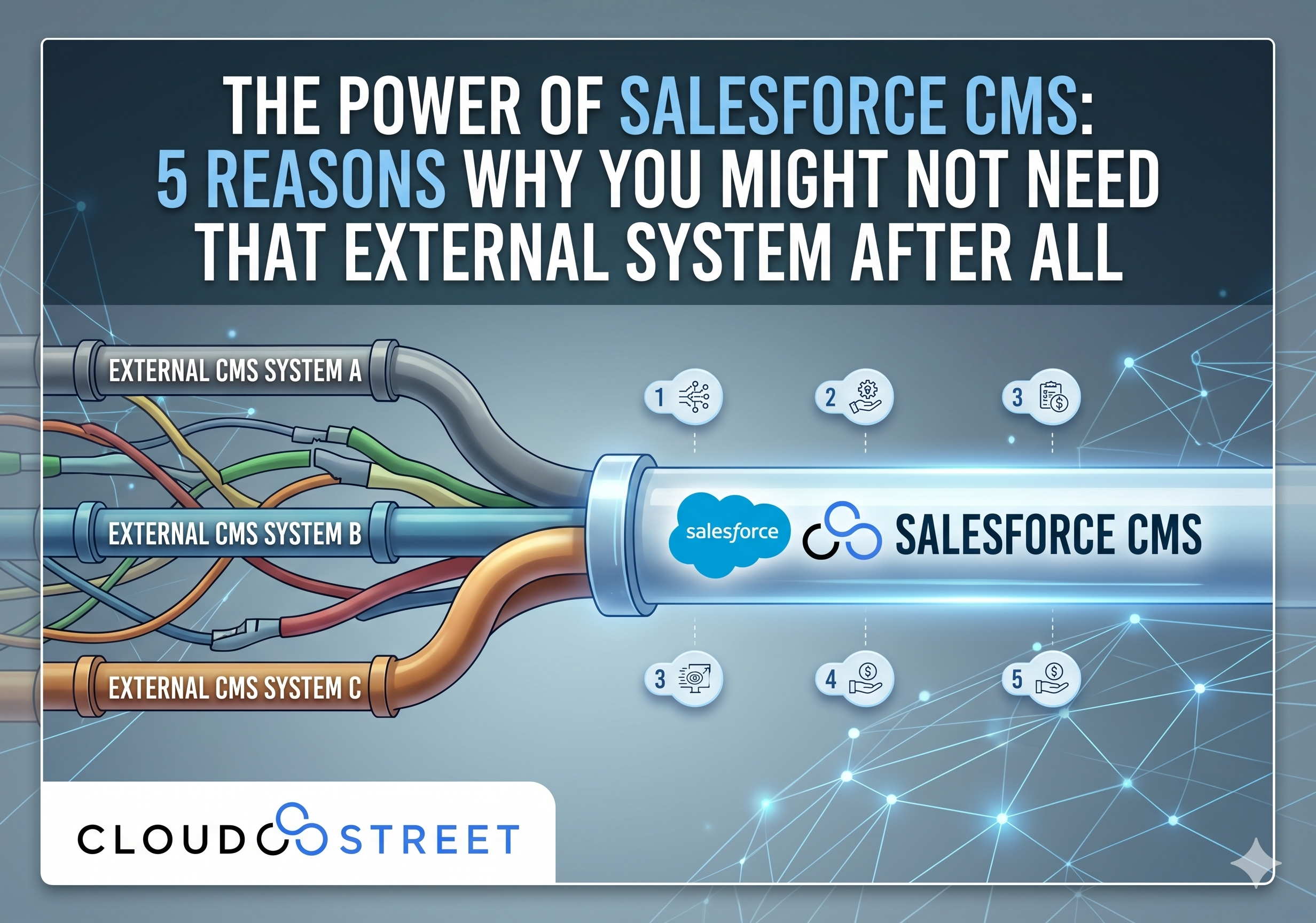
The Power of Salesforce CMS: 5 Reasons Why You Might Not Need That External System After All
Choosing the right Content Management System (CMS) often feels like a tug-of-war between power and simplicity. For businesses already operating within the Salesforce ecosystem, the question usually boils down to: “Is Salesforce CMS enough, or do I need to integrate something like Contentful or Contentstack?”
At CLOUDSTREET, we help businesses locally in Houston, Texas, and globally navigate these exact architecture decisions. While external services have their place, many organizations are surprised to find that Salesforce CMS is more than capable of handling their enterprise needs without the added complexity of a third-party integration.
In this post, we’ll focus less on defining Salesforce CMS and more on the practical question most teams actually care about: how much value can you squeeze out of it before you truly need an external platform.
How Far Can You Push Salesforce CMS?
If you want a full primer on what Salesforce CMS is, we already cover that in detail here: Can You Use Salesforce as a Content Management System?.
The more important discussion for Salesforce-centric organizations is not whether Salesforce CMS exists as a viable option. It is how high the ceiling really is. In many cases, that ceiling is much higher than companies expect. Teams can manage structured content, power Experience Cloud sites, support Commerce experiences, reuse assets across channels, and deliver API-driven content to external touchpoints without immediately jumping to Contentful, Contentstack, or another standalone CMS.
That does not mean Salesforce CMS is the perfect fit for every scenario. It does mean many businesses underestimate just how far they can push it inside the Salesforce ecosystem before the tradeoffs of an external system become worth it.
Need help optimizing your Salesforce ROI? Explore our services.
5 Reasons the Salesforce CMS Ceiling Is Higher Than Most Teams Expect
Before looking at an external “headless” CMS, consider these five ways companies can push Salesforce CMS further than they often assume.
1. You Can Personalize More Than You Think
One of the biggest reasons the ceiling feels high is Salesforce CMS’s native connection to CRM data. When your content lives where your customer data lives, personalization becomes much easier to operationalize. You can show different content to a “Gold Tier” customer than a “Silver Tier” customer based on real-time Salesforce data, without building the same amount of middleware and API logic often required in Salesforce CMS vs Contentful discussions.
2. Experience Cloud Coverage Goes a Long Way
If you are already using Experience Cloud content management, Salesforce CMS can cover a surprisingly wide range of portal, partner, and customer-facing use cases. You don’t have to worry about stitching together authentication, permissions, and content sync across separate systems. Your content authors stay in a familiar environment, and your developers can pull content into Lightning Web Components (LWC) or the Lightning Web Runtime (LWR) with far less friction than a disconnected stack.

3. Governance Stays Simpler as You Scale
A lot of companies do not hit the CMS ceiling because their real challenge is not content modeling, but operational control. With Salesforce CMS, your existing Salesforce sharing rules, profiles, and governance model help manage who can create, edit, and publish content. That unified security model can carry organizations much farther than expected before they need the editorial complexity of a separate enterprise CMS.
4. Omnichannel Delivery Is Better Than It Gets Credit For
Salesforce CMS allows you to deliver content to non-Salesforce channels via APIs. While it is often framed around Experience Cloud, it can also serve as a headless CMS for Salesforce use case when you need to feed content into a custom React app, mobile application, or other digital touchpoint. For many organizations, that flexibility is enough to delay or eliminate the need for an external platform.
5. The ROI Case for Waiting Is Usually Strong
Integrating an external service like Sitecore or Contentstack involves license fees, implementation costs, and ongoing maintenance for the bridge between platforms. In practice, many businesses can get far more mileage from Salesforce CMS than expected before those extra capabilities become necessary. That makes the ceiling not just technically high, but financially high too, because the out-of-the-box value inside Salesforce often covers far more ground than teams initially assume.
Salesforce CMS vs. The Alternatives
It is common for IT leaders to compare Salesforce CMS vs Contentful or Contentstack when planning a digital transformation. These external tools are “best-of-breed” headless platforms. They offer incredibly flexible content modeling and are designed for developers first.
However, the key question is not whether those tools are powerful. It is whether you have actually reached the Salesforce CMS ceiling yet. In many organizations, the answer is no. Contentful and Contentstack may offer more editorial flexibility at the outer edge, but they also require you to build the “connective tissue” to your CRM manually. You have to map users, handle API rate limits, and ensure that when a customer’s status changes in Salesforce, the CMS knows how to react.
Salesforce CMS, by contrast, is “Salesforce-first.” It’s designed to make your Salesforce-powered storefronts and portals better, faster. If your digital experiences are still closely tied to Salesforce data, users, permissions, and workflows, there is often more room to grow with Salesforce CMS than teams initially expect.

Want to see how we’ve implemented these solutions? View our case studies.
Understanding Salesforce CMS Limits
While we are big proponents of staying within the ecosystem, it is important to be realistic about Salesforce CMS limits.
You might consider an external service if:
- Ultra-Complex Modeling: You have thousands of content types with deep, nested relationships that go beyond standard articles, assets, and reusable content blocks.
- Developer Ergonomics: Your development team is entirely external to the Salesforce ecosystem and requires specific SDKs or JAMstack workflows that aren’t native to Salesforce.
- Massive Non-Salesforce Scale: You are managing dozens of global websites and channels that have little to no meaningful connection to Salesforce CRM data, users, or permissions.
The key point is that these are real ceilings, but they are higher than many companies assume. For the vast majority of mid-to-large businesses, those limits are not the starting point. Most companies can push Salesforce CMS much further before the ROI of a standalone platform becomes compelling, especially when they want to keep content, customer context, and governance inside one ecosystem.
The CLOUDSTREET Advantage
Based in Houston, Texas, CLOUDSTREET works with businesses around the globe to ensure they aren’t over-engineering their tech stacks. We believe in maximizing the tools you already pay for. Before you sign a contract for an expensive external CMS, let us show you how far you can push Salesforce.
Whether you are looking for Staff Augmentation or a full B2B Commerce Implementation, our team is here to help you drive real ROI from your Salesforce investment.

Conclusion: Stick with What Works
Salesforce CMS has evolved from a basic tool into a robust, enterprise-ready content platform with a higher ceiling than many teams realize. By keeping your content management within the Salesforce ecosystem, you gain speed, security, and strong personalization capabilities while often covering far more use cases than expected before an external platform is necessary.
External systems like Contentful and Sitecore are powerful, but for the Salesforce-centric business, they often represent an unnecessary layer of complexity until you have truly pushed Salesforce CMS to its practical limits.
Ready to streamline your content strategy?
Category
Discover insights that drive results - explore out latest blog posts now
DealHub Salesforce Integration for Manufacturers: Connecting CPQ, Contracts, and CRM
About the manufacturer: mid-market industrial equipment company A U.S.-based, mid-market [...]
Salesforce Data 360 and Agentforce: Why Grounding Is What Makes AI Agents Dependable
An AI agent can produce a fluent answer and still [...]
Salesforce Data 360 Governance and Informatica: Managing Data Quality, Access, and Trust in the Agentic Era
Data governance becomes more consequential when business data does more [...]