The SMB Agentforce Readiness Checklist: A Detailed Guide to Preparing, Building, and Launching AI Agents
Label: Agentforce Commerce
Category: Blog
Salesforce Agentforce can help a small or mid-sized business extend its service, sales, commerce, and operations teams. However, an agent is only as dependable as the data, processes, permissions, and escalation rules behind it.
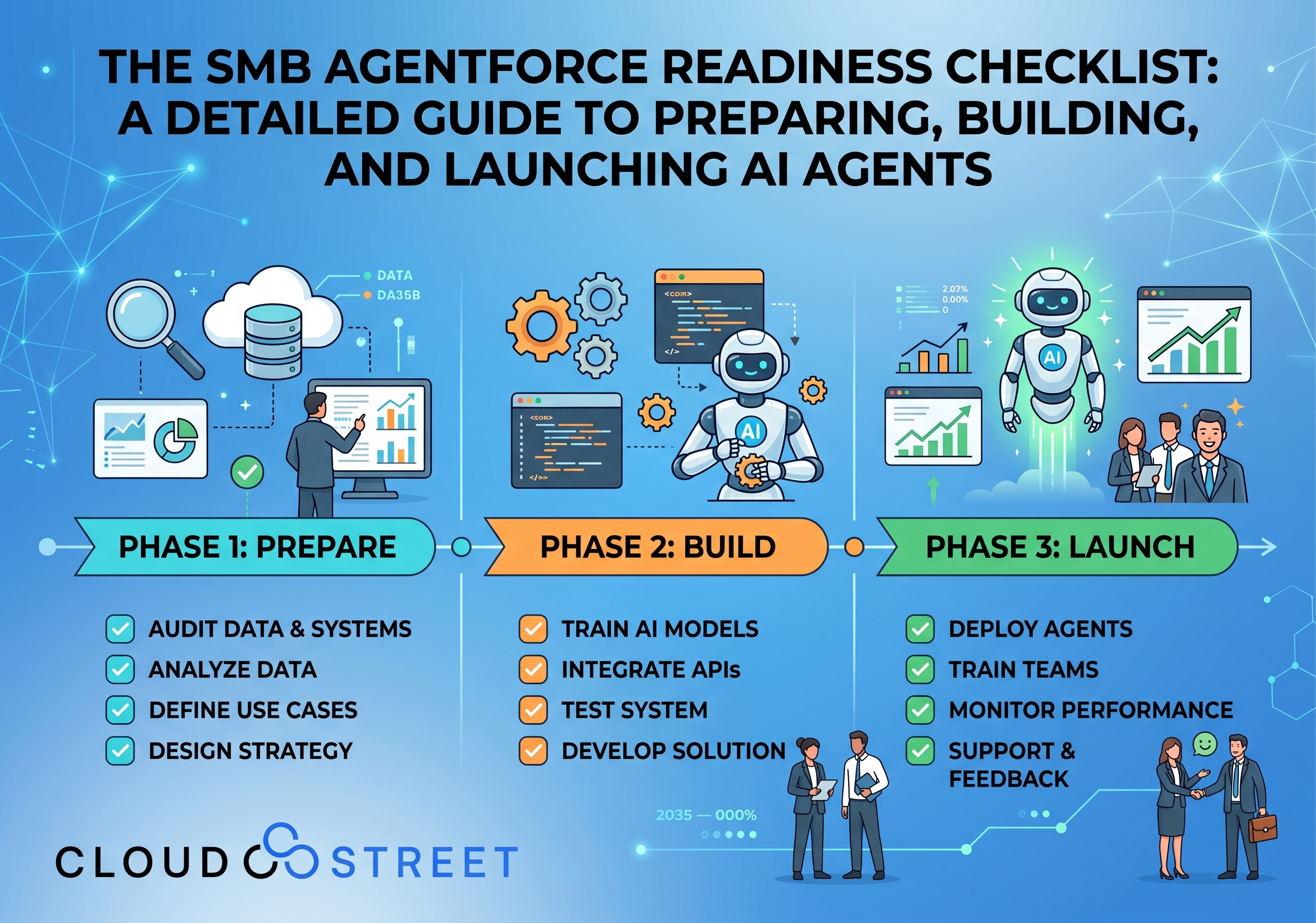
This detailed guide expands the four phases in the Salesforce SMB Agentforce Ready Checklist:
- Readiness
- Setup
- Sandbox Development
- Activation
Our goal is to provide a practical framework for SMB Agentforce readiness, whether your organization is exploring Salesforce AI for small business, preparing an existing Salesforce org, or considering Agentforce Commerce for B2C, D2C, or B2B operations.
CloudStreet is based in Houston, Texas, and serves customers locally and globally. We help organizations connect Salesforce data, workflows, integrations, and governance so AI investments support measurable business objectives without removing human judgment from important decisions.
What Agentforce readiness means for an SMB
Agentforce readiness is not simply turning on an AI feature. It means confirming that your organization has the following five foundations:
- A focused business use case: The first agent has a defined job rather than a broad mandate to answer everything.
- Reliable data and knowledge: The agent can retrieve current, relevant information from approved sources.
- Controlled actions: The agent has permission to perform only the tasks appropriate for its role.
- Human oversight: Sensitive, ambiguous, or high-impact situations have clear handoff paths.
- Measurable outcomes: Your team has baseline metrics and a review process for evaluating performance.
For an SMB, this disciplined approach helps control scope and reduce unnecessary implementation complexity. The business case is not that AI replaces experienced employees. Instead, an agent can handle repetitive questions, retrieve information, prepare records, and initiate approved workflows while employees retain responsibility for judgment, exceptions, relationships, and accountability.
Schedule a Call to discuss whether your Salesforce environment is ready for a first Agentforce use case.
The business case: extending a small team responsibly
Small and mid-sized businesses often have limited capacity in service, sales operations, ecommerce, and administration. An agent may extend that capacity by helping with tasks such as:
- Answering frequently asked customer questions.
- Qualifying inbound leads against defined criteria.
- Summarizing cases, conversations, or account activity.
- Providing order, shipment, or quote-status information.
- Creating or updating Salesforce records.
- Routing complex requests to the right employee.
- Helping internal users locate approved information.
The strongest first use cases are usually high-volume, repeatable, and relatively easy to measure. A request involving a refund approval, legal interpretation, pricing exception, or sensitive account change may require more human involvement than a request for order status or a published return policy.
For Agentforce Commerce, the design should reflect the business model:
- B2C Commerce: Support product questions, order status, returns, and customer service.
- D2C Commerce: Connect storefront interactions with customer identity, marketing preferences, fulfillment, and support.
- B2B Commerce: Focus on authenticated customer self-service, including customer-specific catalogs and pricing, approved products, account context, order history, quote status, reorder workflows, and support.
B2B use cases should not simply imitate a generic consumer marketplace. A distributor or wholesale buyer may need access to contract pricing, account entitlements, purchase history, and approved products rather than broad, Amazon-style recommendations.
Phase 1: Readiness

1. Unify data with Data 360 or Data Cloud
Data 360, formerly known in many Salesforce contexts as Data Cloud, can help connect information from Salesforce and external systems. The objective is not to move every piece of data into Salesforce. The objective is to make approved, relevant context available to the agent when it is needed.
Before setup, evaluate:
- Which systems contain the source-of-truth information.
- How Accounts, Contacts, products, orders, cases, and identities are mapped.
- Whether duplicate identities can be resolved reliably.
- Whether important fields are complete, current, and consistently formatted.
- Which users, agents, and integrations can access each data set.
- How sensitive information is masked, restricted, retained, or deleted.
A unified profile is not automatically usable agent context. The agent also needs a clear retrieval strategy, relevant grounding sources, appropriate permissions, and instructions about how to interpret conflicting information.
2. Consider zero-copy access where appropriate
For external data sources such as AWS, zero-copy access may allow Salesforce to work with data without creating an unnecessary duplicate. This can reduce replication, storage, and synchronization concerns in suitable architectures.
Zero-copy access still requires careful review of:
- Query latency and availability.
- External-system permissions.
- Data residency and regulatory requirements.
- Ownership of definitions and business logic.
- Failure behavior when the external source is unavailable.
- Whether the agent can retrieve the information quickly enough for the channel.
Copying or synchronizing data may remain appropriate when the agent requires predictable response times, offline access, transformation, historical snapshots, or a stable operational record. The right decision depends on the use case and architecture, not on the label “zero-copy.”
3. Choose one high-impact task
Select a first task using four practical criteria:
- Volume: Does the organization handle the request frequently?
- Repeatability: Are the inputs, rules, and expected outcomes reasonably consistent?
- Measurement: Can you establish a baseline and evaluate improvement?
- Risk control: Can the organization limit the agent’s authority and provide human escalation?
Examples include customer FAQs, case triage, lead qualification, order-status questions, scheduling requests, and internal employee assistance.
4. Complete the readiness checks
Document the following before proceeding:
- Process owner and executive sponsor.
- Source-of-truth systems and relevant Salesforce objects.
- Data quality issues and remediation owners.
- Knowledge articles, policies, and product content.
- Agent permissions and approved actions.
- Escalation rules and human ownership.
- Compliance and sensitive-data considerations.
- Baseline metrics such as response time, case volume, resolution time, conversion, or satisfaction.
If these items are unclear, the recommendation is to narrow the use case or complete the missing preparation before building.
Phase 2: Setup
Salesforce packaging, eligibility, product names, entitlements, and included capabilities can change. Organizations should confirm current details with Salesforce and review their specific agreement before planning a launch.
1. Confirm Foundations and entitlements
Where eligible, Salesforce Foundations may provide access to included Data 360 and agent capabilities. Eligibility is not universal, and included functionality can vary by edition, agreement, release, and configuration.
As part of setup, verify:
- Salesforce edition and enabled features.
- Data 360 or Data Cloud availability.
- Agentforce licensing and channel requirements.
- Einstein and Trust Layer settings.
- Sandbox availability.
- User, integration, and runtime permissions.
- Commercial terms for usage and additional capacity.
The readiness checklist may show 200,000 Agentforce flex credits as an included starting allocation with Foundations. Treat this as an example of the allocation presented in the source checklist, not as a universal guarantee. Credit availability, consumption rules, actions, channels, overage terms, and eligible orgs should be confirmed for the specific customer agreement.
2. Define how the agent should work
Create an agent brief that states:
- The agent’s purpose and intended audience.
- Topics within scope and topics outside scope.
- Approved data sources.
- Permitted read and write actions.
- Actions requiring approval.
- Tone, terminology, and response format.
- Escalation conditions.
- Authentication requirements.
- Logging and audit expectations.
- Ownership for ongoing maintenance.
An agent that can “help customers” without a defined boundary is difficult to test and govern. A specific instruction such as “answer authenticated order-status questions using approved order and fulfillment data, then escalate delivery disputes” provides a more practical foundation.
3. Establish an AI operating policy
Your policy should address:
- Sensitive personal, financial, health, or confidential information.
- Human review of customer-facing responses.
- Approval requirements for refunds, discounts, cancellations, and record changes.
- Rules for claims, recommendations, and regulated communications.
- Prompt, response, and action review.
- Incident reporting and remediation.
- Named business, technical, security, and compliance owners.
Get a Quote if you need help translating these decisions into a Salesforce implementation plan.
Phase 3: Sandbox Development

1. Build outside production
Create the agent in a sandbox so configuration, prompts, actions, flows, and integrations can be tested without affecting live customer workflows.
A full-copy sandbox may be useful when testing requires:
- Realistic Account and Contact relationships.
- Complex order, product, or entitlement relationships.
- Existing automation and integration behavior.
- Large or varied data sets.
- Representative security and sharing rules.
Full-copy environments require privacy controls, masking, restricted access, and careful handling of sensitive information. A smaller sandbox may be sufficient for early configuration and functional testing.
2. Create an AI style guide
The style guide should define:
- Brand tone and level of formality.
- Approved product and service terminology.
- Prohibited claims and unsupported guarantees.
- Response length and formatting.
- How uncertainty is communicated.
- Escalation language.
- Differences between customer, employee, B2C, D2C, and B2B audiences.
3. Test answers and actions
A complete Agentforce sandbox testing program should include:
- Functional testing for expected questions and workflows.
- Permission testing for different users and customers.
- Negative testing for unsupported requests.
- Grounding and hallucination testing.
- Security and sensitive-data testing.
- Load and volume testing.
- Integration testing.
- User acceptance testing.
Test actions, not only responses. Confirm whether the agent correctly creates a case, updates an order, invokes Flow, calls Apex or an API, sends a notification, records a handoff, and recovers when an action fails.
4. Prepare deployment controls
Before production deployment, document:
- Version history for prompts, topics, actions, and flows.
- Deployment sequence and dependencies.
- Stakeholder signoff.
- Rollback criteria.
- Sandbox refresh timing.
- Production monitoring ownership.
- Post-launch support coverage.
Phase 4: Activation

Deploy the agent only to approved channels, such as a website, mobile application, Slack, or another supported surface. Each channel requires different design decisions around authentication, session history, accessibility, identity resolution, and escalation.
1. Establish handoff guardrails
A human handoff should preserve useful context, including:
- Customer identity and authentication status.
- Conversation transcript.
- Relevant Salesforce records.
- Actions attempted by the agent.
- Errors or missing data encountered.
- Recommended next steps.
- Reason for escalation.
A handoff that simply tells the customer to start over can reduce the value of automation. The employee receiving the conversation should have enough context to continue efficiently.
2. Monitor performance
Use Agent Analytics and operational reporting to review:
- Engagement and adoption.
- Containment or deflection.
- Resolution and conversion.
- Response quality.
- Escalation rate.
- Customer satisfaction.
- Action success and failure.
- Cost and credit consumption.
- Employee acceptance and usage.
Activation is the beginning of an operating cycle. Review conversations, update knowledge, adjust topics and actions, refine instructions, train users, and expand only after the first use case is stable.
Detailed Agentforce readiness checklist
| Phase | Checklist item | Owner | Evidence of readiness | Common risk |
|---|---|---|---|---|
| Readiness | Select one bounded use case | Executive sponsor and process owner | Written use-case brief and baseline metrics | Scope expands before testing |
| Readiness | Map source systems | Data and Salesforce leads | Data map, ownership record, integration inventory | Conflicting sources produce unreliable answers |
| Readiness | Review data quality | Data owner | Completeness, duplication, validity, and timeliness review | Poor records undermine trust |
| Readiness | Prepare knowledge | Service, commerce, or operations owner | Approved and current articles and policies | Outdated content creates incorrect responses |
| Setup | Confirm Salesforce eligibility | Salesforce administrator and procurement | Verified entitlements and commercial terms | Included capabilities are assumed rather than confirmed |
| Setup | Define agent permissions | Security and platform owner | Runtime permission model and action inventory | Excessive access enables unintended changes |
| Setup | Define escalation rules | Process owner | Documented human-handoff scenarios | Sensitive requests remain with the agent |
| Sandbox Development | Create test environment | Salesforce administrator | Sandbox and deployment plan | Production workflows are affected |
| Sandbox Development | Build style guide | Marketing and business owner | Approved terminology and response examples | Responses do not match the brand |
| Sandbox Development | Test actions and integrations | QA and technical leads | Test results, defects, and remediation records | Answers pass while actions fail |
| Activation | Approve channels | Product, security, and service owners | Channel design and authentication decision | Channel limitations are overlooked |
| Activation | Monitor launch | Operations and platform owner | Dashboards, alerts, review cadence, and support plan | Problems remain hidden after go-live |
Example 30/60/90-day rollout plan
This is an example planning model, not a guarantee of timing or Salesforce functionality.
Days 1–30: Assess and prepare
- Select the first use case.
- Document process ownership and baseline metrics.
- Review Salesforce licensing and Foundations eligibility.
- Map data sources and permissions.
- Audit knowledge and workflow dependencies.
- Define the AI operating policy.
Days 31–60: Build and test
- Create the sandbox.
- Configure the agent brief, topics, actions, and grounding sources.
- Establish the AI style guide.
- Run functional, security, negative, integration, and action testing.
- Complete user acceptance testing.
- Review deployment and rollback criteria.
Days 61–90: Activate and optimize
- Deploy to one approved channel.
- Monitor conversations and action outcomes closely.
- Review escalations, failed actions, and unsupported questions.
- Compare results with baseline metrics.
- Correct knowledge, data, or workflow issues.
- Decide whether to stabilize, revise, or expand the use case.
Security, governance, and human oversight
Good Agentforce governance combines Salesforce security controls with business ownership. Use least-privilege access, separate administrator and runtime responsibilities, and review permissions whenever topics or actions change.
Governance should also define:
- Who approves new actions.
- Who owns data quality.
- Who reviews customer-facing content.
- Who investigates incidents.
- How changes are tested and released.
- How conversations and actions are audited.
- How frequently policies and grounding sources are reviewed.
For external systems, governance includes integration credentials, API limits, data residency, failure behavior, and ownership of the external source. For commerce, it also includes customer-specific pricing, catalog entitlements, inventory, order history, payment information, and returns.
Common mistakes SMBs should avoid
- Starting with a broad “general assistant” instead of one measurable task.
- Assuming unified data is automatically accurate or agent-ready.
- Treating included credits as guaranteed for every customer.
- Giving the agent broad permissions for convenience.
- Testing responses while ignoring record updates and integrations.
- Launching without a human-handoff process.
- Using outdated knowledge articles as grounding sources.
- Measuring activity without measuring resolution, quality, cost, and adoption.
- Expanding to additional channels before the first channel is stable.
- Treating activation as the end of implementation rather than the start of operations.
CloudStreet’s role in Agentforce readiness and implementation
CloudStreet helps organizations assess Salesforce data, configure Data 360 or Data Cloud, design Agentforce use cases, build and test agents, connect Salesforce workflows, and establish practical governance.
Our experience spans:
- Sales Cloud and lead-management processes.
- Service Cloud and customer self-service.
- Commerce Cloud for B2C, D2C, and B2B use cases.
- Experience Cloud portals and authenticated customer experiences.
- ERP and external-system integrations.
- Salesforce workflow, Flow, Apex, and API coordination.
- Data quality, reporting, and operational adoption.
For commerce organizations, we can help connect Agentforce to the operational context that buyers actually need. That may include customer-specific catalogs, contract pricing, approved products, account relationships, orders, quotes, fulfillment, returns, and support. Our B2B Commerce Accelerator provides additional context for self-service commerce architecture.
When Salesforce and ERP information need to work together, our Salesforce Oracle Fusion integration services can help address orders, invoices, inventory, payment status, and post-sales workflows.
We are based in Houston, Texas, and serve customers locally and globally. Organizations evaluating an implementation partner can also review our Houston Salesforce consulting guide.
For broader implementation, integration, customization, and support needs, explore our Salesforce Services or Salesforce AI and Agentforce services.
Conclusion and next steps
SMB Agentforce readiness is a business and operating decision as much as a technical one. The strongest implementation path begins with a focused use case, reliable context, controlled actions, realistic sandbox testing, clear human oversight, and metrics that leadership can review.
Whether your priority is customer service, lead qualification, order self-service, internal assistance, or Agentforce Commerce, the four-phase model provides a practical sequence:
- Prepare the data and select the use case.
- Confirm the environment, entitlements, scope, and governance.
- Build and test safely in a sandbox.
- Activate carefully, monitor performance, and improve continuously.
Contact Our Team to review your Salesforce environment, identify a suitable first use case, and create an Agentforce implementation roadmap.
Category
Discover insights that drive results - explore out latest blog posts now
DealHub Salesforce Integration for Manufacturers: Connecting CPQ, Contracts, and CRM
About the manufacturer: mid-market industrial equipment company A U.S.-based, mid-market [...]
Salesforce Data 360 and Agentforce: Why Grounding Is What Makes AI Agents Dependable
An AI agent can produce a fluent answer and still [...]
Salesforce Data 360 Governance and Informatica: Managing Data Quality, Access, and Trust in the Agentic Era
Data governance becomes more consequential when business data does more [...]