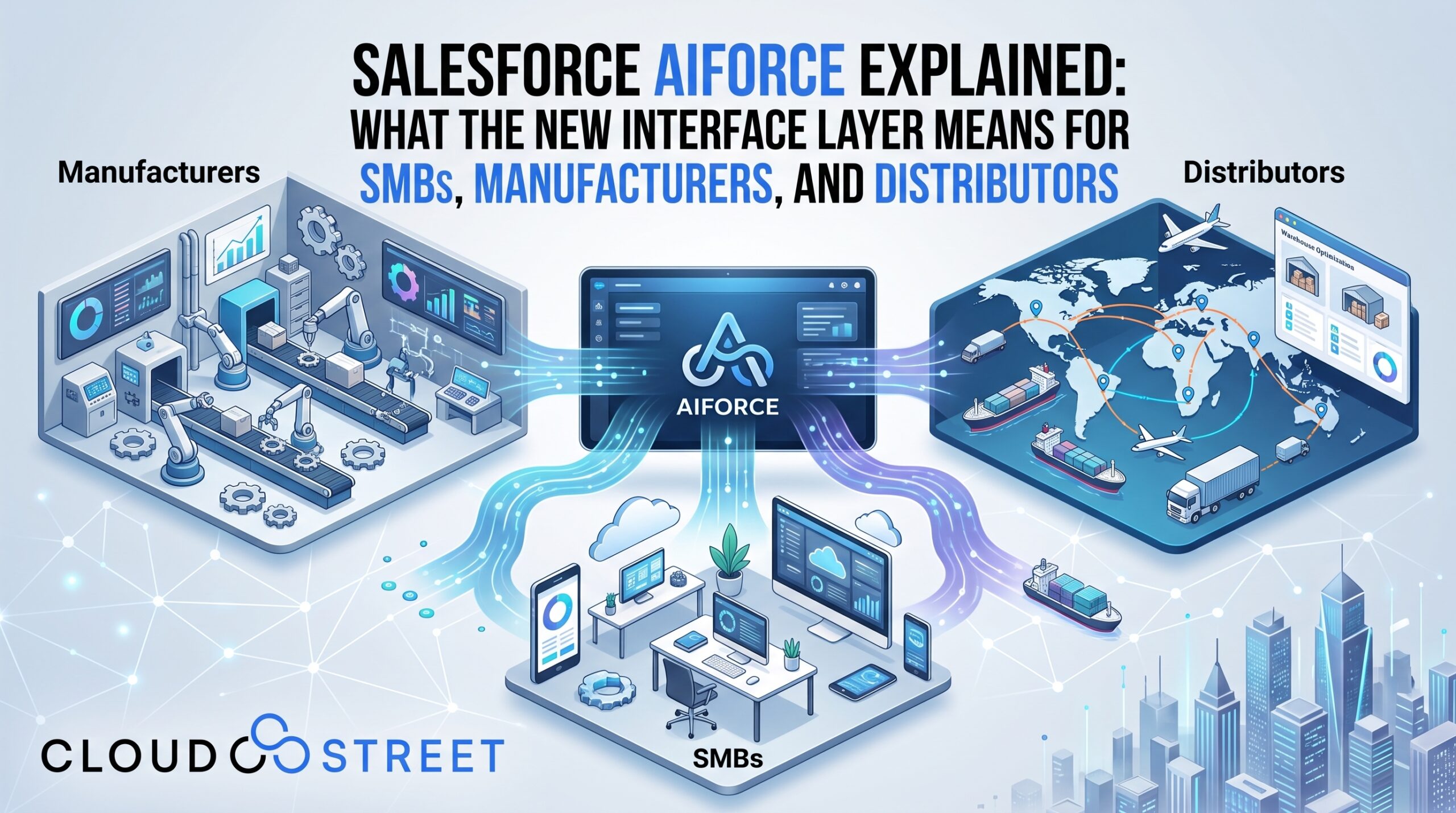
Salesforce AIforce Explained: What the New Interface Layer Means for SMBs, Manufacturers, and Distributors
Category: Blog
Label: Agentforce Commerce
Salesforce’s AIforce announcement at Dreamforce in September 2026 signals a meaningful change in how people may interact with CRM systems. The familiar Salesforce interface is no longer the only place where employees and AI agents can access Salesforce data, workflows, and business logic.
According to Salesforce’s AIforce announcement, the platform is moving toward a model in which Salesforce comes to the user. Employees can work with trusted CRM context in tools such as Claude, Slack, or Salesforce Lightning instead of opening Salesforce, navigating layouts, and searching manually through fields.
For businesses of every size, the practical question is not whether AI is interesting. It is whether AI can be connected to the right data, permissions, and business processes without creating a new governance problem. We see AIforce as Salesforce’s answer to that interface and access challenge.
What Is AIforce?
AIforce is a live interface layer that brings the data, workflows, business logic, semantics, permissions, security, and governance inside Salesforce to external AI interfaces.
The underlying concept is straightforward:
- A user asks a question or requests an action in the tool where they already work.
- AIforce connects that request to Salesforce data and platform capabilities.
- Salesforce applies the user’s existing permissions and business rules.
- The answer or action is returned to the user through the same interface.
AIforce is powered by Salesforce’s Headless Toolkit, an open architecture that exposes Salesforce through MCPs, APIs, plug-ins, skills, and developer tools. Salesforce describes this as a way for administrators to connect the platform once so teams can access it through multiple interfaces without a new permissions model or a migration.
That does not mean every organization can ignore integration planning. External systems such as ERP, warehouse management, finance, or inventory platforms still require thoughtful architecture. However, the Salesforce layer does not need to be recreated separately for every AI surface.
Every request is intended to run through the Salesforce security model. An AI agent should see only what the requesting person is allowed to see, and actions should route back through Salesforce’s existing logic.
Salesforce also highlights Zero Data Retention. Under this approach, business data can be used to answer a request without being retained by the model provider. Organizations should still confirm the current contractual terms, availability, and regional conditions that apply to their Salesforce and AI agreements.
5 Characteristics That Define AIforce
AIforce is more than a chatbot embedded in a CRM. Five characteristics explain why the announcement matters.
1. Interface independence
Users can access Salesforce intelligence through Claude, Slack, Lightning, or other connected interfaces. The CRM remains the system of record, but users do not always need to work directly inside its traditional screens.
2. Permission inheritance
AIforce is designed to respect existing Salesforce permissions, sharing rules, and business logic. A sales representative, service agent, distributor, and executive should not automatically receive the same information simply because they ask similar questions.
3. Action, not just answers
The value is not limited to summarizing records. AIforce can support actions such as creating a task, updating an owner, drafting an email, reviewing an opportunity, or starting a workflow. Subject to Salesforce rules and the permissions of the person making the request.
4. Composable experiences
Users and administrators can describe live interfaces, views, and agents in plain language. This makes it possible to create a focused working surface for a specific team or workflow rather than asking every employee to use the same generic dashboard.
5. Open technical access
The Headless Toolkit provides the architecture for connecting Salesforce capabilities to MCP servers, APIs, plug-ins, skills, and developer tools. That gives organizations more flexibility in choosing how people and agents interact with the platform.
Talk with CloudStreet about Salesforce AI readiness.

The 3 Launch Components of AIforce
Salesforce introduced AIforce through three initial components.
1. Claudeforce
Claudeforce extends the Salesforce and Anthropic partnership by bringing Salesforce into Claude through a prebuilt MCP server.
The launch includes 37 prebuilt sales skills covering activities from prospecting through pipeline hygiene. Salesforce also introduced a Salesforce Development plug-in for Claude Code with more than 40 skills and a skills library on GitHub.
Claudeforce has been piloted by Deloitte, GitLab, and Legora and is available in beta. Salesforce has indicated that analytics with Tableau, as well as skills for service, marketing, commerce, and industry workflows, are planned.
For a sales team, a request might involve reviewing pipeline coverage, identifying stalled opportunities, preparing account research, or updating CRM records. The important distinction is that Claude is not operating on an isolated export. The intended connection is to Salesforce context, permissions, and actions.
2. Slackforce
Slackforce brings Salesforce context into Slack, where many teams already coordinate work.
Slackforce Surfaces creates live interfaces that teams can filter, explore, comment on, and act on together. Slackbot can reason across Slack conversations and Salesforce context. For example, it may identify accounts that have gone quiet, review related support cases and message threads, suggest a reassignment, create a follow-up task, or draft a win-back email.
Slack CRM connects Slack conversations, users, and updates to Salesforce records. Slack Code also turns AI-assisted development into a collaborative team activity within Slack.
For organizations that struggle with CRM adoption, this matters because the problem may not be a lack of data. Employees may simply spend their working day in Slack, email, ERP screens, or operational tools rather than in Salesforce.
3. Agentforce Coworker
Agentforce Coworker is an AI teammate inside the Salesforce Lightning interface. It can reason across accounts, activity, and history, surface insights, and take action within existing Salesforce permissions and business rules.
It can also call specialized Agentforce agents that an organization has already built. Salesforce says Coworker can be activated with a button and does not require a migration.
Salesforce reports that 100,000 users activated Coworker within its first 35 days. Fulton Bank described moving from zero to more than 20 production use cases supporting approximately 3,000 users. These figures are Salesforce-reported examples, not a guarantee of results for every organization, but they indicate the type of adoption Salesforce is targeting.
Where AIforce Fits in the Salesforce Architecture
AIforce is easier to understand when viewed as part of a larger architecture:
- Data 360 unifies and federates data while providing metadata, context, and memory.
- Customer 360 provides business applications, processes, permissions, and actions across sales, service, marketing, and commerce.
- Agentforce provides the digital workforce layer, including specialized agents for business tasks.
- AIforce brings those capabilities to the interfaces where people and agents already work.
This structure is important because AIforce does not replace Data 360, Customer 360, or Agentforce. It exposes their value through additional interfaces.
Why AIforce Matters for SMBs
For small and mid-sized businesses, the practical barrier to AI has often been access rather than interest. A smaller company may not have a large Salesforce administration team available to build dashboards, train every user, or redesign every workflow.
AIforce may reduce that interface barrier in three ways:
- Employees can ask questions in plain language instead of learning every Salesforce layout.
- Existing permissions and business rules can remain the foundation for AI interactions.
- Teams can begin with a focused workflow rather than undertaking a broad CRM migration.
The SMB takeaway is measured but important: organizations may be able to obtain more value from Salesforce data they already own without adding a large internal development program.
That value still depends on data quality. If account ownership, opportunity stages, product records, or service histories are inconsistent, an easier interface will not solve the underlying problem.
Schedule a Call to discuss a practical Salesforce AI starting point.
Why AIforce Matters for Manufacturers and Distributors
Manufacturers and distributors operate with commercial logic that generic AI tools rarely understand on their own. Common requirements include:
- Contract and negotiated pricing
- Customer-specific catalogs
- Volume-based discounts
- Net terms and credit policies
- Quotes and reorder workflows
- Account hierarchies with multiple ship-to locations
- Multi-warehouse inventory and fulfillment rules
Sales and service teams may need answers that span Salesforce, an ERP, inventory systems, and finance. A representative may want to know whether a product is available, whether a customer’s quote is still valid, whether payment is overdue, or when an order will ship.
AIforce can bring Salesforce context into Slack, Claude, and Lightning while preserving the permissions that determine what each user can see. For organizations connecting Salesforce with Oracle Fusion, Salesforce and Oracle Fusion integration remains a foundation for reliable order, inventory, invoice, and customer data.
The commerce opportunity is also significant. Agentforce Commerce applies to B2C, D2C, and B2B Commerce. For B2B businesses, the useful applications are grounded in real account context:
- Customer-specific pricing
- Approved product catalogs
- Order history
- Quote status
- Reordering
- Account-level service
- Support and fulfillment information
Salesforce Commerce Cloud and Experience Cloud are designed to work together for customer portals. Our B2B Commerce Cloud services focus on the complex pricing, catalog, account, and integration requirements that manufacturers, distributors, and wholesalers typically bring to a digital commerce program.

What Still Has to Be Right: 4 Readiness Considerations
AIforce can make the interface easier, but it does not remove the need for sound platform management. Before expanding AI access, leadership teams should evaluate:
- Data quality: Are customer, product, opportunity, case, order, and inventory records accurate enough to support decisions?
- Business rules: Are pricing, approval, assignment, and escalation rules clearly defined?
- Permissions: Do sharing settings reflect what users and agents should be able to view or change?
- Governance: Is there a process for testing, monitoring, approving, and revising AI use cases?
Permission inheritance and Zero Data Retention are important reasons enterprise and regulated organizations can evaluate AIforce. They are not substitutes for internal governance. Businesses should confirm current Salesforce packaging, pricing, availability, data-processing terms, and regional requirements before making a purchasing decision.
Get a Quote for Salesforce implementation, integration, or AI readiness work.
A Realistic AIforce Adoption Path
We recommend starting with one workflow, one user group, and one measurable outcome.
A practical sequence is:
- Select a high-value, contained workflow such as pipeline review, case summarization, quote follow-up, or order-status support.
- Audit the relevant Salesforce data, permissions, and business rules.
- Build and test in a sandbox.
- Define human review and escalation points.
- Launch with a limited user group.
- Measure adoption, accuracy, cycle time, and business impact.
- Expand only after results are repeatable.

CloudStreet’s Perspective: Mark Lum on Salesforce AI Adoption
Mark Lum is the Managing Partner at CloudStreet in Houston, Texas. His background includes technical writing, Salesforce administration, and leadership of Salesforce implementation, commerce, integration, and AI engagements.
Mark provides strategic oversight on CloudStreet commerce and AI projects. His approach to Salesforce AI adoption focuses on practical foundations: grounding, permissions, data readiness, workflow design, testing, and measurable business outcomes.
That perspective is particularly relevant for SMBs, manufacturers, and distributors. AI needs to work with the way a business prices products, serves accounts, manages orders, and controls access to information. A polished demonstration is not the same as a dependable production process.
CloudStreet helps organizations assess their data, configure Data 360, design agent use cases, build and test in sandboxes, and establish governance. We are based in Houston, Texas, and serve customers locally and globally.
You can connect with Mark on LinkedIn or Contact Our Team to discuss Agentforce, AIforce, Commerce Cloud, or a broader Salesforce roadmap.
Conclusion: Start With the Interface, Plan for the Operating Model
Salesforce AIforce matters because it changes where CRM work can happen. Salesforce data, workflows, and agents may become available in Claude, Slack, Lightning, and other interfaces without requiring employees to spend all day inside the traditional CRM experience.
For SMBs, that can lower the adoption barrier. For manufacturers and distributors, it can make complex customer, product, pricing, order, and service context more accessible across daily operations.
The recommendation is to begin pragmatically. Select one workflow, verify the data and permissions behind it, test the experience, and measure the outcome. AIforce may simplify access to Salesforce, but business readiness will determine whether that access creates lasting value.
Pricing, packaging, availability, and features can change and may vary by region and customer agreement. Confirm current details with Salesforce and involve experienced implementation advisors before proceeding.
Schedule a Call with Mark Lum and the CloudStreet team to evaluate your next Salesforce AI step.
Category
Discover insights that drive results - explore out latest blog posts now
DealHub Salesforce Integration for Manufacturers: Connecting CPQ, Contracts, and CRM
About the manufacturer: mid-market industrial equipment company A U.S.-based, mid-market [...]
Salesforce Data 360 and Agentforce: Why Grounding Is What Makes AI Agents Dependable
An AI agent can produce a fluent answer and still [...]
Salesforce Data 360 Governance and Informatica: Managing Data Quality, Access, and Trust in the Agentic Era
Data governance becomes more consequential when business data does more [...]