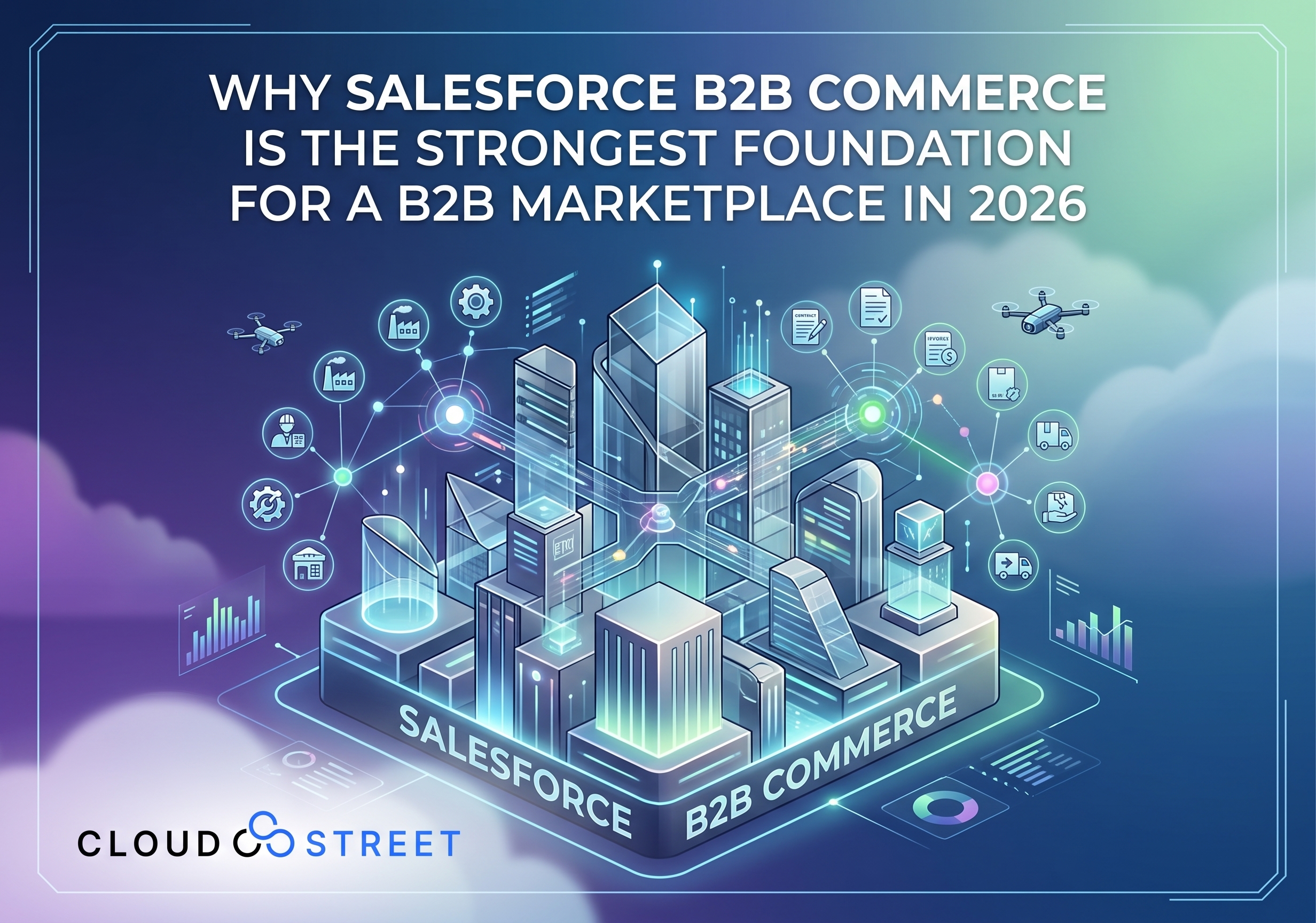
Why Salesforce B2B Commerce Is the Strongest Foundation for a B2B Marketplace in 2026
Category: Blog
Introduction: the B2B marketplace question
B2B buyers increasingly expect a marketplace-style experience: multiple suppliers, one place to search, one cart, one purchase order, and a coordinated fulfillment process.
For the marketplace operator, however, the customer-facing storefront is only one part of the challenge. The real operating model includes supplier onboarding, catalog governance, contract pricing, customer entitlements, order routing, settlement, reporting, and integration with ERP and fulfillment systems.
That complexity leads many companies to assume they need a dedicated marketplace platform. We recommend evaluating that assumption carefully.
Salesforce already provides a strong foundation through B2B Commerce, now presented within the broader Agentforce Commerce portfolio. Agentforce Commerce applies to B2C, D2C, and B2B Commerce. For many companies building a curated, one-to-many marketplace, B2B Commerce can provide the required commerce capacity without adding a separate marketplace product.
Salesforce does offer a Marketplace capability. Its marketplace ecosystem also includes AgentExchange, Salesforce’s marketplace for apps and agents. Those offerings can be appropriate for specific requirements. But a B2B company should distinguish between needing a marketplace for apps or third-party sellers and needing a multi-supplier purchasing experience for business customers.
Most companies that already have established buyers, accounts, pricing agreements, and Salesforce data should begin with a one-to-many model: one marketplace operator curates and manages a network of suppliers. That approach is generally easier to govern than a many-to-many model in which every supplier, buyer, and transaction relationship is independently managed.
The right model also depends on whether the marketplace is vertical or horizontal, local or global, and whether the operator controls fulfillment, billing, or supplier settlement.
If you are evaluating a Salesforce B2B Commerce marketplace, Schedule a Call with our team to discuss the operating model before selecting additional software.
What a B2B marketplace actually requires: 10 capabilities
A B2B marketplace is not simply a website with multiple vendors. It is a coordinated commercial system. At minimum, the platform and implementation should address these 10 requirements:
- Multiple suppliers in one buying experience
Buyers should be able to discover products from multiple suppliers without navigating disconnected storefronts. - Supplier onboarding and catalog maintenance
Suppliers need a controlled way to submit products, update attributes, provide documentation, and maintain availability. - Customer-specific and contract pricing
Pricing may vary by customer, supplier, contract, volume tier, region, or buying group. - Company accounts and buyer permissions
A business account may contain multiple buyers, locations, approval rules, spending limits, and procurement roles. - Entitlements and visibility
Customers may see different suppliers, products, catalogs, or prices depending on their account and commercial agreement. - Punchout and procurement integration
cXML and OCI connectivity may be important for organizations that buy through procurement systems. - Quotes and RFQ workflows
Large or specialized purchases may require negotiated quotes before a buyer can place an order. - Order splitting and fulfillment
A single cart may contain products from several suppliers, requiring separate fulfillment, shipping, returns, and status tracking. - Payment, invoicing, and settlement
The operator may collect payment, extend credit, issue invoices, calculate commissions, and reconcile amounts owed to suppliers. - Reporting for three stakeholders
Marketplace operators, suppliers, and buyers each need different reporting, from GMV and margins to supplier performance and order history.

The B2B marketplace platform options on the market
Companies generally evaluate five types of marketplace architecture:
- Marketplace overlay software
An overlay handles supplier functionality while a separate commerce platform powers the storefront. This can accelerate selected capabilities, but it also creates a second system to license, integrate, secure, and maintain. Some models also charge transaction or GMV-based fees. - Full-stack SaaS marketplace suites
A single vendor provides most marketplace functions. This can reduce the number of vendors involved, although the operator accepts more dependency on that provider’s roadmap, data model, and commercial terms. - Self-hosted or licensed platforms
These offer greater infrastructure and customization control, but the customer assumes more responsibility for upgrades, security, reliability, and operations. - Open-source marketplace software
Open source can provide code access and flexibility. The license cost may be lower, but development, support, testing, security, and ongoing maintenance remain the customer’s responsibility. - Marketplace capabilities built on an existing commerce platform
This approach extends a platform the business already owns. It can reduce duplication and keep customer, product, order, and account data closer to the existing system of record.
A realistic B2B marketplace cost model should include software licensing, marketplace licensing, implementation, integrations, data migration, supplier onboarding, support, training, and change management.
Also examine fees tied to gross merchandise value. A percentage-based fee may appear manageable at launch, but it increases precisely when the marketplace grows. A platform licensed by users, capacity, or selected features may create a different cost profile. Neither model is automatically right; the important question is how total cost changes at one, three, and five times current volume.
Why Salesforce is a strong foundation for a B2B marketplace
1. One platform of record
Salesforce can hold customers, accounts, contacts, suppliers represented as accounts, products, price books, orders, cases, and commercial relationships in one connected environment.
That reduces the risk of building a marketplace system that knows what a buyer purchased but not why the buyer was entitled to that product, which contract applied, or which account owner should handle the issue.
2. Native B2B commerce capabilities
B2B Commerce provides the essential building blocks for a marketplace, including:
- Product catalogs and categories
- Buyer accounts and buyer groups
- Account hierarchies
- Entitlement policies
- Customer-specific price books
- Carts and checkout
- Order creation and order history
- Inventory and pricing lookups
- Experience Cloud storefronts and portals
- Flow, Apex, APIs, and integration options
Salesforce’s B2B Commerce documentation and product overview describe capabilities for negotiated pricing, tailored catalogs, buyer entitlements, large-volume orders, split shipments, and account-based selling.
3. Commercial complexity
Many lightweight marketplace products handle product listings effectively but require significant customization for B2B pricing. Salesforce is designed around account-based commerce, which is important when every customer may have a different agreement.
A marketplace implementation can extend that foundation to support supplier cost, buyer price, contract price, volume tiers, discounts, commissions, and effective dates.
4. Experience Cloud portals
Experience Cloud can support the buyer storefront and the supplier experience. A buyer portal may include approved catalogs, account information, order history, reorder options, and approvals. A supplier portal may provide catalog submissions, product updates, order visibility, and fulfillment status.
Using related Salesforce experiences can reduce the number of disconnected identity, permission, and portal systems.
5. Agentforce Commerce
Agentforce Commerce supports B2C, D2C, and B2B Commerce use cases. In B2B, the practical value is not generic consumer-style recommendations alone. It is helping existing customers find approved products, view contract pricing, check order history, request quote status, and complete reorder workflows.
Agentforce actions can be connected to Salesforce data, Flow, Apex, and integration services. Our Salesforce AI and Agentforce services focus on applying those capabilities to specific business processes and governance requirements.
6. Integration strength
Marketplace orders rarely end in the storefront. They need to reach ERP, inventory, tax, payment, warehouse, shipping, and finance systems. Salesforce supports standard integration patterns and can be extended through APIs, middleware, Flow, and Apex.
CloudStreet also works with Oracle Fusion and other back-office platforms through our Salesforce Oracle Fusion integration services.
7. Data and AI readiness
A marketplace depends on consistent product, supplier, customer, inventory, and pricing data. Data 360 can help unify internal and external data sources so that commerce and AI experiences operate from more reliable context.
8. A different cost shape
Salesforce licensing typically scales around users, editions, capacity, and selected features rather than automatically taking a percentage of marketplace revenue. That distinction deserves attention during a three-year TCO analysis.
9. AgentExchange ecosystem
Salesforce’s AgentExchange ecosystem provides access to approved apps and agents when a marketplace requires a specialized capability. This can extend the platform without forcing every function into a custom build.
When the Salesforce Marketplace product makes sense, and when B2B Commerce is enough
Salesforce does offer a Marketplace product or offering for selected multi-seller requirements. It may be relevant for larger, more complex programs that need packaged seller-management functions, specialized marketplace operations, or a model closely aligned with the product’s supported architecture.
For many curated B2B marketplaces, however, B2B Commerce already provides sufficient capacity.
| Requirement | B2B Commerce alone | Consider an added marketplace product |
|---|---|---|
| Curated one-to-many supplier marketplace | Typically appropriate | If packaged marketplace administration is preferred |
| Supplier self-service catalog maintenance | Experience Cloud plus configuration and extensions | If extensive prebuilt seller tools are required |
| Orders split across suppliers | Achievable through commerce and orchestration design | If packaged routing is a core requirement |
| Avoiding GMV-based fees | Often more straightforward to model | Review any added transaction fees |
| Deep contract pricing | Strong fit for B2B Commerce | Usually not the primary reason to add a product |
| Procurement punchout | Requires integration design | Consider specialized procurement functionality |
| Multi-currency and global operations | Supported with architecture and integration planning | Consider additional localization requirements |
| Very large many-to-many supplier networks | Requires careful custom architecture | A dedicated marketplace product may be worth evaluating |
CloudStreet’s approach: turning B2B Commerce into a marketplace with less effort
We do not begin with a blank codebase. We configure and extend B2B Commerce using reusable architecture patterns and accelerators.
Our work typically covers nine implementation areas:
- Model suppliers as accounts with roles, contacts, products, and buyer relationships.
- Build an Experience Cloud supplier portal for catalog submissions, pricing updates, and order visibility.
- Ingest catalog data through CSV and APIs, with validation, approval, enrichment, and mapping to a unified product model.
- Apply entitlement rules so buyers see the right suppliers, catalogs, and products.
- Configure supplier costs, customer pricing, contract pricing, tiers, and commissions.
- Split multi-supplier carts into routed orders with separate fulfillment and returns.
- Reconcile payments, invoices, supplier settlement, and ERP transactions.
- Provide operator, supplier, and buyer reporting.
- Govern permissions, sharing, audit history, testing, and release management.
We have experience with franchisee marketplaces that consolidate products from multiple manufacturers into one storefront with group-discounted pricing. We also bring experience in aviation parts distribution, customer-specific pricing, complex catalogs, ERP and Oracle Fusion integrations, and quote-to-cash processes. One aviation implementation included a catalog of more than 430,000 SKUs.

This approach can reduce custom build effort, improve time to value, and leave the customer with a foundation it owns rather than a separate marketplace layer that duplicates core commerce data.
Explore our B2B Commerce Accelerator or Get a Quote for a marketplace architecture assessment.
A practical evaluation framework: 10 questions
Before committing to a B2B marketplace platform, ask:
- Does it run commerce itself, or require a second platform?
- What does it cost at three times current volume?
- Can one order contain products from multiple suppliers?
- How are separate fulfillment and returns handled?
- Can each customer have agreed prices?
- Can buyers operate under company accounts and approval limits?
- Does it support quotes and RFQs?
- Who owns the code, data, and customer relationship?
- How does it connect to ERP, inventory, tax, payment, and fulfillment?
- What is the three-year total cost of ownership?
Common mistakes companies make
- Buying an overlay before evaluating the commerce platform underneath.
- Assuming a marketplace tool automatically handles contract pricing and account hierarchies.
- Underestimating supplier onboarding and catalog quality.
- Ignoring order splitting, settlement, and finance requirements.
- Treating the marketplace as a website project instead of an operating model change.
- Accepting a revenue-share model without forecasting growth.
- Starting with too many suppliers instead of a curated, high-value group.
- Designing the buyer experience while leaving the supplier experience undefined.
Conclusion: build on the commerce foundation you already own
Salesforce B2B Commerce, within Agentforce Commerce, provides the catalog, pricing, account, entitlement, checkout, order, portal, and integration capabilities that many B2B marketplaces require.
Salesforce’s Marketplace offering can make sense for specific programs. But for a curated one-to-many marketplace, adding a separate marketplace product may introduce cost, integration, and governance overhead without solving the core commercial problem.
CloudStreet extends B2B Commerce with supplier onboarding, catalog ingestion, vendor assignment, order splitting, settlement, reporting, and portal patterns. We are based in Houston, Texas, and support customers locally and globally.
If you are considering how to build a B2B marketplace on Salesforce, Contact Our Team for a working session focused on your suppliers, pricing model, order flow, and integration landscape.

Category
Discover insights that drive results - explore out latest blog posts now
DealHub Salesforce Integration for Manufacturers: Connecting CPQ, Contracts, and CRM
About the manufacturer: mid-market industrial equipment company A U.S.-based, mid-market [...]
Salesforce Data 360 and Agentforce: Why Grounding Is What Makes AI Agents Dependable
An AI agent can produce a fluent answer and still [...]
Salesforce Data 360 Governance and Informatica: Managing Data Quality, Access, and Trust in the Agentic Era
Data governance becomes more consequential when business data does more [...]