Building a Franchisee Marketplace with Salesforce B2B Commerce LE: A Case Study in Group Purchasing
Category: Blog
Label: Agentforce Commerce
Note: This is an anonymous case study. CloudStreet did not have permission to identify the client by name or use the project for client-branded promotion.
Executive summary: A Salesforce marketplace for franchisees
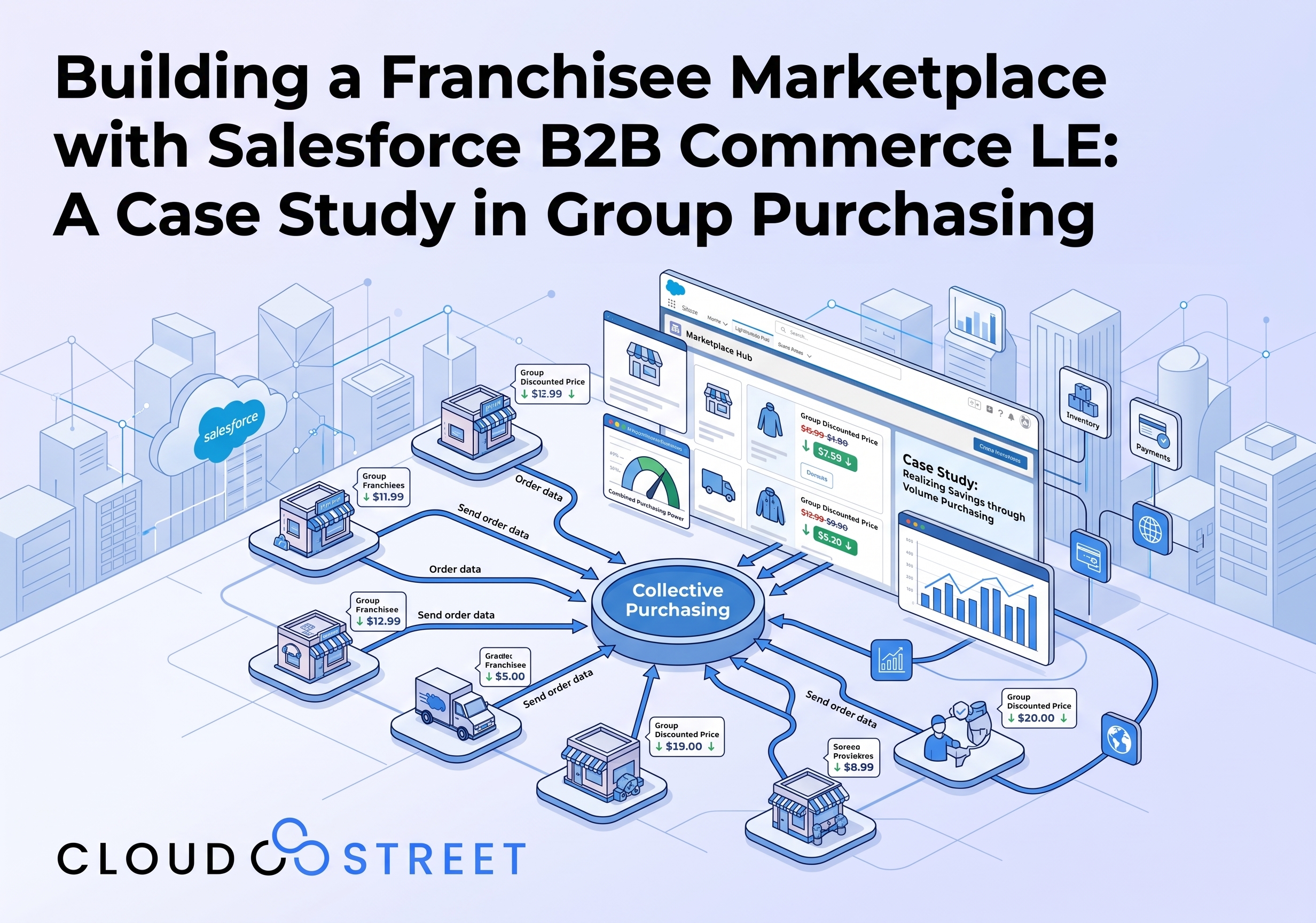
We implemented Salesforce B2B Commerce Lightning Experience (B2B Commerce LE) for a national franchisor that wanted to create a centralized purchasing marketplace for its franchisees.
Before the project, franchisees purchased laboratory supplies through separate manufacturer ordering processes. The franchisor wanted to consolidate that activity into a single Salesforce storefront where franchisees could:
- Browse products from multiple manufacturers.
- Place orders through one purchasing experience.
- Buy using group-discounted, volume-based pricing negotiated by the franchisor.
- Manage purchases for multiple franchise locations during one session.
- Repeat common purchases without rebuilding every order from the beginning.
The initial implementation was intentionally limited. The storefront launched with products from the three most common manufacturers: McKesson, Abbott, and CLIAWaived: and access was initially restricted to the largest franchisees.
The project did not include payment, shipping, tax, ERP, inventory, or other external checkout integrations. Instead, orders were created in Salesforce using a purchase-order-only checkout process aligned with the client’s procurement model.
Key takeaway
A franchisee purchasing marketplace does not need to begin with a highly integrated commerce ecosystem. A focused Salesforce B2B Commerce LE implementation can provide a practical foundation for consolidated ordering, supplier variety, group purchasing, and future expansion: provided the initial scope matches the operating model.
Schedule a Call with CloudStreet to discuss whether a phased B2B Commerce approach fits your franchise network.
Client context and business challenge
The client was a national franchisor supporting a distributed network of franchise locations. Those franchisees needed recurring access to laboratory supplies from multiple manufacturers.
The purchasing model created several business considerations:
- Franchisees had to navigate different manufacturer ordering processes.
- Product discovery and repeat purchasing could require unnecessary administrative effort.
- Negotiated group pricing was harder to manage consistently across disparate purchasing channels.
- The franchisor had limited centralized visibility into order activity and purchasing patterns.
- Buyers managing multiple locations needed a practical way to identify the location associated with each order.
The objective was not to replace every supplier system or create a fully integrated order-to-cash platform at the outset. The objective was to establish a Salesforce marketplace for franchisees that simplified the front-end buying experience and created Salesforce Order records for downstream handling.
Why a marketplace model made sense for a national franchisor
A marketplace model allowed the franchisor to act as the coordinating purchasing channel while preserving access to products from multiple manufacturers.
Rather than asking every franchisee to manage separate supplier relationships and storefronts, the franchisor could provide one B2B storefront with a curated product catalog. This structure also supported the franchisor’s commercial model: negotiate volume-based pricing with suppliers and make those group purchasing advantages available to participating franchisees.
The model created a clear separation of responsibilities:
- The franchisor established supplier relationships, product availability, and negotiated pricing.
- Manufacturers remained the source of the products and related fulfillment processes.
- Franchisees used one storefront to identify products and submit purchase orders.
- Salesforce served as the system where orders were created and managed.
This type of architecture can be useful for franchise organizations, buying groups, distributors, and associations that want to coordinate purchasing without requiring every buyer to use the same supplier-specific process.
For additional context on storefront design, reordering, customer-specific pricing, and implementation scope, see our B2B Commerce Accelerator.
Solution: Salesforce B2B Commerce LE storefront
We implemented the storefront using Salesforce B2B Commerce LE as a standard implementation with targeted customizations for the client’s procurement requirements.
Salesforce Commerce solutions can support several commerce models, including:
- B2B Commerce for business buyers, distributors, partners, and franchisees.
- B2C Commerce for direct consumer purchasing.
- D2C Commerce for brands selling directly to end customers.
This specific project was a B2B Commerce LE implementation for franchisee procurement. It was not a consumer storefront, and it was not designed as a direct-to-consumer shopping experience.
The initial catalog included the three manufacturers most commonly used by the participating franchisees:
- McKesson
- Abbott
- CLIAWaived
The storefront gave franchisee buyers access to products from these manufacturers within one Salesforce experience. The franchisor could then use its group purchasing relationships to establish volume-based pricing for the participating network.
Variations feature used during its beta period
The implementation also utilized the Salesforce Variations feature while it was in beta. This allowed the storefront to represent product variations in a more structured manner during the early product launch.
Using a feature during a beta period requires appropriate planning. Product teams should consider:
- How the feature behaves in the target Salesforce environment.
- Whether its data model supports the intended catalog structure.
- What testing is appropriate before exposing it to buyers.
- How future Salesforce releases may affect the implementation.
- What operational fallback exists if requirements change.
This consideration is especially relevant for a limited launch where the organization can validate the buying experience with a controlled audience before expanding.

Launch strategy and scope control
The client chose a controlled rollout rather than opening the marketplace to the entire franchise network immediately.
The initial deployment was limited in two important ways:
- Product scope: The launch included the three most common manufacturers.
- Buyer scope: Access was initially restricted to the largest franchisees.
This approach helped keep the implementation aligned with the client’s immediate purchasing priorities. It also created an opportunity to observe how high-volume buyers interacted with the storefront before introducing additional complexity.
A phased launch can help franchisors evaluate:
- Catalog organization and search behavior.
- Whether pricing rules are understandable to buyers.
- The effectiveness of the purchase-order workflow.
- How multi-location buyers select an account.
- Which products should be added next.
- What training or support materials franchisees need.
The anticipated advantage of this approach was not a guaranteed outcome or measured ROI. Instead, the limited launch was expected to provide a manageable environment for validation, feedback, and refinement.
Contact Our Team if your organization is considering a pilot storefront for selected franchisees, distributors, or business accounts.
Custom checkout and multi-location buying experience
1. Purchase-order-only checkout
The client specifically wanted orders created in Salesforce without external checkout integrations.
No payment gateway, shipping service, tax engine, fulfillment platform, or other external checkout integration was included. To support the client’s process, we enabled checkout only with a purchase order.
We wrote and configured code to bypass checkout steps that depended on shipping, tax, payment, and related services. We then added the ability for buyers to enter their PO information and complete checkout.
This approach matched the client’s procurement model and avoided introducing checkout requirements that were not part of the initial operating process.
The expected benefit was a lower level of friction for franchisee buyers who already relied on purchase orders. It also kept the first release focused on order creation rather than prematurely expanding into payment and fulfillment orchestration.
2. Multi-location account switching
Some franchisee buyers were responsible for purchasing for more than one location. We configured those buyers to use a multi-account switcher at checkout.
This allowed one buyer to:
- Begin a purchasing session.
- Select the relevant franchise location.
- Add products to the order.
- Switch to another authorized location.
- Continue purchasing within the same session.
- Complete orders with the appropriate account context.
This multi-location B2B ordering capability was important because a single buyer may operate across multiple legal entities, offices, clinics, or franchise locations. Without a clear account-switching workflow, buyers can create confusion around order ownership and destination.
3. Saving a previous order to a list
We also developed the ability to save a previous order to a list for easier repeat purchasing.
Recurring laboratory supply purchases often include familiar product combinations. A saved order list can give buyers a practical starting point for subsequent purchases, while still allowing them to adjust quantities or remove items as needed.
The anticipated benefit was less time spent reconstructing frequently repeated orders and a more consistent purchasing experience for franchisees.

Expected benefits: Projected, not measured outcomes
Because this was an early and limited deployment, we are not disclosing quantified results or claiming confirmed ROI. The following are hypothetical or anticipated benefits based on the solution design and the client’s stated objectives:
- Reduced purchasing effort: Franchisees were expected to spend less time navigating separate manufacturer ordering processes.
- More consistent use of group pricing: A centralized storefront was expected to make negotiated volume-based pricing more accessible across participating franchisees.
- Improved purchasing visibility: Salesforce Order records were expected to give the franchisor a clearer view of order activity and purchasing patterns.
- Easier repeat ordering: Saved order lists were expected to simplify recurring purchases.
- Fewer checkout barriers: A PO-only workflow was expected to better match existing franchisee procurement practices.
- Better pilot adoption: Starting with the largest franchisees was expected to concentrate early usage among buyers with significant purchasing needs.
- A foundation for expansion: The storefront was expected to provide a platform for adding more manufacturers, franchisees, catalog products, and future integrations.
These benefits would need to be validated through post-launch measurement. Useful metrics could include active buyer adoption, order frequency, repeat-list usage, average time to submit an order, pricing utilization, support requests, and the number of manufacturer catalogs added over time.
Lessons for franchisors considering B2B Commerce
This project illustrates several considerations for organizations planning a B2B Commerce platform for franchisors.
Start with the purchasing model
The storefront should reflect how buyers actually procure products. In this case, franchisees used purchase orders, so the initial checkout did not require credit-card payment or integrated shipping and tax services.
Separate marketplace goals from integration goals
A marketplace can provide value before every back-office system is connected. The client wanted Salesforce Orders created first. Future integrations could be evaluated later based on operational priorities and business case.
For organizations that eventually need ERP connectivity, our Salesforce and Oracle Fusion integration services page provides additional information about connecting orders, inventory, invoices, and financial workflows.
Treat multi-location access as a core requirement
Franchisee organizations often have buyers who work across several locations. Account context, permissions, and order ownership should be addressed during discovery rather than treated as a later enhancement.
Use a phased catalog strategy
Launching with the most frequently purchased manufacturers can help teams test the experience against real buying behavior without taking on the complexity of every supplier and product category at once.
Plan for future intelligence carefully
Agentforce Commerce may support future commerce use cases such as product discovery, recommendations, guided shopping, and merchant productivity. However, Agentforce Commerce was not represented as part of this specific implementation. Any future AI capability should be assessed against data quality, permissions, buyer needs, governance, and measurable business objectives.
Learn more about CloudStreet’s perspective on Salesforce AI and Agentforce.

CloudStreet implementation role and delivery model
CloudStreet served as an independent subcontractor to a pre-existing agency that was already assisting the client with other Salesforce matters.
CloudStreet did not have permission to promote the project using the client’s name, which is why this case study remains anonymous. It is also important to clarify the delivery responsibilities:
- CloudStreet implemented 100% of the Salesforce B2B Commerce LE solution described in this case study.
- CloudStreet completed the implementation without assistance from the other agency.
- The other agency’s work on the client’s broader Salesforce matters should not be interpreted as contribution to this B2B Commerce LE implementation.
Our broader Salesforce Services include implementation, configuration, customization, Commerce Cloud services, integration planning, development, and ongoing support.
CloudStreet is based in Houston, Texas, and we work with customers locally and globally. That delivery model allows us to support regional businesses as well as distributed franchise, supplier, and enterprise organizations operating across multiple markets.
Conclusion: A practical foundation for group purchasing
This anonymous project shows how a national franchisor can use Salesforce B2B Commerce LE to create a centralized marketplace for franchisee purchasing.
The solution brought multiple laboratory supply manufacturers into one Salesforce storefront, supported group-discounted pricing negotiated by the franchisor, created Salesforce Orders without external checkout integrations, and added workflows for purchase orders, multi-location buying, and repeat ordering.
The implementation was intentionally focused. It did not attempt to solve payment, shipping, tax, inventory, or fulfillment integration in the first release. Instead, it established a controlled foundation that could be evaluated and expanded as the franchisor’s priorities developed.
If you are evaluating a franchisee purchasing marketplace, CloudStreet can help you assess the right starting scope.
- Schedule a Call to review your franchisee purchasing model.
- Get a Quote for a Salesforce B2B Commerce discovery and implementation plan.
- Contact Our Team to discuss multi-location ordering, supplier catalogs, PO checkout, or future integrations.
Category
Discover insights that drive results - explore out latest blog posts now
DealHub Salesforce Integration for Manufacturers: Connecting CPQ, Contracts, and CRM
About the manufacturer: mid-market industrial equipment company A U.S.-based, mid-market [...]
Salesforce Data 360 and Agentforce: Why Grounding Is What Makes AI Agents Dependable
An AI agent can produce a fluent answer and still [...]
Salesforce Data 360 Governance and Informatica: Managing Data Quality, Access, and Trust in the Agentic Era
Data governance becomes more consequential when business data does more [...]