Salesforce Summer ’26: The “Finally, My Buyers Can Do it Themselves” Release
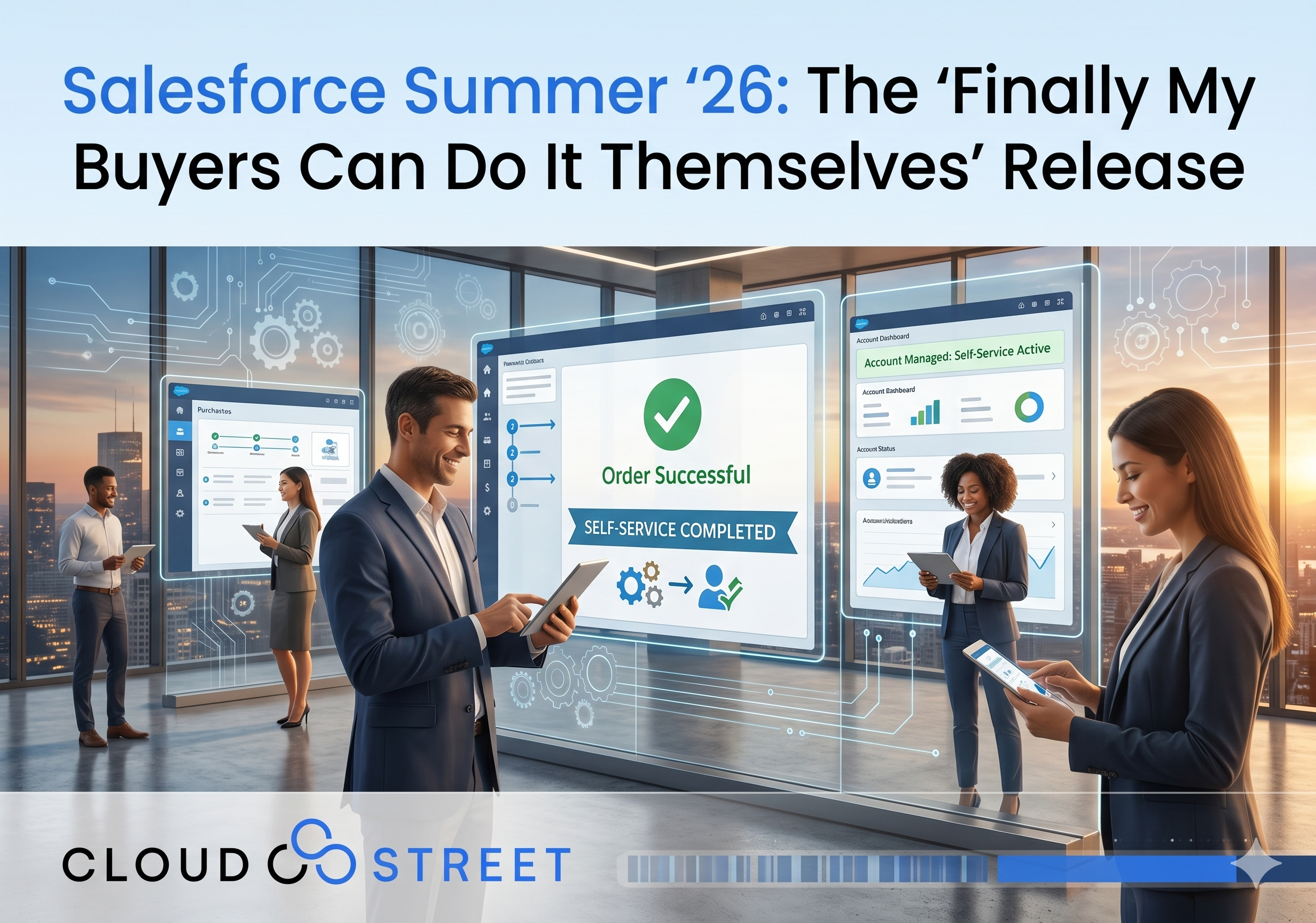
If you’ve spent any time in the B2B or D2C Commerce space, you know the “customer journey” usually involves a lot of hand-holding. Whether it’s a buyer waiting three days for a sales rep to approve a quote or a customer calling support just to change their monthly subscription quantity, the friction has been real.
The Salesforce Summer ’26 release is effectively a declaration of war on that friction. At CLOUDSTREET, we’ve been digging through the release notes, and the overarching theme is clear: Autonomy. Salesforce is finally giving buyers the keys to the kingdom, allowing them to manage complex configurations, quotes, and subscriptions without ever needing to pick up the phone.
Based out of our headquarters in Houston, Texas, the CLOUDSTREET team helps businesses locally and globally navigate these massive updates to ensure they aren’t just “buying software,” but actually seeing a return on their investment. If you’re wondering how these changes impact your bottom line, you might want to check out our guide on the real cost of implementing Salesforce and how to get your ROI faster.
Here are the 5 major feature areas in the Summer ’26 release that are changing the game for B2B and D2C Commerce Cloud.
1. Agentforce: The Shop Assistant That Never Sleeps
For years, chatbots were mostly just glorified FAQ search bars. If a customer wanted to actually buy something, the bot would eventually just give up and say, “Let me connect you to a human.”
With the Summer ’26 release, Agentforce for Commerce turns that bot into a fully functional sales agent. We aren’t just talking about answering questions; we’re talking about transaction-capable AI.
- In-Chat Add to Cart: Buyers can now ask the agent to find specific parts or products and add them directly to their cart without leaving the chat interface.
- Conversational Checkout: Agentforce can now guide a user through the entire checkout process, including selecting shipping methods and applying promotional codes.
- Order Status and Modifications: Instead of digging through an “Order History” page, buyers can simply ask, “Where is my order?” or “Can I add two more units to my last shipment?”
This level of self-service is a massive win for D2C brands, but the implications for B2B Commerce Cloud are even bigger. It reduces the load on your support teams and lets your high-value sales reps focus on closing deals rather than acting as human order-entry clerks.

2. B2B Self-Service Quotes: Closing the Gap
In the traditional B2B world, quotes are where deals go to die: or at least where they go to take a very long nap. A buyer requests a quote, a rep reviews it, an admin approves it, and then… it sits in an inbox.
Summer ’26 introduces Self-Service Quotes, a feature that finally treats the B2B buyer like an adult.
- Quote-to-Order Conversion: Once a quote is approved by your internal sales team, the buyer can see that approved status in their own portal and convert it into an active order with a single click.
- Negotiation Transparency: Buyers can see the history of the quote, the applied discounts, and any expiration dates directly within the storefront.
- Streamlined Re-ordering: If a buyer has a recurring need based on a previously negotiated quote, they can initiate a new request based on those terms without starting from scratch.
This feature alone removes days of administrative lag from the sales cycle. For companies looking to scale their B2B operations, this is the kind of efficiency that makes or breaks a fiscal year. If you need a hand setting up these complex workflows, CLOUDSTREET offers Salesforce staff augmentation to get your team up to speed quickly.
3. Subscription Management: No-Contact Recurring Revenue
Managing subscriptions used to be a nightmare of manual overrides. If a customer wanted to pause their subscription, upgrade their tier, or change their billing frequency, it almost always required an internal user to jump into the back end.
The Summer ’26 release brings “no-contact” subscription management to the forefront.
- Self-Service Amendments: Buyers can now increase or decrease quantities, swap products within a subscription bundle, or change the delivery frequency directly from their account dashboard.
- Automated Renewals with Flexibility: Customers can opt-in for automated renewals but retain the ability to modify the upcoming order up to a specific “lock date.”
- Simplified Cancellation Flows: While nobody likes to see a customer leave, providing a clear, self-service way to manage or pause a subscription actually increases long-term trust and reduces churn-related support tickets.
By moving these tasks to the storefront, you’re not just saving time; you’re meeting the modern buyer’s expectation for instant control. Whether you’re in Houston or halfway across the globe, your customers expect this level of digital maturity.

4. Intelligent Search: Attribute Weighting and SKU Prioritization
If a customer can’t find it, they can’t buy it. Salesforce has revamped the Commerce Search engine in Summer ’26 to give merchandisers much more granular control over how results are displayed.
One of the most requested features: Attribute Weighting: is finally here.
- Priority Scoring: You can now tell the search engine that “Product Name” matches are worth more than “Description” matches, or that specific attributes (like “Brand” or “Material”) should carry more weight in the ranking algorithm.
- SKU Prioritization: In B2B, buyers often search by exact SKU or part number. The new search enhancements ensure that exact SKU matches are pinned to the top, bypassing the “fuzzy logic” that sometimes confuses technical searches.
- Search Suggestions with Context: The search bar now suggests categories and popular products based on the buyer’s specific account segment and past purchase history.
This ensures that your most profitable products (or the ones you have the most of in the warehouse) are the ones your buyers see first. It’s a subtle change that has a massive impact on conversion rates.

5. Enhanced Storefront Control: Pages, Carts, and Shipping
The last pillar of this release focuses on the “plumbing” of the storefront. Salesforce has introduced several updates to the Storefront and Checkout experience that give admins more power without requiring custom code.
- Dynamic Store Pages: You can now create more personalized landing pages that change based on the buyer’s localized region or customer group.
- Advanced Cart Logic: Admins can now set more complex rules for cart validations: such as minimum order quantities for specific high-weight items: without needing to write custom Apex triggers.
- Split Shipping Enhancements: For D2C retailers, the ability to let a customer ship items in a single order to multiple addresses (or choose different shipping speeds for different items) has been significantly streamlined in the checkout flow.
These updates mean your team can move faster. Instead of waiting for a developer to build a custom solution, your commerce managers can use the declarative tools provided in the Summer ’26 release to respond to market trends in real-time.
Why the Summer ’26 Release Matters for Your ROI
At CLOUDSTREET, we talk a lot about ROI because, at the end of the day, that’s why you’re using Salesforce. The Summer ’26 release is designed to lower your “Cost to Serve.” By pushing tasks like quoting, subscription management, and complex search onto the AI and the buyer’s own self-service portal, you are essentially scaling your business without adding to your headcount.
Whether you are a local Houston business looking to modernize your operations or a global enterprise seeking a more efficient B2B engine, these features provide a clear path forward. If you’re feeling overwhelmed by the technical requirements of these new features, don’t hesitate to reach out. From offshore Salesforce managed services to high-level strategic consulting, we ensure your tech stack is working for you, not the other way around.
Ready to take the next step?
- Audit Your Current Flow: Are your buyers still calling in for things they should be able to do themselves?
- Test Agentforce: See how a conversational sales agent can change your conversion rates in a sandbox environment.
- Upgrade Your B2B Experience: Transition your B2B Commerce Cloud to include self-service quoting before your competitors do.
The future of commerce is autonomous. Don’t let your business get left behind in the manual era. Contact us today to see how we can help you implement these Summer ’26 features and start seeing results immediately.

Category
Discover insights that drive results - explore out latest blog posts now
DealHub Salesforce Integration for Manufacturers: Connecting CPQ, Contracts, and CRM
About the manufacturer: mid-market industrial equipment company A U.S.-based, mid-market [...]
Salesforce Data 360 and Agentforce: Why Grounding Is What Makes AI Agents Dependable
An AI agent can produce a fluent answer and still [...]
Salesforce Data 360 Governance and Informatica: Managing Data Quality, Access, and Trust in the Agentic Era
Data governance becomes more consequential when business data does more [...]