From Rules to Results: The Evolution of Salesforce CPQ to Revenue Lifecycle Management (RLM)
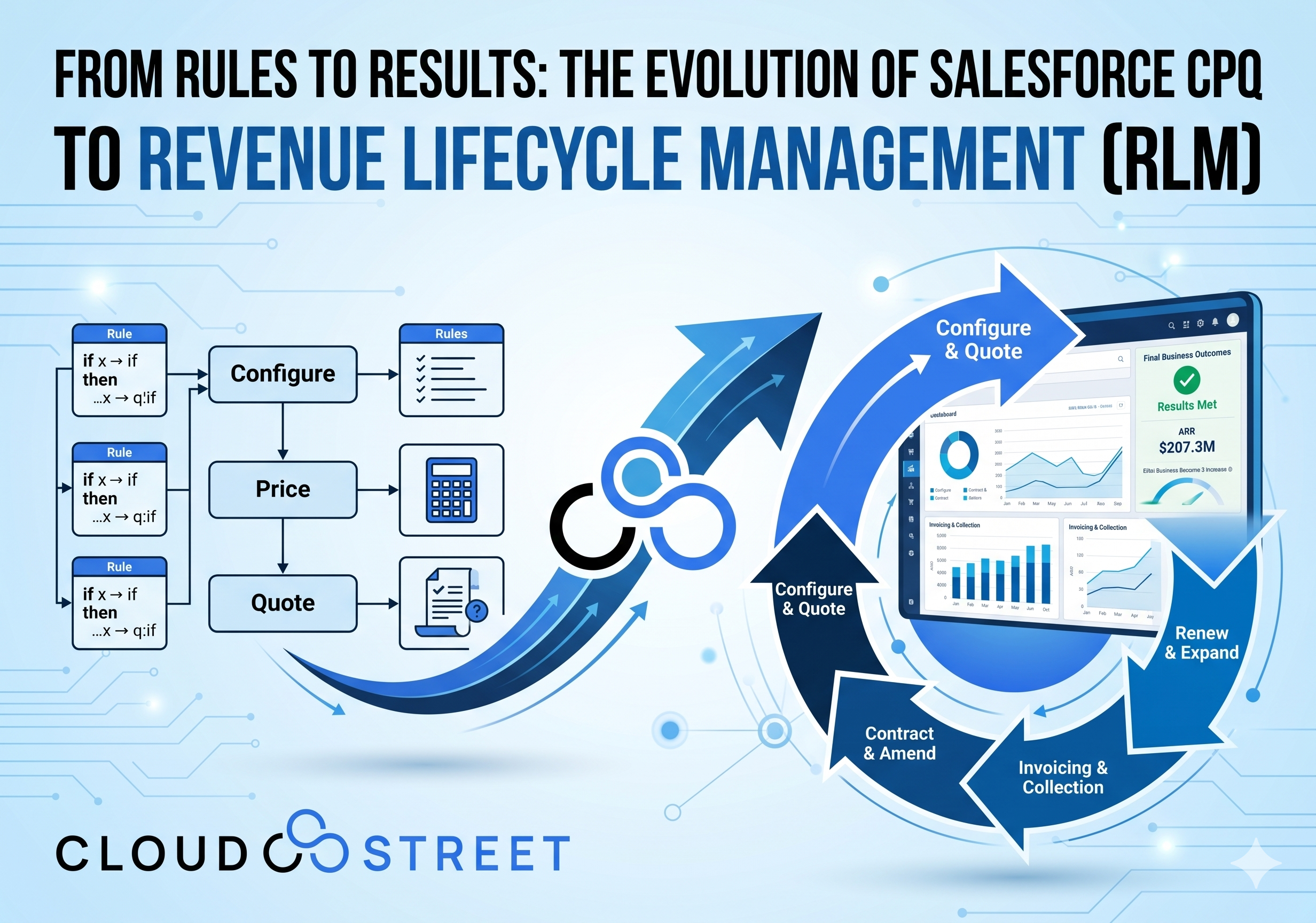
For over a decade, Salesforce CPQ (Configure, Price, Quote) was the gold standard for sales teams looking to move beyond spreadsheets. If you’ve spent any time in the ecosystem, you know the story: Salesforce acquired SteelBrick in 2015, turned it into a powerhouse managed package, and helped thousands of companies automate their quoting logic.
But as we sit here in April 2026, the landscape has shifted. The “managed package” era is giving way to something more integrated, more powerful, and significantly more intelligent. We are moving from a world of rigid product rules to a world of fluid results. Welcome to the era of Revenue Lifecycle Management (RLM) and Agentforce.
At CLOUDSTREET, based in the heart of Houston, Texas, we’ve helped businesses from the Energy Corridor to global enterprises in Europe and Asia navigate this transition. We’ve seen firsthand how the “complexity tax” of old CPQ setups can slow down even the most aggressive sales teams.
The 3 Major Catalyst Points for the RLM Evolution
Why did Salesforce decide to move away from the traditional CPQ architecture? It comes down to three primary pain points that were holding back modern B2B enterprises:
- The Managed Package Bottleneck: Traditional CPQ lived as a “managed package.” This meant it had its own data model and its own engine that sometimes felt bolted onto the side of Sales Cloud rather than being a part of it.
- The “Too Complex” Trap: Many companies built CPQ systems so complex that making a single price change required a three-week development cycle. This rigidity is the antithesis of modern business agility.
- Fragmented Lifecycles: Quoting is just one part of the story. In a subscription-heavy world, you need to manage the entire lifecycle: amendments, renewals, billing, and revenue recognition: in one seamless flow.

From Rules to Results: 5 Key Differences Between CPQ and RLM
When we talk about the evolution to Revenue Lifecycle Management, we aren’t just talking about a name change. We are talking about a fundamental architectural shift. Here are the 5 biggest changes you need to know:
1. Native Integration vs. Managed Package
Unlike the old CPQ, RLM is built natively on the Salesforce Core platform. This means it uses standard objects and the high-performance “Hyperforce” infrastructure. No more waiting for “calculations” to sync back to the opportunity; the data is already where it needs to be.
2. High-Performance Product Discovery
RLM introduces a streamlined way for sales reps (and customers) to find products. Instead of digging through nested categories, the new discovery engine feels more like a B2B commerce experience. You can see how this integrates with the front-end by checking out our B2B Commerce Cloud insights.
3. Dynamic Revenue Orchestration (DRO)
In the old world, once the quote was signed, CPQ’s job was done. RLM introduces DRO, which manages what happens after the signature. It triggers provisioning, fulfillment, and downstream financial activities automatically.
4. Simplified “Asset” Management
Managing what a customer actually owns (their assets) has historically been a nightmare in CPQ. RLM treats the “Asset” as the source of truth, making “Amend, Renew, and Cancel” (ARC) actions much more intuitive.
5. Unified Data Model for Global Scale
For our clients who operate globally from our Houston hub, the ability to handle multi-currency, multi-jurisdiction tax, and complex global catalogs without hitting governor limits is the biggest win of the RLM transition.
Pro Tip from Mark Lum: “Don’t just migrate your old CPQ rules to RLM. Use this as an opportunity to simplify. If your sales reps need a 40-page manual to create a quote, your system is broken, not your reps.”
The 2026 Game Changer: Agentforce Revenue Management
The most exciting development this year is the integration of Agentforce. We are no longer just building “rules”; we are deploying “agents.”
In the past, if a customer wanted a custom configuration, a sales rep had to manually click through a configurator, ensuring they didn’t violate any of the hundreds of “Product Rules” or “Summary Variables” set up by the admin.
Now, with Agentforce Revenue Management, we use a Reason-Act-Observe loop.
- Reason: The AI agent analyzes the customer’s requirements and the current product catalog.
- Act: The agent autonomously configures the quote, applies the correct discount tiers, and ensures compliance with legal terms.
- Observe: The agent looks at the output: does it meet the margin requirements? Does it conflict with existing assets? It then adjusts in real-time.
This moves the burden of complexity from the human to the AI. Your sales team focuses on the relationship; the Agent handles the configuration logic.

Avoiding the “Complexity Tax”
One of the reasons CLOUDSTREET has become a go-to for Salesforce managed services is our focus on ROI. We’ve seen too many companies pay a “complexity tax”: the hidden cost of maintaining a system that is too difficult to change.
The move to RLM is specifically designed to kill the complexity tax. By using native Salesforce Flow for logic instead of proprietary CPQ “Price Rules,” you empower your standard Salesforce admins to manage the system. You no longer need a specialized “CPQ Developer” for every minor adjustment.
If you’re wondering how this looks in practice, our case studies highlight how we’ve simplified Quote-to-Cash cycles for various industries.
Why 2026 is the Year to Start Your Migration
If you are still running on the old SteelBrick managed package, you aren’t “behind” yet, but the gap is widening. Salesforce is pouring its R&D budget into RLM and Agentforce.
3 Reasons to start your RLM planning now:
- Scale: If your quote lines are reaching into the thousands, the old CPQ engine will eventually lag. RLM handles high-volume transactions with ease.
- AI Readiness: You cannot truly leverage Agentforce for quoting if your data is trapped in an old managed package architecture.
- Unified Commerce: RLM bridges the gap between B2B Commerce and Sales. Whether a customer buys through a portal or a rep, the engine is the same.

Local Expertise, Global Reach: The CLOUDSTREET Advantage
Based in Houston, Texas, CLOUDSTREET understands the unique needs of both local businesses and global enterprises. Whether you are a mid-market manufacturer in Texas or a global SaaS provider, the Quote-to-Cash process is the heartbeat of your business.
We don’t just implement software; we solve business problems. As Michael McLaughlin from Salesforce noted in his testimonial, our approach is centered on delivering actual value, not just checking boxes.

Ready to evolve your Revenue Operations?
The transition from CPQ to RLM isn’t just a technical upgrade: it’s a strategic shift toward a more agile, AI-driven future.
- Explore our services: See how we handle Salesforce Staff Augmentation to help you bridge the skills gap during a migration.
- Get in touch: Ready to talk about your specific Quote-to-Cash challenges? Contact us here.
- See the results: Check out what our clients are saying, from Elisabeth Constantine to Bart Rabalais.
The “Complexity Tax” is optional. The evolution to RLM is inevitable. Let’s make sure your business is on the right side of that curve.

Category
Discover insights that drive results - explore out latest blog posts now
DealHub Salesforce Integration for Manufacturers: Connecting CPQ, Contracts, and CRM
About the manufacturer: mid-market industrial equipment company A U.S.-based, mid-market [...]
Salesforce Data 360 and Agentforce: Why Grounding Is What Makes AI Agents Dependable
An AI agent can produce a fluent answer and still [...]
Salesforce Data 360 Governance and Informatica: Managing Data Quality, Access, and Trust in the Agentic Era
Data governance becomes more consequential when business data does more [...]