Salsify and Salesforce B2B Commerce: Turning Product Data Into a Working Customer Portal
Category: Blog | Label: Agentforce Commerce
A B2B customer portal is only as useful as the product information behind it. Buyers may need technical specifications, product attributes, unit-of-measure details, compliance documents, manuals, and clear imagery before they can confidently place an order. A SKU and a price are rarely enough.
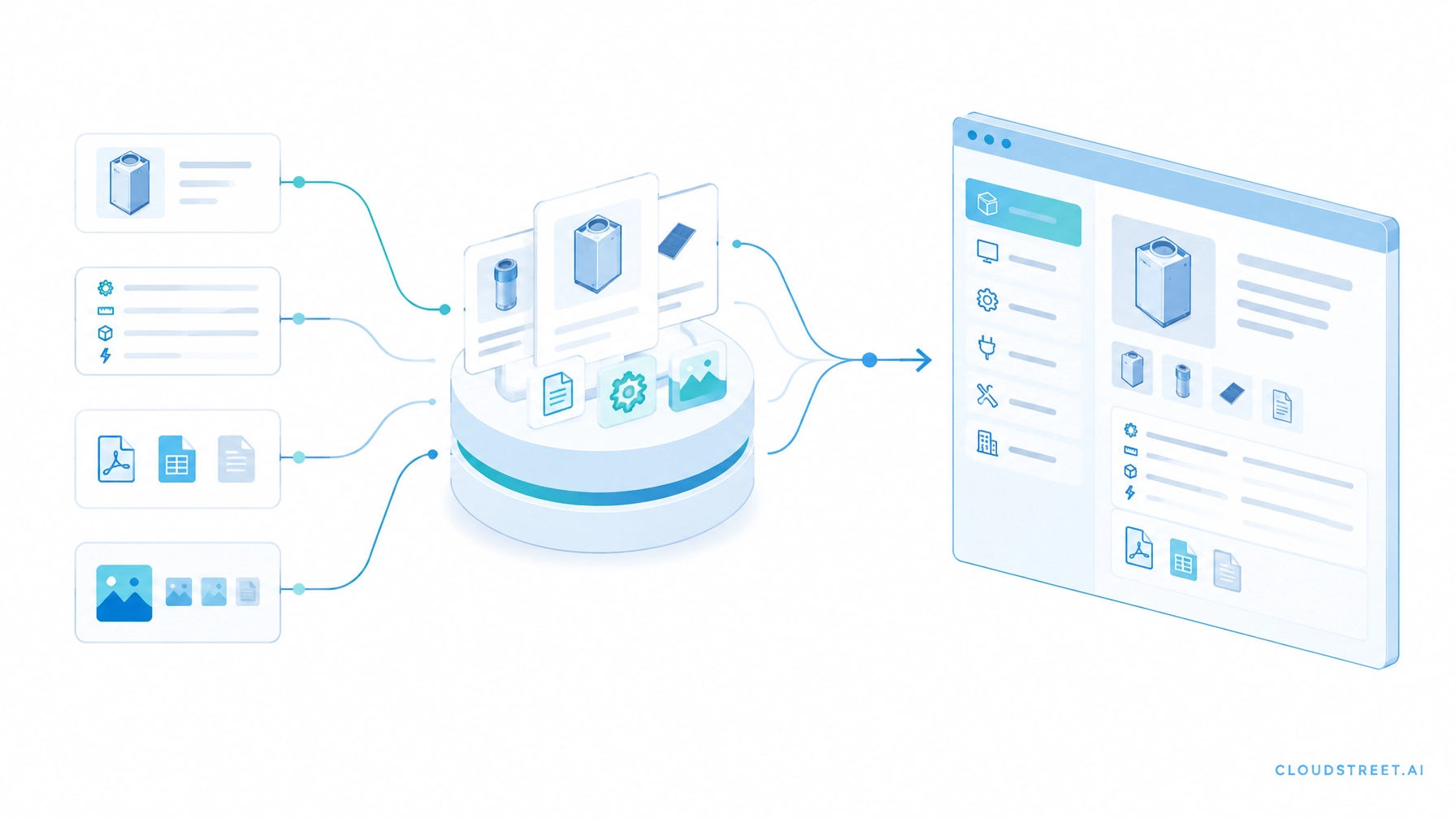
When product content is spread across spreadsheets, an ERP system, supplier files, and individual folders, the portal can inherit those inconsistencies. We help connect product content managed in Salsify with Salesforce B2B Commerce, so approved information can reach the customer experience in a structured, governed way.
CloudStreet is based in Houston, Texas, and serves customers locally and globally. If you’re evaluating a product data integration, schedule a call to discuss your systems and catalog.
What Salsify does and why product teams use it
Salsify is a product experience management (PXM) platform for managing product information, digital assets, and content distribution across channels. It gives merchandising and product teams a central place to create, enrich, govern, and syndicate product content.
That content can include product descriptions, specifications, technical attributes, images, and supporting documents. For a company selling through multiple channels, a PXM platform can help teams manage product information consistently while adapting it for different markets or audiences.
Salesforce B2B Commerce needs product content mapped to its commerce data model. The work of a Salsify Salesforce integration is to connect the two in a way that reflects how your catalog, categories, fields, and customer portal actually operate. This is one part of a broader Salesforce B2B Commerce implementation.
Why B2B product data is harder than B2C
Manufacturers and distributors may manage thousands, or hundreds of thousands, of SKUs, each with technical attributes and related content. The same item can be described differently in an ERP, supplier file, spreadsheet, or marketing document. Variants, packaging levels, and multiple units of measure add further complexity.
The content can also vary by market or buyer group. One customer may need a particular document or description, while another needs a different set of product details. Specifications, safety data, certificates, and manuals can have their own ownership and approval processes across product management, marketing, and ecommerce.
That’s why PIM Salesforce B2B Commerce work is not simply a matter of copying fields. The integration needs to reflect product relationships, content rules, and the people responsible for approving updates.
13 integration responsibilities to plan for
A reliable Salsify B2B Commerce integration begins with clear decisions about what data moves, where it belongs, and how the teams will manage it. Common responsibilities include:
- Product mapping: Match Salsify products and variants to Salesforce B2B Commerce products, including standard and custom fields.
- Attributes and specifications: Define how technical fields, localized values, and units of measure map and validate.
- Rich content: Synchronize approved descriptions, marketing copy, and other product content.
- Documents and assets: Link specification sheets, certificates, safety data, and manuals to the correct product records.
- Categories and catalogs: Align the Salsify hierarchy with commerce catalogs and categories so navigation and buyer entitlements work as intended.
- Media handling: Decide whether assets are referenced from a source platform, copied into Salesforce, or managed through a digital asset management (DAM) system.
- Synchronization pattern: Select scheduled or event-driven updates, delta detection, and full-load processes for initial publication or recovery.
- Reliability controls: Include idempotent processing, error logging, retries for transient failures, and alerts for unresolved issues.
- Preview and approval: Give merchandisers a way to review product presentation in a test or preview environment before content goes live.
- Content governance: Establish approval ownership, change tracking, conflict resolution, and workflows that support audit needs.
- Other system connections: Consider whether product data also needs to reach Sales Cloud, Service Cloud, an ERP, or other sales channels.
- Validation and testing: Check completeness, rendering, search, filtering, categories, asset loading, mobile views, and performance.
- Ongoing operations: Monitor synchronization health, plan for large catalog changes, and define who handles content exceptions after launch.

Where pricing, inventory, and orders belong
A dependable B2B product data integration defines system-of-record boundaries. In a typical design, Salsify owns curated product content: descriptions, specifications, attributes, and digital assets. Salesforce B2B Commerce owns the commerce experience and its product presentation.
Pricing belongs in Salesforce price books and customer-specific pricing logic, not in the Salsify content feed. Inventory and availability may come from Salesforce or an ERP, depending on the business architecture. Orders are created and managed through the commerce and order-processing workflows, with connections to backend systems where needed.
Keeping those responsibilities clear reduces the chance of conflicting updates and helps teams know where to make each change. For example, a content editor can update a product description in Salsify, while an authorized commerce or ERP process governs customer pricing and stock information.
How CloudStreet approaches a Salsify-to-Salesforce integration
We start with discovery: how products are structured, who owns each field, what buyers need to see, and how updates should move between platforms. Mapping and content quality decisions often take longer than the technical connection itself. Many catalogs also have incomplete attributes; an integration can make those gaps visible, but it does not automatically resolve them.
Next, we design and implement the data flow, including mapping rules, synchronization controls, asset handling, and governance. We work with merchandising and business stakeholders to establish how new or changed content is reviewed before publication. The aim is to reduce manual re-entry, shorten the time between content approval and portal availability, and give merchandisers control without creating a development ticket for every routine update.
Some companies also combine Experience Cloud and Commerce Cloud in their customer portal architecture. The right division depends on the customer experience, access model, and commerce requirements.
For connected back-office processes, we also integrate B2B Commerce with ERP platforms such as SAP, Oracle Fusion, NetSuite, and Sage Intacct; payment gateways such as CyberSource and Stripe; and tax and shipping services such as Avalara. Learn more about our Oracle Fusion integration services.

What we test before launch
We test the integration as a working customer experience, not only as a successful data transfer. That includes checking required attribute completeness, product and variant relationships, category placement, search and filtering behavior, and how images and documents load.
We also validate mobile presentation and performance against realistic catalog volumes. A small sample of products may not reveal issues that appear during a large initial load or a significant batch of content changes. Preview and approval workflows are tested too, so teams can confirm what buyers will see before publication.
Common problems in product data projects
Common challenges include unclear ownership of fields, inconsistent units of measure, duplicated or incomplete specifications, and category structures that don’t align between systems. Asset links can also fail if storage, permissions, or file naming conventions are not accounted for.
Another risk is treating every field as if it has one universal value. Some content varies by market or buyer group, so the solution needs to account for those rules instead of forcing different needs into one generic product record.
CloudStreet’s experience with Salesforce, B2B Commerce, and Salsify
We have experience implementing integrations across Salesforce, Salesforce B2B Commerce, and Salsify, connecting product content to live commerce experiences. Our work also includes complex catalogs, customer-specific pricing, franchisee marketplaces, and quote-to-cash processes.
The following is an illustrative description of catalog scale, not a named customer case study or an audited performance claim: in an aviation parts distribution implementation, the catalog included more than 430,000 SKUs.
Our B2B Commerce Accelerator uses reusable frameworks informed by prior projects to help shorten implementation time. CloudStreet is accredited by Salesforce for Commerce Cloud and delivers through a hybrid onshore and nearshore (LATAM) model. Mark Lum, Managing Partner, provides strategic oversight on commerce projects; you can connect with Mark on LinkedIn.
Agentforce Commerce applies to B2C, D2C, and B2B Commerce. For teams considering how AI fits into a commerce roadmap, explore our Salesforce AI services. Our Salesforce case studies offer further examples of commerce and integration work.
Turn product content into a better customer portal
A useful portal depends on more than product records and prices. Buyers need accurate, complete content, and internal teams need a clear process for maintaining it. A well-designed Salsify Salesforce integration connects product content to the commerce experience while preserving clear ownership of pricing, inventory, orders, and approvals.
We’re based in Houston, Texas, and work with customers locally and globally. To discuss your catalog, integration approach, or Salesforce architecture, contact our team, get a quote, or schedule a call.
Category
Discover insights that drive results - explore out latest blog posts now
Salsify and Salesforce B2B Commerce: Turning Product Data Into a Working Customer Portal
Category: Blog | Label: Agentforce Commerce A B2B customer portal [...]
Launch a Salesforce AI Contact Center in Under an Hour: Agentic Service on Service Cloud
Category: Blog | Label: Agentforce Commerce A prepared team can [...]
B2B Commerce Is More Than Self-Service: 5 Ways to Turn Your Customer Portal Into a Revenue Engine
Category: Blog Label: Agentforce Commerce A B2B customer portal can [...]