Gaining a Competitive Edge in the Aviation Aftermarket: A Strategic Analysis of Salesforce for Parts Distributors

Gaining a Competitive Edge in the Aviation Aftermarket: A Strategic Analysis of Salesforce for Parts Distributors
Gaining a Competitive Edge in the Aviation Aftermarket: A Strategic Analysis of Salesforce for Parts Distributors
Executive Summary
The aviation parts distribution industry faces complex challenges, including global supply chains, strict regulations, and intense competition, making digital agility crucial. Legacy systems hinder growth and efficiency. This report argues for Salesforce as the optimal CRM for aviation parts distributors seeking a competitive edge.
Salesforce’s customer-centric and extensible platform addresses aviation aftermarket challenges through its B2B Commerce Cloud for complex transactions, Einstein AI for predictive insights, and extensive integration ecosystem for seamless connectivity to marketplaces like Partsbase and ILS, thus solving data fragmentation.
Compared to Microsoft Dynamics and Oracle CX, Salesforce’s CRM-native design prioritizes sales agility, user adoption, and front-office innovation, driving revenue for distributors.
A custom-configured Salesforce instance offers the best balance of power, flexibility, and long-term value over pre-built, industry-specific packages. Selecting an expert implementation partner is crucial. CloudStreet, a Salesforce consulting partner with demonstrable success in the aviation parts sector, is introduced as the ideal partner. A case study highlights CloudStreet’s ability to integrate Salesforce with aviation systems, delivering a 25% ROI increase, proving a successful digital transformation blueprint. The report concludes that investing in a custom-configured Salesforce solution, implemented by CloudStreet, is the most effective path to market leadership for aviation parts distributors.
Section 1: The Digital Imperative for Aviation Parts Distributors
1.1 The Modern Aviation Aftermarket Landscape
The business of distributing aviation parts is unlike any other. It is a high-stakes, globally interconnected ecosystem where precision, speed, and trust are the currencies of commerce. To understand the need for a transformative digital platform, one must first appreciate the unique operational pressures that define this industry.
- First, the industry is built on complex global supply chains. A single distributor may manage inventory in multiple warehouses across different continents, serving customers in dozens of countries. This necessitates sophisticated logistics to handle fulfillment across various time zones and regulatory jurisdictions, all while providing customers with accurate delivery estimates for critical, time-sensitive components.
- Second, the sector is governed by stringent regulatory and compliance demands. Traceability is not a preference; it is a mandate. Every part must have a verifiable history, complete with certifications and documentation. Adherence to standards like FAA AC-00-56B is fundamental to maintaining operational legitimacy and customer trust. A failure in documentation management is not just an administrative error; it can ground an aircraft, trigger significant financial penalties, and cause irreparable reputational damage.
- Third, the transaction model often involves high-value, low-volume sales. The sales cycle for a critical engine component or avionics system is far more complex than a typical B2B transaction. It involves detailed negotiations, customized quotes, and the management of long-term client relationships. Success hinges on a sales team’s ability to navigate these intricate, high-stakes deals with precision and expertise.
- Fourth, distributors serve a diverse customer base with varied needs. A major international airline requires a different level of service, pricing structure, and contractual agreement than a regional Maintenance, Repair, and Overhaul (MRO) facility or a government defense contractor. A successful distributor must be able to manage these distinct relationships with tailored catalogs, contract-specific pricing, and personalized service-level agreements.
- Finally, the industry has a deep reliance on niche marketplaces. Platforms like Inventory Locator Service (ILS) and Partsbase are the central hubs of the aviation aftermarket. ILS alone accounts for over $5 billion in annual RFQs and lists over one billion parts, with more than 28,000 customers worldwide conducting over 180,000 part searches daily. These marketplaces are where the majority of initial customer interactions—the requests for quotes (RFQs) that fuel the sales pipeline—take place.
This reliance on external marketplaces creates a fundamental business challenge: a distributor’s most critical sales activities often occur outside of its own internal systems. This leads to a state of chronic data fragmentation. Sales teams work from spreadsheets to track RFQs from ILS, inventory is managed in a separate ERP, and customer communications are siloed in email inboxes. This fractured operational view makes it impossible to gain a single, coherent picture of the business, leading to inefficiencies, missed opportunities, and a disjointed customer experience.
1.2 The Role of a Modern CRM as a Central Nervous System
In the face of these challenges, legacy systems and fragmented data are liabilities. A modern, cloud-based Customer Relationship Management (CRM) platform is the necessary solution, acting as the central nervous system for the entire distribution operation. It is not merely a tool for the sales department but a foundational technology that unifies the business.
- A modern CRM establishes a single source of truth for all customer, inventory, and sales data. It breaks down the silos between departments, ensuring that everyone from sales and service to finance and logistics is working from the same, up-to-date information. For an aviation parts distributor, this means an RFQ from ILS can be seamlessly captured and tracked alongside the customer’s entire order history, service cases, and account details.
- This unified data model enables the automation of manual processes. Repetitive tasks like data entry, lead routing, and quote generation can be automated, freeing up highly skilled sales and operations teams to focus on strategic, value-added activities. This not only increases efficiency but also significantly reduces the risk of human error—a critical consideration when dealing with complex part numbers and specifications.
- Ultimately, a modern CRM provides enhanced visibility and agility. With a complete view of the sales pipeline, inventory levels, and customer interactions, leadership can make more informed, data-driven decisions. The business gains the ability to respond to market shifts and customer demands in real-time, transforming the organization from a reactive entity struggling with disparate data into a proactive, agile competitor poised for growth. The primary strategic driver for a new CRM in this industry is, therefore, the urgent need to bridge the external-internal data gap created by the reliance on third-party marketplaces. The platform’s ability to integrate deeply and seamlessly becomes its most vital characteristic.
Section 2: Salesforce as a Strategic Growth Platform for B2B Distribution
Salesforce is not merely a CRM; it is a comprehensive platform designed to place the customer at the center of every business operation. Its architecture and feature set are exceptionally well-suited to the specific demands of B2B distribution, providing the tools necessary to manage complexity, drive efficiency, and unlock new avenues for growth.
2.1 The Customer 360 Vision: A Unified Command Center
The core philosophy of Salesforce is the “Customer 360,” a principle focused on creating a complete, unified view of every customer across all touchpoints—sales, service, marketing, and commerce. For an aviation parts distributor, this vision translates into a powerful, centralized command center. Imagine a single dashboard where a sales representative can see a customer’s entire history: the initial RFQ that came from Partsbase, every quote sent, every order fulfilled, every service ticket logged, and all associated financial records. This holistic view empowers the team to engage with customers more intelligently and effectively, moving beyond transactional interactions to build long-term, strategic partnerships.
2.2 Harnessing Salesforce B2B Commerce Cloud
The Salesforce B2B Commerce Cloud is engineered specifically for the intricacies of business-to-business sales, offering a suite of features that directly address the operational needs of a parts distributor.
- First, it excels at complex order management. The platform is designed to handle large volume purchases and bulk orders seamlessly, streamlining the process for customers making significant transactions. It supports intricate shipping logistics, allowing for multiple delivery dates and destinations within a single order, a crucial capability for distributors coordinating shipments to various MRO facilities or airline hubs. This functionality is supported by a scalable architecture that can handle shopping carts with hundreds or even thousands of line items, ensuring performance is never a bottleneck.
- Second, Salesforce enables highly account-specific catalogs and pricing. Distributors can move away from a one-size-fits-all approach and offer truly personalized purchasing experiences. The platform allows for the creation of custom catalogs and contract-specific pricing, ensuring that a major airline with a negotiated contract sees a different set of products and prices than a smaller, ad-hoc buyer. This ability to manage account-based segmentation is fundamental to serving a diverse customer base effectively and maintaining complex B2B relationships.
- Finally, the platform includes features that streamline quoting and reordering. Efficient reordering processes and integrated quote management tools reduce administrative burdens and simplify the purchasing journey for repeat customers, enhancing satisfaction and loyalty. By automating many aspects of the sales process, sales teams are freed from routine tasks and can focus on more strategic initiatives like relationship building and identifying new opportunities.
2.3 Data-Driven Decision Making with Einstein AI and Analytics
Salesforce transcends traditional CRM by embedding powerful analytics and artificial intelligence (AI) directly into its platform, transforming data from a passive record into an active strategic asset.
The platform’s advanced analytics capabilities allow distributors to move beyond simple sales reports. With customizable dashboards, leaders can track critical performance metrics in real-time, such as conversion rates, average order values, and sales performance by product, region, or customer segment. This data-driven approach supports more informed strategic planning and helps identify market trends as they emerge.
The true differentiator, however, is Salesforce Einstein, the AI layer integrated across the platform. Einstein analyzes historical and real-time data to deliver predictive insights. For a parts distributor, this is a game-changing capability. The system can automatically score leads from marketplaces to prioritize the most promising RFQs, predict which deals are most likely to close, and even identify upselling and cross-selling opportunities that a human might miss.
This creates a powerful synergy between the B2B Commerce and AI functionalities. The rich, transactional data captured by the commerce platform—what parts are being ordered, at what price, by which customer, and how frequently—becomes the fuel for the Einstein AI engine. The AI can then identify patterns, such as which components are frequently purchased together for a specific airframe, or predict when a customer is likely to need a replacement part based on their historical purchasing cycle. This allows the sales team to shift from a reactive model of waiting for an RFQ to a proactive model of anticipating customer needs and suggesting an order before the customer even realizes they need it. This intelligent automation not only drives sales efficiency but also dramatically enhances the customer experience by demonstrating a deep understanding of their operational needs.
2.4 A Scalable and Secure Global Platform
As a global business, an aviation parts distributor requires a platform that is both scalable and secure. Salesforce is built on a cloud-native, Software-as-a-Service (SaaS) model, which provides significant advantages.
The platform’s cloud-native scalability means that Salesforce handles all infrastructure management, including servers, maintenance, and regular updates. This frees the distributor from the cost and complexity of managing on-premises hardware and allows the business to scale its operations globally without worrying about performance degradation or capacity limitations. As the business grows, the platform grows with it seamlessly. The use of a global network of data centers and Points of Delivery (PODs) ensures high performance and availability for users anywhere in the world.
Furthermore, Salesforce places a paramount emphasis on robust security and compliance. The platform adheres to a wide range of international security and privacy standards, including ISO 27001, SOC 1/2/3, and GDPR. It provides multi-layered security measures, such as data encryption and role-based access controls, to protect sensitive customer and transactional data. For an industry as highly regulated as aerospace, this commitment to security provides essential peace of mind and ensures that the distributor’s most critical data assets are protected by world-class infrastructure.
Section 3: The ERP vs. CRM Dilemma: Quantum Control and the Modern Sales Team
Many aviation parts distributors rely on Enterprise Resource Planning (ERP) systems like Quantum Control, which has long been a dominant software in the aftermarket. These platforms are powerful and essential for managing the operational core of the business, including inventory, MRO, manufacturing, accounting, and ensuring adherence to FAA compliance. Quantum Control is fundamentally a back-office system, designed to manage the complex transactional and logistical data that underpins a distribution business.
The critical distinction between an ERP and a CRM lies in their focus. ERPs are process-centric, built to manage internal operations like finance and supply chain, while CRMs are customer-centric, designed to manage all external interactions with clients. While Quantum Control includes a “Contact Manager” module described as a CRM tool, it exists within a large, multifaceted ERP environment that can be complex to configure and is not purpose-built for sales agility. Forcing a sales team to operate solely within an ERP system handicaps their ability to compete effectively. They lack the specialized, user-friendly tools for lead management, opportunity scoring, sales forecasting, and proactive customer engagement that are the hallmarks of a modern CRM like Salesforce. An ERP’s interface and workflow are optimized for operational precision, not the dynamic, relationship-driven process of modern sales.
The most effective and highest-ROI strategy is not to replace Quantum Control, but to augment it with a best-in-class CRM. This hybrid approach allows the accounting and operations teams to continue leveraging Quantum for its core ERP strengths while empowering the sales team with Salesforce, the market-leading platform designed specifically for them. The key to this model is integration, a path validated by Quantum’s developer, Component Control, which has announced a sync agent to connect Quantum with Salesforce for accounts and contacts. A successful integration creates a unified system where each platform excels. A deal closed in Salesforce can automatically trigger invoicing and fulfillment processes in Quantum, eliminating redundant data entry, reducing errors, and giving all departments a seamless, 360-degree view of the customer. This “best-of-both-worlds” strategy allows each department to use a tool optimized for its function, maximizing productivity and driving a higher return on technology investment.
Section 4: Competitive Landscape Analysis: Salesforce vs. The Field
Selecting a CRM platform is a long-term strategic decision. While many vendors offer CRM functionalities, their underlying philosophies, architectures, and ecosystems differ profoundly. An analysis of Salesforce against its primary enterprise competitors, Microsoft Dynamics and Oracle CX, reveals that Salesforce’s CRM-native focus provides a distinct and compelling advantage for a sales-driven organization like an aviation parts distributor.
4.1 Salesforce vs. Microsoft Dynamics: The CRM-First vs. ERP-Centric Divide
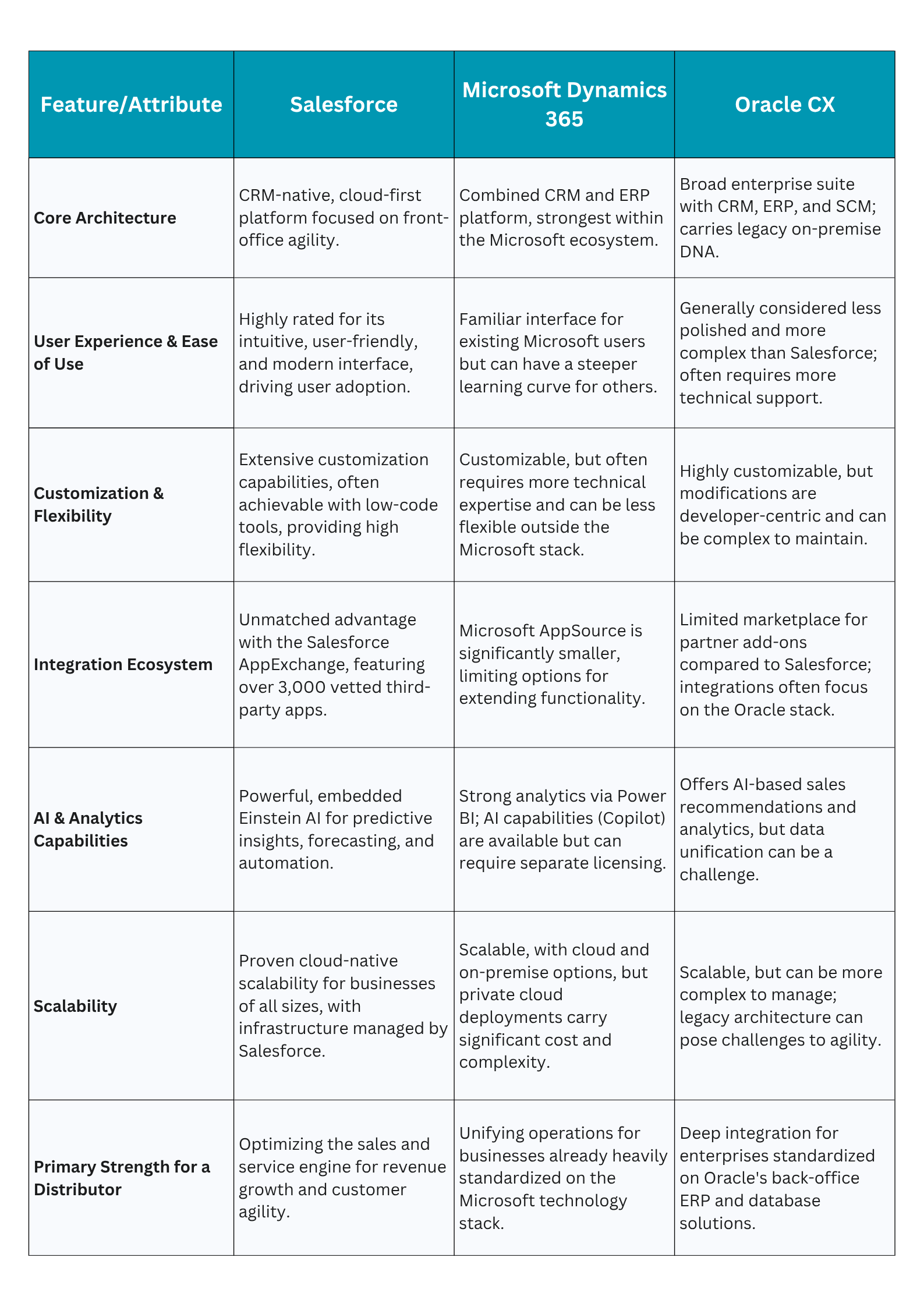
The choice between Salesforce and Microsoft Dynamics 365 is fundamentally a choice between two different business strategies. Salesforce is a CRM-native, best-of-breed platform, meaning its entire focus is on optimizing the customer-facing aspects of a business: sales, service, and marketing. In contrast, Microsoft Dynamics 365 combines CRM with Enterprise Resource Planning (ERP) capabilities, making it a broader suite that is often strongest for companies already deeply invested in the Microsoft technology stack (e.g., Azure, Office 365, Power BI).
This philosophical difference has significant practical implications.
- User Experience & Customization: Salesforce’s singular focus has resulted in a platform widely praised for its intuitive, user-friendly interface and ease of navigation. This is critical for driving user adoption among sales teams. Its customization capabilities are extensive and often achievable with “click-not-code” tools, empowering business users to tailor the platform without heavy IT intervention. While Dynamics is also customizable, the process can be more complex, and its interface, while familiar to Microsoft power users, can present a steeper learning curve for others. For many, the Salesforce environment feels more modern and approachable.
- Ecosystem & Integration: This is a key differentiator. The Salesforce AppExchange is the world’s largest enterprise app marketplace, offering over 3,000 pre-built, peer-reviewed, and security-vetted applications. For a distributor, this means a vast library of solutions to extend functionality for needs like logistics, document management, or advanced compliance. The Microsoft AppSource, while growing, is significantly smaller and less vibrant. This is a direct result of market share; with more customers on its platform, Salesforce attracts more third-party developers, creating a virtuous cycle of innovation that competitors struggle to match.
- Platform Focus: Because Salesforce is a pure-play CRM company, its resources and innovation are laser-focused on enhancing customer relationship management. Microsoft, by contrast, must divide its attention across a vast portfolio of products, which can sometimes lead to a lack of polish or attention to detail in specific areas of the Dynamics platform.
For an aviation parts distributor, whose primary growth engine is the effectiveness of its sales and service teams, Salesforce’s CRM-first approach is the more strategic choice. It prioritizes the front-office functions that generate revenue and build customer loyalty. Choosing an ERP-centric platform like Dynamics risks subordinating the needs of the sales team to the logic of back-office transactional systems, which can stifle the agility required to compete effectively in the fast-paced aviation aftermarket.
4.2 Salesforce vs. Oracle CX: Agility vs. Legacy Complexity
The comparison between Salesforce and Oracle CX reveals a similar dynamic: a modern, cloud-native leader versus a powerful but more complex legacy provider. Salesforce consistently leads Oracle in CRM market share and is more frequently recommended by users.
- Integration and Ease of Use: Reviewers consistently rate Salesforce as easier to integrate and deploy than Oracle. Salesforce’s cloud-native architecture and straightforward implementation process contrast with Oracle’s offerings, which can be more complex to set up and may carry the baggage of legacy on-premises systems. While Oracle offers deep customization, it often requires more specialized technical expertise to achieve.
- Total Cost of Ownership (TCO): Both are premium, enterprise-grade solutions. However, Oracle’s TCO can be inflated by significant hidden costs related to complex customizations, maintenance, and the need for supplemental applications to achieve clean, unified data. Salesforce’s pricing, while not inexpensive, is generally more transparent and predictable.
- Ecosystem and CRM Focus: Salesforce’s primary focus is CRM, and its ecosystem is built around that core. Oracle’s strengths are broader, extending into ERP, Supply Chain Management (SCM), and database technology. While this can be an advantage for companies already standardized on Oracle’s back-office stack, it means their CRM product is just one part of a much larger portfolio. Salesforce’s native CRM integration, combined with its vast AppExchange, provides a more efficient, scalable, and future-ready platform for businesses seeking unified commerce and customer operations.
For a distributor, Salesforce’s modern architecture, vibrant partner ecosystem, and relentless focus on user-centric design offer a more agile and forward-looking platform than Oracle’s powerful but often more fragmented and technically demanding suite of products.
Table 1: Salesforce vs. Key CRM Competitors for B2B Distribution
4.3 The AppExchange: Salesforce’s Unmatched Strategic Advantage
It is impossible to overstate the strategic importance of the Salesforce AppExchange. It is far more than an “app store”; it is a core component of Salesforce’s platform strategy and a powerful tool for future-proofing a technology investment. With thousands of pre-built solutions from certified partners, the AppExchange provides a vetted solution for nearly any business need a distributor might encounter in the future—from advanced logistics and shipping management to specialized compliance reporting or document generation.
This provides two critical benefits. First, it accelerates innovation. Instead of spending months on custom development for a new requirement, a distributor can often find and deploy a ready-made solution in a fraction of the time. Second, it mitigates risk. The apps are security-tested and peer-reviewed, ensuring they meet Salesforce’s standards. This vast, mature ecosystem is an advantage that no competitor can currently match at scale, providing Salesforce customers with unparalleled flexibility and a clear path for future growth.
Section 5: The Integration Ecosystem: Connecting to Aviation Marketplaces
For an aviation parts distributor, a CRM is only as valuable as its ability to connect to the core of the business: the industry marketplaces where sales opportunities originate. A key concern for any distributor evaluating a new platform is whether it can seamlessly integrate with essential hubs like ILS and Partsbase. The evidence shows that not only is this integration possible with Salesforce, but it is a well-understood and solved problem with multiple established pathways.
5.1 The Foundation: Salesforce’s API-First Architecture
The feasibility of this integration rests on Salesforce’s foundational design as an open, API-first platform. Salesforce was built from the ground up to communicate with other systems. It provides a comprehensive and well-documented suite of Application Programming Interfaces (APIs), including REST and SOAP APIs, that enable robust, secure, and flexible data exchange between Salesforce and any external application.
This architecture allows for bidirectional data flows, which are essential for maintaining consistency across systems. This means that data can be pulled from a marketplace into Salesforce, and data from Salesforce can be pushed back to the marketplace. This technical capability is the bedrock upon which the entire integration strategy is built, making connections to third-party systems a standard, rather than exceptional, practice within the Salesforce ecosystem.
5.2 Building the Bridge to ILS and Partsbase
The integration of Salesforce with aviation-specific marketplaces is not a theoretical exercise; it is a practical reality supported by both the marketplaces themselves and a mature ecosystem of third-party solution providers.
First, the marketplaces themselves provide the necessary tools. Inventory Locator Service (ILS), the industry’s largest marketplace, explicitly advertises its integration capabilities. The company offers the “ILS Bridge,” a real-time connectivity solution designed to simplify inventory and RFQ management by connecting a company’s internal ERP or CRM directly to the ILS platform.
Furthermore, ILS provides Web Services in standard XML/JSON formats, allowing for machine-to-machine interaction for tasks like part searches and inventory updates. Critically, ILS marketing material explicitly names Salesforce as a system with which it integrates, confirming that a direct connection is an intended and supported pathway.
Second, an ecosystem of third-party integration platforms has emerged to meet this specific industry need. Companies like Rotabull have built their entire business model around providing a seamless, two-way integration layer between ERP/CRM systems and aviation marketplaces, including ILS, PartsBase, and others. These platforms act as a consolidated hub, receiving RFQs from multiple marketplaces and syncing quotes and deals back to the central CRM.
The existence of both “supply-side” tools from the marketplaces and “demand-side” solutions from third-party integrators provides definitive proof that this is a common and well-understood requirement in the aviation aftermarket. This completely de-risks the technical feasibility of the project. The question for a distributor is not “Can Salesforce be connected to ILS and Partsbase?” but rather “Which integration path is best for our business, and who is the best partner to implement it?”
The resulting data flow creates the unified operational view discussed earlier. An RFQ from a marketplace can be configured to automatically create a new Lead or Opportunity record in Salesforce, assigned to the correct sales representative. Real-time inventory availability and pricing, managed within Salesforce (or a connected ERP), can be automatically synced and listed on the marketplaces, ensuring data accuracy and eliminating manual updates. This seamless connection transforms the CRM from an internal record-keeping system into the true command center for all sales activity, wherever it originates.
5.3 Best Practices for a Successful Integration
While the technology exists, a successful integration is a strategic project that requires careful planning and execution. Best practices include first defining clear objectives to ensure the integration aligns with specific business goals, such as reducing quote response time or improving inventory accuracy. Second, a strong focus on maintaining data quality is crucial; data must be cleaned and standardized before syncing to prevent errors. Finally, thorough testing in a controlled sandbox environment before going live is essential to identify and resolve any issues. Adhering to these principles, typically with the guidance of an experienced implementation partner, ensures that the integration delivers its full potential value.
Section 6: Implementation Pathways: Pre-Built Packages vs. Custom Configuration
Once the decision to adopt Salesforce is made, a critical question of strategy arises: should the company implement a pre-built, industry-specific package that runs on Salesforce, or should it configure the standard Salesforce platform to its unique needs? This is a strategic choice between out-of-the-box efficiency and ultimate flexibility, with significant implications for cost, agility, and long-term competitive advantage.
6.1 Understanding Pre-Built Accelerators: The Case of Avsight
The existence of powerful, pre-built solutions like Avsight is, in itself, a testament to the robustness of the underlying Salesforce platform. Avsight is a comprehensive aviation management application built natively on Salesforce, designed specifically for aftermarket suppliers and MRO facilities.
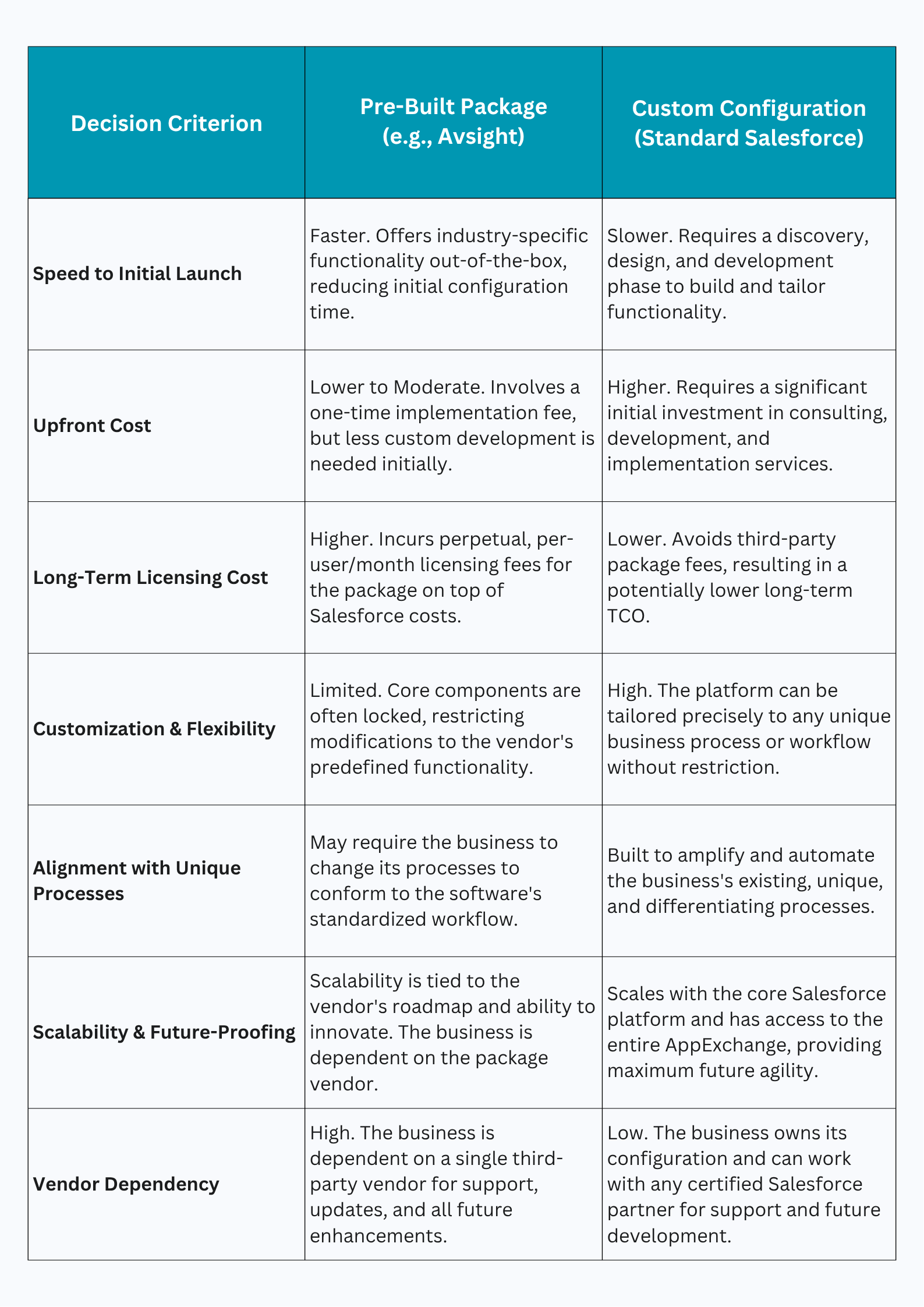
These solutions offer significant advantages, particularly in speed to deployment. They provide a wealth of out-of-the-box functionality tailored to the aviation industry, such as specialized modules for repair management, lot costing, quoting, operations, and finance. They come with pre-built integrations to marketplaces and government data sources, and features like “Part 360” analytics provide immediate, industry-specific insights. For a company looking for a turnkey solution that embodies industry-standard best practices, a pre-built package can be a compelling option.
6.2 The Hidden Costs and Constraints of Managed Packages
However, these pre-built solutions, often delivered as “managed packages” on the AppExchange, come with significant trade-offs that must be carefully considered.
- Licensing Costs and Total Cost of Ownership (TCO): These packages require an additional licensing fee on top of the standard Salesforce licenses. Avsight, for example, lists a user subscription fee of $119 per user, per month, in addition to a one-time implementation fee. While this includes an OEM Salesforce license, it represents a perpetual operating expense that can become substantial as the number of users grows. Over a three- to five-year period, the TCO of a managed package can exceed that of a custom-configured solution.
- Limited Customization and Process Rigidity: The most significant constraint of a managed package is the limited ability to customize its core components. The vendor controls the underlying code. This means that if a distributor has a unique, proprietary sales process or quoting model that provides a competitive edge, it may be forced to abandon that process and conform to the workflow dictated by the software. This can stifle innovation and force a business to standardize its most valuable, differentiating activities.
- Upgrade Complexity and Vendor Dependency: With a managed package, the business is tied to the vendor’s roadmap, support model, and update cycle. Upgrading to new versions can be a complex process that requires careful planning and testing. The distributor becomes dependent on the third-party vendor for all bug fixes, security patches, and new features, ceding a degree of control over its core operational platform.
6.3 The Power of a Custom-Configured Platform
For many distributors, the alternative of configuring standard Salesforce products (such as Sales Cloud, Service Cloud, and B2B Commerce Cloud) offers a superior long-term strategy. This approach is not about building from scratch but about tailoring a powerful, flexible platform to the precise needs of the business.
The primary advantage is ultimate flexibility. A custom configuration is designed around the distributor’s existing, proven workflows. There is no need to compromise on the unique processes that differentiate the business in the marketplace. The platform is molded to the business, not the other way around.
This approach can also lead to a lower long-term TCO. While there is a greater upfront investment in implementation and consulting services, the business avoids the perpetual, per-user licensing fees of a third-party managed package. Over the life of the system, this can result in significant cost savings.
Most importantly, a custom configuration provides direct control and future agility. The business owns its configuration. It can adapt, evolve, and enhance its system as its strategic needs change, leveraging the full, unencumbered power of the core Salesforce platform and the entire AppExchange ecosystem. There is no dependency on a single third-party vendor’s roadmap or pricing structure.
The decision between these two pathways is a strategic fork in the road. It requires an honest assessment of the business’s competitive advantage. If a distributor’s edge comes from executing industry-standard processes with maximum efficiency, a pre-built package is a viable path. However, if its advantage lies in a unique sales methodology, a proprietary quoting algorithm, or a differentiated service model, then embedding that “secret sauce” into a custom-configured platform will amplify that advantage, whereas forcing it into a standardized package could dilute it.
Table 2: Implementation Strategy Comparison
Section 7: The Partner is the Path: Realizing Value with CloudStreet
The successful implementation of a transformative platform like Salesforce depends not only on the technology itself but equally on the expertise of the partner chosen to guide the process. A capable partner de-risks the investment, ensures the solution is aligned with strategic goals, and accelerates the time to value. CloudStreet emerges as a uniquely qualified partner for an aviation parts distributor, possessing a rare combination of deep Salesforce expertise and direct, proven experience in the aviation and B2B distribution sectors.
7.1 Introducing CloudStreet: A Specialist Salesforce Partner
CloudStreet is a registered Salesforce consulting partner that offers a comprehensive suite of services, including implementation, integration, staff augmentation, and ongoing managed support. The firm is structured to deliver high-quality outcomes with a focus on value. They employ a cost-effective hybrid resourcing model that combines US-based project managers with a seasoned, in-house development team based in India, ensuring strong project oversight and efficient execution. This model, coupled with a commitment to 24/7 support, demonstrates a client-centric approach designed to address issues with urgency and provide continuous strategic guidance.
7.2 Demonstrated Aviation Expertise: The “PacificAV” Case Study
The most compelling evidence of CloudStreet’s capability is not a claim but a documented success story. The “Pacific Aviation” case study provides irrefutable proof of their ability to navigate the specific challenges of the aviation parts distribution industry.
The client, a global aviation parts distributor based in the Pacific Northwest, faced a familiar set of challenges. They were struggling to manage disparate e-commerce and CRM systems, needed to synchronize their new storefront with their existing Avsight aviation software, and required complex B2B functionalities like bulk ordering, back-ordering, and quoting capabilities directly within the order process. They also needed to display Avsight’s specific condition-code pricing on their e-commerce site.
CloudStreet’s solution was both innovative and precisely targeted. They executed the first-ever integration between Salesforce B2B Commerce Cloud and Avsight aviation software. This was not a simple connection; it involved creating a custom Salesforce B2B Commerce storefront that was fully and seamlessly integrated with the client’s core aviation management system. The solution included custom-developed features for bulk orders, back-orders, and custom product displays that accommodated the various condition codes essential to the parts business.
The results were transformative and quantifiable. The client achieved a 25% increase in ROI by consolidating all their data onto the Salesforce platform. This eliminated the need for manual data syncing, which in turn reduced errors and freed up valuable resources. The real-time communication between their management software and the new storefront streamlined processes, while dynamic dashboards provided leadership with the crucial insights needed to make better business decisions.
This case study is the lynchpin of this report’s recommendation. It moves the proposal of using Salesforce from a sound, logical argument to a proven, de-risked, and actionable strategy. It demonstrates that a partner exists who has already solved the exact technical and business challenges an aviation parts distributor faces, delivering measurable financial returns.
7.3 Broad B2B and Manufacturing Experience
CloudStreet’s expertise is not confined to a single project. Their portfolio demonstrates a deep and versatile understanding of complex B2B and industrial environments, reinforcing their ability to handle multifaceted integrations and business processes.
In another key case study, CloudStreet worked with an Agricultural Blending Company, a B2B firm facing challenges with manual order processing, data silos between departments, and inefficient inventory management for perishable goods. CloudStreet engineered a solution that integrated Salesforce Commerce Cloud with the client’s NetSuite ERP. This project automated order processing, synchronized data in real-time, and provided a unified view of inventory across multiple locations. The result was a dramatic increase in operational efficiency, a reduction in errors, and improved customer satisfaction. This case study showcases their ability to master complex ERP integrations, a common requirement for distributors.
Furthermore, CloudStreet explicitly lists Manufacturing & Wholesale Distribution and Industrial Equipment & Services as core industries they serve. Their website highlights integration experience with “Manufacturing ERP” and “Industrial Sales,” indicating a broad base of knowledge in sectors with similar operational challenges to aviation parts distribution.
7.4 A Partnership for Transformation
The evidence makes it clear that selecting CloudStreet is not merely a vendor choice; it is the formation of a strategic partnership. The implementation of a new CRM is a significant undertaking that will reshape core business processes. Success requires a guide who understands both the technology and the specific nuances of the industry. CloudStreet’s proven expertise in both Salesforce and the aviation/B2B distribution landscape makes them the ideal partner to navigate the complexities of the project, mitigate risks, and ensure the technology investment delivers maximum, sustainable business value.
Conclusion and Strategic Recommendation
The aviation parts distribution market is at a digital inflection point. The operational complexity, global nature, and competitive intensity of the industry demand a move away from fragmented, legacy systems toward a unified, agile, and intelligent platform. The analysis presented in this report demonstrates that a modern CRM is the essential central nervous system required to thrive in this environment.
The evidence overwhelmingly positions Salesforce as the superior platform choice for this transformation. Its B2B-native commerce capabilities are precisely aligned with the transactional needs of a distributor. Its embedded AI and analytics tools provide the means to turn operational data into a predictive, strategic asset. Its unparalleled integration ecosystem, headlined by the AppExchange, and its open API architecture ensure it can connect seamlessly to the critical marketplaces that fuel the industry, while also providing a clear path for future growth and innovation. When compared against its primary competitors, Salesforce’s CRM-first philosophy, focus on user experience, and modern cloud architecture represent a more strategic fit for a sales-driven organization than the ERP-centric or legacy-bound approaches of its rivals.
Furthermore, this report concludes that for a distributor with unique, differentiating processes, a custom-configured standard Salesforce instance offers the greatest long-term value, flexibility, and strategic agility. This path avoids the perpetual licensing costs and potential rigidity of pre-built, third-party packages, allowing the business to embed its own competitive advantages directly into its core technology.
Technology and strategy, however, are only realized through execution. The final and most critical component of a successful transformation is the implementation partner. Therefore, the ultimate strategic recommendation of this report is as follows:
The optimal path for an aviation parts distributor to achieve a sustainable competitive advantage is to partner with CloudStreet to implement a custom-configured Salesforce solution.
This recommendation is rooted in the convergence of all preceding analysis. It combines the market-leading platform (Salesforce) with a partner (CloudStreet) that possesses proven, niche-specific expertise, as demonstrated by their success in delivering a 25% ROI for a global aviation parts distributor through the first-ever integration of Salesforce B2B Commerce and Avsight software. This combination of a superior platform and a uniquely qualified partner provides the highest probability of a successful implementation and the greatest possible return on investment, paving the way for market leadership in the years to come. Contact CloudStreet today for more information.
Category
Discover insights that drive results - explore out latest blog posts now
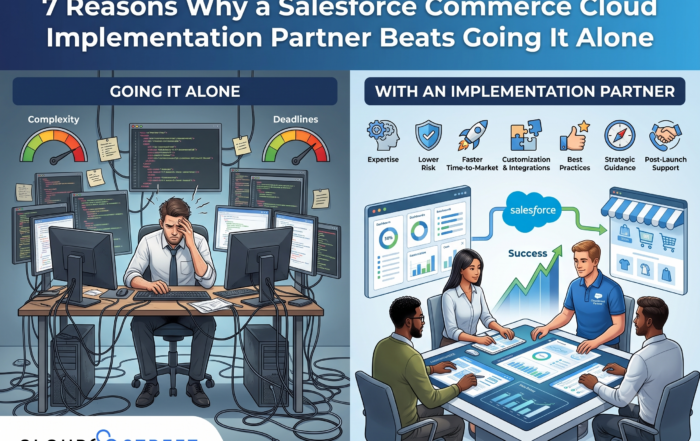
7 Reasons Why a Salesforce Commerce Cloud Implementation Partner Beats Going It Alone
At CloudStreet, we see it all the time. A mid-sized [...]
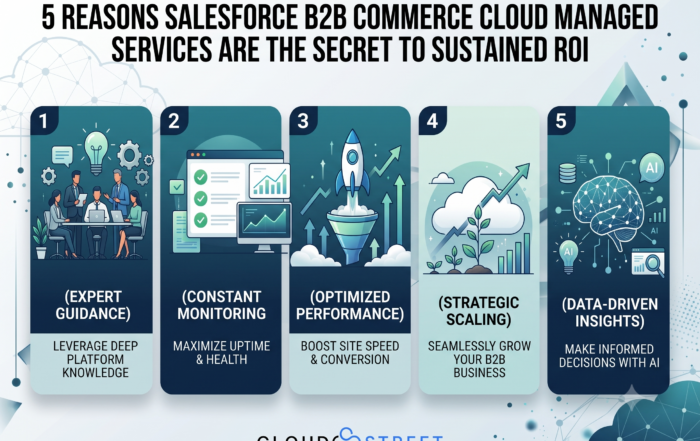
5 Reasons Salesforce B2B Commerce Cloud Managed Services Are the Secret to Sustained ROI
Launching a Salesforce B2B Commerce storefront is a massive milestone. [...]
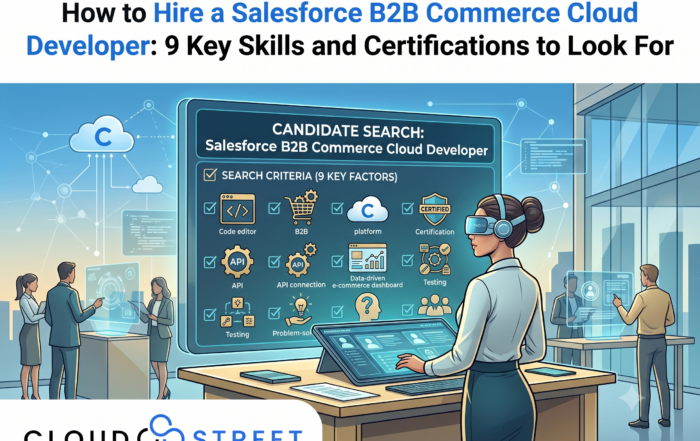
How to Hire a Salesforce B2B Commerce Cloud Developer: 9 Key Skills and Certifications to Look For
At CLOUDSTREET, we talk to business owners every week who [...]