Agentic or Traditional? The 3-Step ROI-Focused Guide to Choosing Your Salesforce Automation
Category: Blog
The Salesforce ecosystem is currently witnessing a tectonic shift. We are moving from the era of “deterministic” automation: where every step is hard-coded into a Flow: to the era of “agentic” automation, where AI agents reason through problems to reach a goal.
But here is the million-dollar question for every Salesforce stakeholder: Does every process need an AI agent?
The short answer is no. At CLOUDSTREET, we believe in moving from “better to best” by optimizing what works and only introducing complexity where it drives massive ROI. Headquartered in Houston, Texas, we help local and global businesses navigate these high-stakes technical decisions. Whether you are a mid-sized distributor in the Energy Corridor or a global enterprise managing complex D2C storefronts, choosing the right automation path is the difference between a high-performing org and a technical debt nightmare.
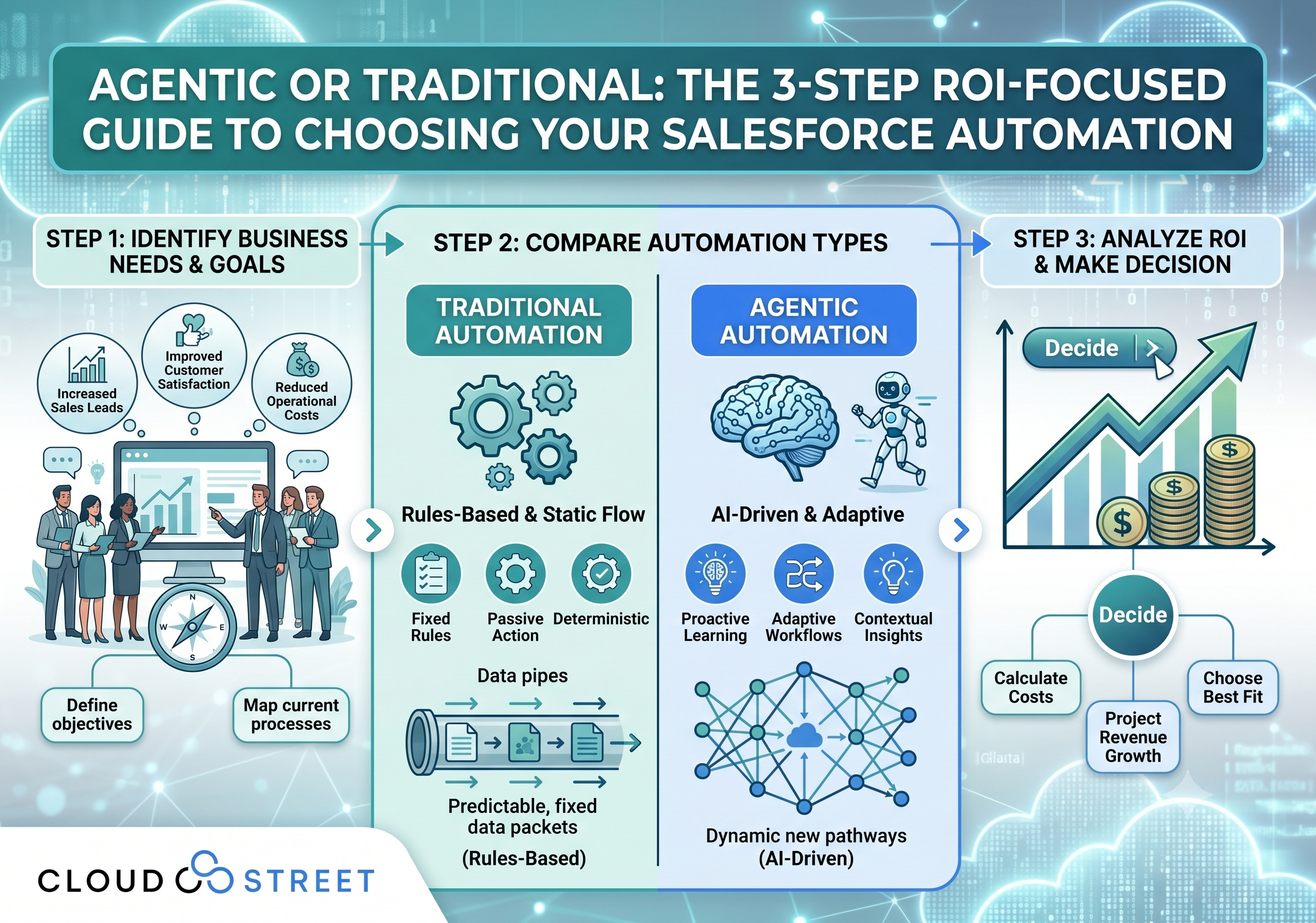
In this guide, we break down the 3 critical steps to determining if your next Salesforce project should be agentic or traditional.
1. Analyzing the Execution Path: Scripted vs. Dynamic
The first axis of decision-making is the Execution Path. This is essentially the “How.”
In traditional automation, such as Salesforce Flow or Apex, the execution path is deterministic. You, as the architect, specify every single branch. If “Status” is “New,” send “Email A.” If “Status” is “Escalated,” create “Task B.” The logic is a rigid script. This is perfect for stable, repeatable processes where the path is predictable.
Choose Traditional (Flow/Apex) when:
- The sequence of steps is stable and repeatable.
- You can fully specify every branch upfront on a whiteboard.
- Logic is driven by simple rules and field-level conditions.
However, in the world of Agentforce, the execution path is probabilistic. You don’t tell the agent how to do it; you tell it what the goal is. The agent then plans, acts, observes the result, and refines its plan in a reasoning loop. This is necessary when the next step depends on information the system hasn’t “learned” yet: like a customer’s nuanced reply in a chat or a specific detail found deep within a PDF.
Choose Agentic (AI Agents) when:
- The path is open-ended or exploratory.
- The sequence of steps varies significantly based on real-time context.
- The system needs to choose between multiple tools or APIs based on what looks “most promising” at runtime.
Explore our Salesforce Implementation Services to see how we build these paths for growth.
2. Evaluating Goal Complexity: Narrow Tasks vs. High-Level Outcomes
The second axis is Goal Complexity. This defines the “What.”
Traditional automation excels at narrow, bounded tasks. These are outcomes that can be measured with absolute certainty. “If a Lead is converted, create a Renewal Opportunity.” This is a precise transaction with a short decision chain. There is no need for reasoning; there is only the execution of a rule.
The 3 Indicators for Narrow Goals:
- The outcome is a single, clear transaction.
- Success criteria are strictly binary (true/false).
- The process requires no trade-off analysis or “judgment.”
Agentic workflows, conversely, are built for high-level, ambiguous outcomes. Imagine a goal like: “Resolve this customer’s billing dispute with minimal back-and-forth.” This is not a single task; it’s a business outcome. An agent must decompose this into sub-tasks: search knowledge, check billing history, verify contract terms, and perhaps offer a credit within a certain threshold.
Choose Agentic for Goals that involve:
- Decomposition into multiple, varying sub-tasks.
- Balancing soft constraints (e.g., customer satisfaction vs. cost).
- Reasoning through complex histories to identify the best “next move.”

3. Determining Data Modality: Structured Fields vs. Unstructured Context
The final axis is Data Modality. This is the “What’s driving the logic.”
For decades, Salesforce has thrived on structured data. Rows, columns, picklists, and checkboxes. If your automation logic lives purely in these fields, traditional Flow is your best friend. It is fast, cost-effective, and highly reliable. There is no reason to introduce the cost of an LLM call to check if a checkbox is “True.”
Stick with Traditional Automation if:
- The data is primarily CRM records and well-defined fields.
- Conditions operate on exact values (enums/picklists).
- There is zero semantic ambiguity in the input.
But as businesses scale, the most valuable data often hides in unstructured modality. Emails, chat transcripts, voice-to-text logs, and legal contracts. Traditional Flow cannot “understand” the tone of an angry email or the specific clause in a 50-page MSA. Agentic workflows use the reasoning power of Large Language Models (LLMs) to interpret these semantics.
Shift to Agentic Workflows if:
- The logic is driven by natural language (emails, chats, notes).
- You need to interpret documents like PDFs, proposals, or MSAs.
- The system must infer intent rather than just reading a field.
Check out our Case Studies to see how we’ve implemented high-ROI automation for global leaders.
The Secret Sauce: Agents Don’t Replace Flows, They Use Them
A common misconception is that AI agents will kill Salesforce Flow. At CLOUDSTREET, we see the opposite. In a high-ROI environment, Agents use Flows as tools.
Think of a Flow as a specialized power tool: like a drill. It does one thing perfectly and reliably. An Agent is the craftsman. The craftsman doesn’t “replace” the drill; they know when and how to use it to build the house.
When we build Agentforce implementations for our clients, we often wrap existing, high-performing Flows into “Actions” that the Agent can invoke. This ensures that the agent handles the messy reasoning and the dynamic planning, but the actual “commitment” to the database remains deterministic, safe, and governed.

The ROI Factor: When to Invest?
Optimization is about more than just “cool technology.” It’s about the bottom line. From our offices in Houston, we advise our clients to look at the Cost of Reasoning vs. Cost of Execution.
- Traditional Automation has a high upfront design cost (you have to map every path) but a very low “per-run” cost.
- Agentic Automation has a lower design cost for complex scenarios (the agent figures out the path) but a higher “per-run” cost due to LLM usage and tokens.
If you have a process that runs 10,000 times a day and the path is 95% predictable, stick with Flow. If you have a process that is highly complex, involves “thinking,” and currently requires expensive human intervention, the ROI for an Agent is astronomical.
Summary: The 3-Step Decision Matrix
| Dimension | Favor Traditional (Flow/Apex) | Favor Agentic (Agentforce) |
|---|---|---|
| Execution Path | Predictable, stable, “scripted” | Dynamic, exploratory, “reasoned” |
| Goal Complexity | Narrow, precise tasks | High-level business outcomes |
| Data Modality | Structured fields and records | Unstructured text and context |
If you are ready to take your Salesforce org from “better to best,” don’t guess: measure. The official Salesforce Architect Decision Guide provides the technical deep-dive, but implementing it for maximum ROI requires a partner who understands the business impact.
Whether you are local to Texas or operating globally, CLOUDSTREET is here to help you bridge the gap between traditional reliability and agentic innovation.
Contact our Houston-based team today to audit your automation strategy.
Category
Discover insights that drive results - explore out latest blog posts now
DealHub Salesforce Integration for Manufacturers: Connecting CPQ, Contracts, and CRM
About the manufacturer: mid-market industrial equipment company A U.S.-based, mid-market [...]
Salesforce Data 360 and Agentforce: Why Grounding Is What Makes AI Agents Dependable
An AI agent can produce a fluent answer and still [...]
Salesforce Data 360 Governance and Informatica: Managing Data Quality, Access, and Trust in the Agentic Era
Data governance becomes more consequential when business data does more [...]