Case Study: Connecting Salesforce Commerce Cloud and Syteline for Global Manufacturing Success
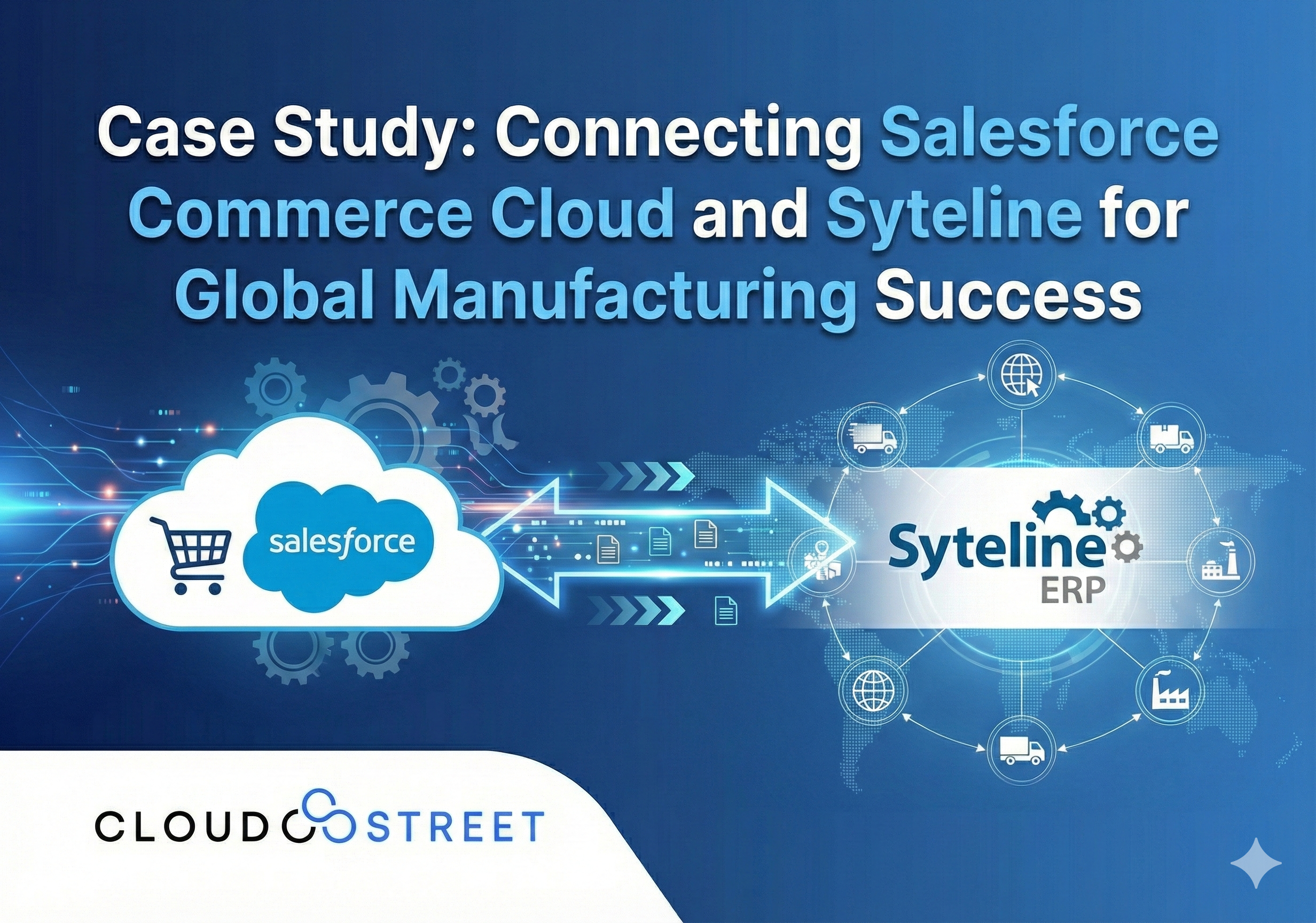
Sometimes the best success stories are the ones we can’t put a name to. Due to a non-disclosure agreement, we’re keeping our client’s identity under wraps, but we can tell you they’re a midsize manufacturer with a strong national presence and several global outposts. And their integration story? That’s absolutely worth sharing.
Here at CLOUDSTREET, we’re based in Houston, Texas, but we work with manufacturers and businesses across the country and around the world. This particular project involved connecting two powerhouse systems, Salesforce Commerce Cloud and Syteline (Infor CloudSuite Industrial), using CloudJunction as our integration middleware. The result? A transformation that went from daily operational headaches to streamlined efficiency.
The Challenge: 4 Critical Problems Holding Growth Back
Our client came to us with what seemed like separate issues, but they all pointed to one core problem: their sales and manufacturing systems weren’t talking to each other.

1. Manual Data Entry Errors Were Costing Real Money
Their team was manually transferring order information from Salesforce Commerce Cloud into Syteline. Every single order. We’re talking about copying customer details, product specifications, quantities, pricing, all by hand. And as you’d expect, human error crept in. Wrong quantities shipped. Pricing discrepancies. Address mistakes that delayed deliveries. Each mistake wasn’t just embarrassing, it was eating into their margins and damaging customer relationships.
2. Inventory Blind Spots Created Customer Service Nightmares
When a customer called asking about product availability, the sales team had to put them on hold, log into a separate system, check inventory levels, then switch back to continue the conversation. Sometimes the information was already outdated by the time they relayed it. This created awkward situations where they’d promise delivery dates they couldn’t meet, or worse, lose sales because they couldn’t confidently commit to stock availability.
3. Sales and Operations Were Living in Different Worlds
The sales team operated in Salesforce, closing deals and managing customer relationships. The operations team lived in Syteline, managing production schedules and inventory. The two departments might as well have been on different planets. Production planning happened in a vacuum, without real visibility into what sales was actually promising customers. This disconnect led to rushed production runs, overtime costs, and missed delivery commitments.
4. Order Fulfillment Moved at a Snail’s Pace
From the moment a customer clicked “purchase” to when their order actually hit the production floor, days would pass. Orders sat in queues waiting for manual review and data entry. In a competitive manufacturing landscape where speed matters, this lag was a serious competitive disadvantage.
If you’re facing similar integration challenges, check out our process to see how we approach complex system connections.
The Solution: CloudJunction Becomes the Bridge
We needed middleware that could handle the complexity of connecting a sophisticated e-commerce platform with an industrial ERP system. CloudJunction fit the bill perfectly.

Think of CloudJunction as the translator at a United Nations meeting, it takes what Salesforce Commerce Cloud says and translates it into language that Syteline understands, and vice versa. But it does more than just translate; it validates, transforms, and routes data intelligently between the two systems.
We’ve written extensively about integrating Salesforce with Syteline, and this project brought all those benefits to life.
What CloudJunction Handled
The integration covered several critical data flows:
- Order synchronization: Every order placed through Salesforce Commerce Cloud automatically appeared in Syteline with all the relevant details
- Inventory updates: Real-time stock levels from Syteline fed directly into Salesforce, visible to both sales teams and customers
- Customer data unification: Customer records, order history, and preferences synced bidirectionally
- Pricing and product catalog sync: Any changes to pricing or product specifications updated across both systems
Implementation: Getting It Right
Here’s the thing about integrations, they’re only as good as the planning behind them. As experts in Houston Salesforce consulting, we’ve learned that rushing into technical implementation without proper groundwork is a recipe for disaster.
We started with discovery sessions, mapping out every touchpoint between systems. Where does an order start? What information travels with it? Who needs to see what data, and when? We documented workflows, identified edge cases, and built comprehensive data mapping tables.
The actual CloudJunction configuration took shape over several weeks. We built connectors, established data transformation rules, and created error handling protocols. What happens if Salesforce goes down? What if Syteline times out during a peak order period? These aren’t hypothetical questions, they’re real scenarios that needed real solutions.
Testing wasn’t a single phase, it was continuous. We started with a sandbox environment, threw every edge case we could think of at the integration, then gradually expanded testing to include real data in controlled batches.
Want to move faster on your next project? Our PayNow Quickstart can help accelerate your Salesforce implementations.
The Results: 5 Major Gains That Changed Everything

Within six months of going live, our client saw transformative changes across their operations.
1. Real-Time Inventory Synchronization
Sales teams could now see actual inventory levels without leaving Salesforce. When a customer asked, “Do you have this in stock?” the answer was immediate and accurate. The e-commerce site displayed real-time availability, reducing customer service inquiries by a significant margin. No more promising products that weren’t available. No more lost sales due to uncertainty.
2. Automated Order Processing
Orders that once took 2-3 days to manually enter now appeared in Syteline within minutes of being placed. The production team could start work immediately. This automation eliminated an entire bottleneck in their fulfillment pipeline. What used to require a dedicated data entry position now happened automatically, freeing that team member to focus on customer-facing activities.
3. Unified Customer View for Support
Customer service transformed overnight. When someone called with a question, the support team saw everything in one place, order history from Syteline, communication history from Salesforce, current production status, shipping information. They went from juggling multiple systems to having a complete 360-degree customer view. Resolution times dropped. Customer satisfaction scores climbed.
4. Operational Efficiency That Boosted ROI
The elimination of manual data entry meant fewer errors, which meant fewer returns, fewer expedited shipments to fix mistakes, and fewer customer appeasement costs. The speed improvement meant they could fulfill more orders with the same resources. Production planning became more accurate because operations could see actual sales data, not week-old reports.
5. Competitive Advantage Through Speed
In manufacturing, speed sells. The ability to confirm orders faster, promise accurate delivery dates, and actually deliver on those promises became a differentiator. Their sales team started winning business specifically because they could commit to timelines that competitors couldn’t match.
Key Takeaways for Manufacturers Considering Integration
If you’re sitting on disconnected systems, here’s what this case study should tell you:
Integration complexity is real, but manageable. Yes, connecting commerce platforms with industrial ERP systems is complex: research suggests these integrations rate about 16 out of 20 on complexity scales. But with the right middleware and the right partner, it’s absolutely doable.
The ROI timeline is measured in months, not years. This client saw measurable improvements within six months. Some benefits: like eliminating manual data entry errors: showed up immediately.
Your systems should work for you, not the other way around. Your team shouldn’t be the middleware: copying data between systems is not a value-added activity. Let technology handle the data movement while your people focus on customers and strategy.
Starting is harder than continuing. The initial integration project requires investment: time, money, expertise. But once it’s running, the ongoing value just keeps accumulating. Every order processed automatically, every inventory sync, every customer interaction improved: it all adds up.
Moving Forward with Your Integration
Whether you’re dealing with Salesforce Commerce Cloud, Syteline, or any combination of business systems that need to talk to each other, the fundamental approach remains the same: understand your workflows, choose the right middleware, plan meticulously, and implement thoughtfully.
From our Houston headquarters, we’ve helped manufacturers across the country and around the globe solve these exact challenges. We understand the unique pressures of manufacturing: the need for accuracy, the importance of speed, the complexity of managing both customer-facing commerce and back-end production.
Ready to explore what integration could do for your manufacturing operation? Let’s talk about your specific challenges and how CloudJunction or other integration tools might fit your needs. Because while we can’t put our client’s name on this success story, we’d love to help you create your own.
The future of manufacturing isn’t about working harder: it’s about working smarter. And that starts with systems that actually talk to each other.
Category
Discover insights that drive results - explore out latest blog posts now
Case Study: How Highland Cabinetry Colorado Built a Modern Wholesale Powerhouse on Salesforce B2B Commerce Cloud
In the world of high-end cabinetry, timing is everything. When [...]
Agentforce ROI: 7 Ways to Maximize Your Salesforce AI Investment
You've heard the buzz. Salesforce Agentforce is supposed to revolutionize [...]
Salesforce B2B Commerce Cloud Partner & Consultant Guide
You're about to drop serious money on a Salesforce B2B [...]