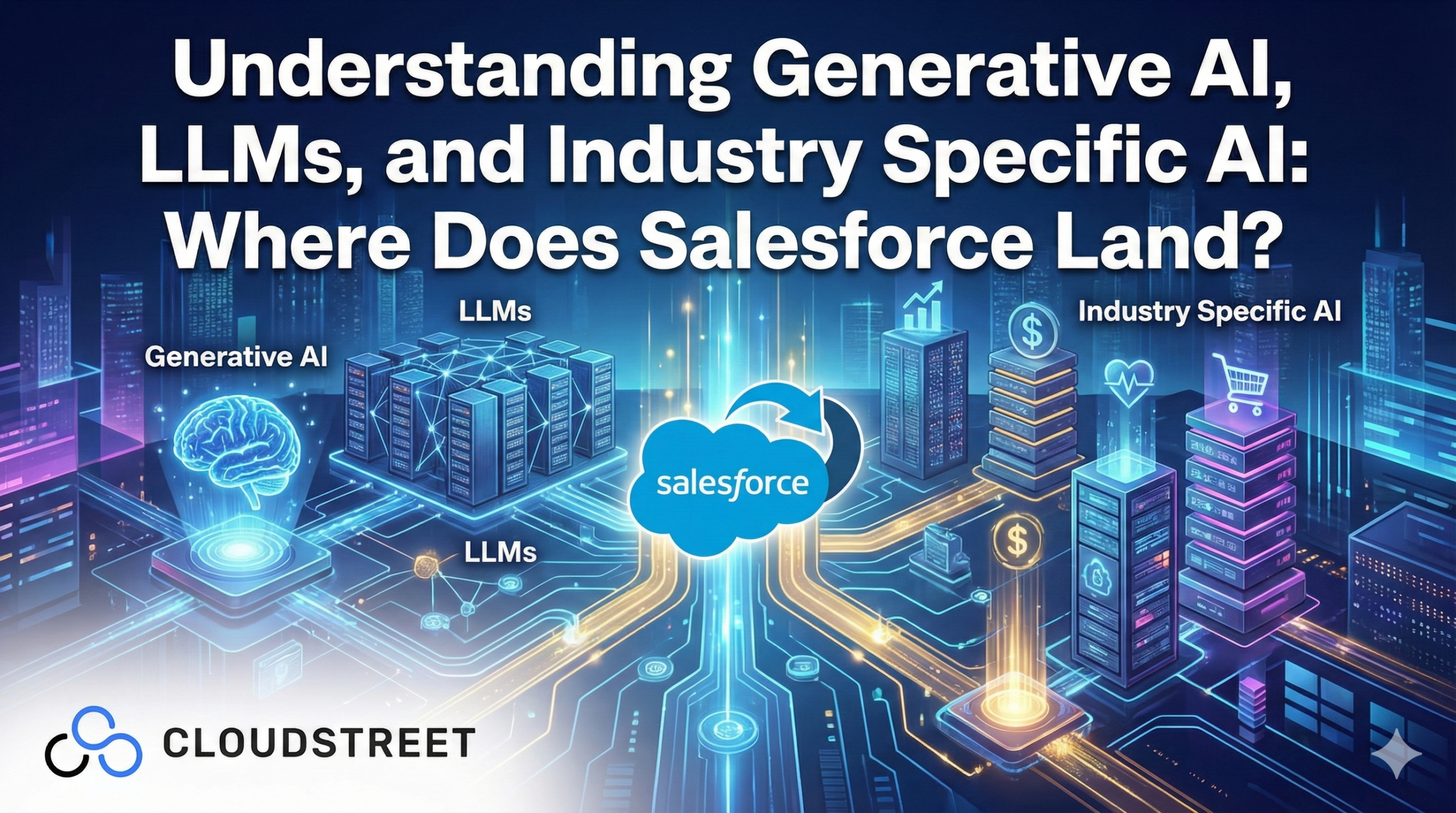
Understanding Generative AI, LLMs, and Industry-Specific AI: Where Does Salesforce Land?
The AI landscape can feel overwhelming for business leaders trying to make sense of all the buzzwords. You’ve probably heard about ChatGPT, Gemini, and various AI tools promising to revolutionize your operations. But what’s the real difference between these general-purpose tools and the specialized AI solutions built for specific industries? And where does Salesforce fit into this picture?
Let’s break it down in simple terms so you can make informed decisions about AI for your business.
What Are Large Language Models (LLMs)?
Think of a Large Language Model as a highly sophisticated autocomplete system. An LLM is essentially a computer program trained on massive amounts of text from the internet: books, articles, websites, and more. During training, the model learns patterns in language and becomes incredibly good at predicting what word should come next in any given sentence.
The “large” part refers to the sheer scale of these systems. Modern LLMs contain billions or even trillions of parameters: think of these as tiny adjustable settings that help the model understand language nuances. The more parameters, the more sophisticated the model’s understanding becomes.

When you type a question into ChatGPT, it’s not searching the internet for answers. Instead, it’s using all those learned patterns to generate a response that statistically makes sense based on its training. This is why LLMs can write emails, explain complex topics, generate code, and even create poetry: they’ve learned the patterns of human communication.
General-Purpose LLMs: The Swiss Army Knives of AI
1. ChatGPT (OpenAI)
ChatGPT is probably the most famous LLM, designed to be a conversational AI assistant. It can handle a wide variety of tasks:
- Writing and editing content
- Answering questions on virtually any topic
- Coding assistance
- Creative writing
- Problem-solving
2. Google Gemini
Google’s answer to ChatGPT, Gemini offers similar capabilities with some unique features:
- Integration with Google’s ecosystem
- Multimodal capabilities (text, images, code)
- Real-time information access
- Advanced reasoning capabilities
3. Claude (Anthropic)
Known for its helpful and harmless approach:
- Strong analytical capabilities
- Excellent for complex reasoning tasks
- Safety-focused design
- Long-form content generation
These general-purpose LLMs are incredibly versatile but have some limitations for business use. They’re not trained on your specific industry data, don’t understand your business processes, and can’t integrate directly with your existing systems without significant custom development.
Industry-Specific AI: Purpose-Built Solutions
While general LLMs are impressive, many companies are finding more value in AI tools designed specifically for their industry or function. These specialized solutions offer several advantages:
1. Financial Services AI
- Fraud detection algorithms trained on financial transaction patterns
- Risk assessment models using industry-specific data
- Compliance monitoring tools that understand regulatory requirements
- Credit scoring systems with domain expertise
2. Healthcare AI
- Medical imaging analysis trained on millions of X-rays, MRIs, and CT scans
- Drug discovery platforms using pharmaceutical research data
- Clinical decision support systems with medical knowledge
- Patient monitoring tools with healthcare-specific algorithms
3. Marketing and Sales AI
- Customer segmentation tools trained on marketing data
- Personalization engines understanding buyer behavior
- Lead scoring models with sales expertise
- Content optimization platforms for specific industries
4. Manufacturing AI
- Predictive maintenance systems trained on equipment data
- Quality control algorithms for production lines
- Supply chain optimization tools
- Safety monitoring systems with manufacturing expertise
The key difference? These specialized AI tools are trained on domain-specific data and designed to solve particular problems within an industry context.
Where Salesforce Lands in the AI Spectrum
Salesforce takes a hybrid approach that bridges the gap between general-purpose LLMs and industry-specific AI solutions. Here’s how their AI strategy breaks down:

Salesforce Einstein: The Foundation
Salesforce Einstein isn’t a single AI model: it’s a platform that includes multiple AI capabilities:
- Einstein Analytics: Predictive analytics for sales forecasting
- Einstein Discovery: Automated insights from business data
- Einstein Vision: Image recognition for various use cases
- Einstein Language: Natural language processing for customer interactions
Integration with General LLMs
Salesforce has partnered with major LLM providers to bring general AI capabilities into their platform:
- Integration with OpenAI’s models
- Partnership with Google for Gemini integration
- Support for various LLM providers through Einstein Trust Layer
Industry-Specific AI Applications
Salesforce packages AI capabilities for specific industries:
- Financial Services Cloud: AI for banking, insurance, and wealth management
- Health Cloud: Healthcare-specific AI and analytics
- Manufacturing Cloud: AI for production and supply chain
- Retail Cloud: Personalization and inventory optimization
The Einstein Trust Layer
This is where Salesforce differentiates itself. The Einstein Trust Layer acts as a secure gateway that:
- Protects your data when using external LLMs
- Ensures AI responses are grounded in your business context
- Maintains compliance with industry regulations
- Provides audit trails for AI interactions
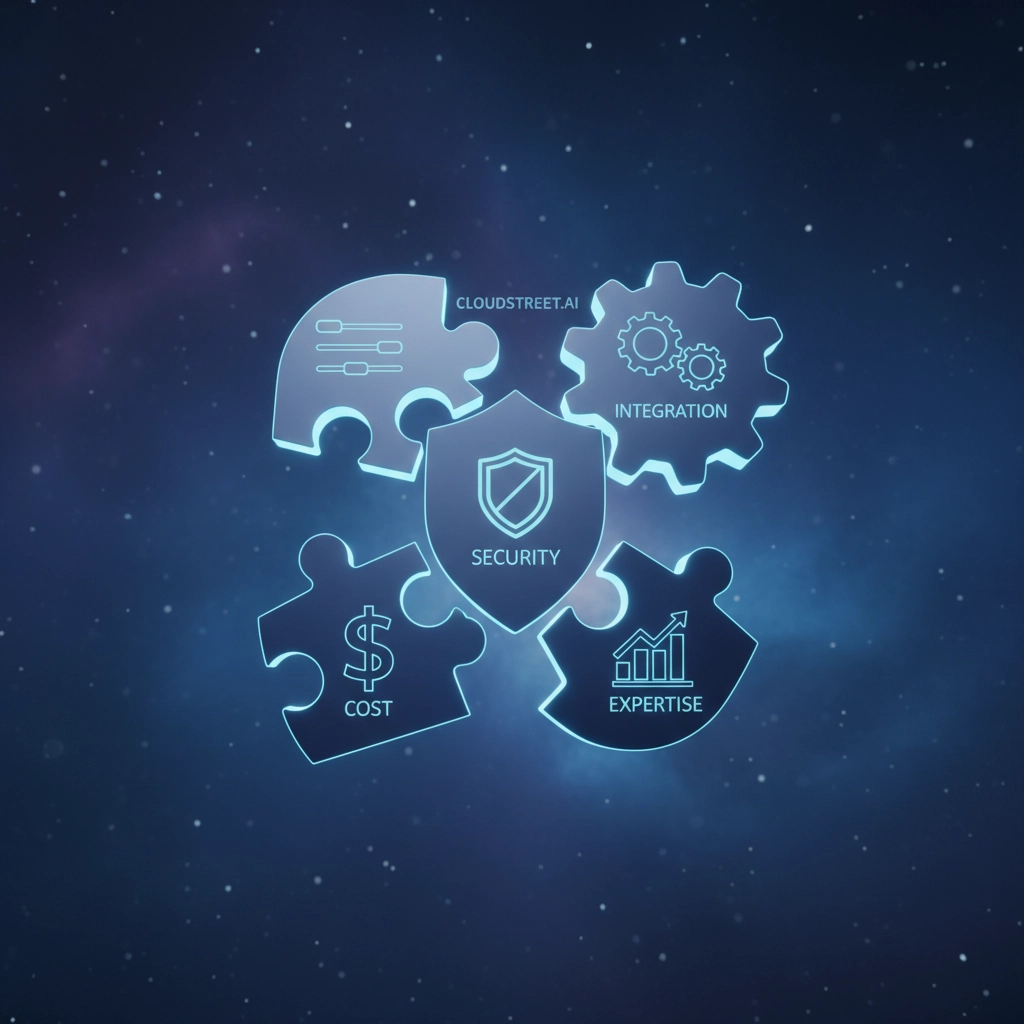
5 Key Considerations for Choosing the Right AI Approach
1. Data Sensitivity and Compliance
If you’re in healthcare, finance, or other regulated industries, general-purpose LLMs might not meet your compliance requirements. Salesforce’s approach with the Einstein Trust Layer offers a middle ground: you get LLM capabilities while maintaining data security and compliance.
2. Integration Requirements
General LLMs require significant custom development to integrate with your existing systems. Salesforce AI capabilities are built into the platform you’re already using, reducing implementation time and complexity.
3. Industry Expertise
While ChatGPT knows a little about everything, it doesn’t understand the specific nuances of your industry like a purpose-built solution. Salesforce combines general AI capabilities with industry-specific knowledge.
4. Customization and Control
General LLMs offer limited customization options. Salesforce allows you to train models on your specific data while leveraging pre-built industry solutions.
5. Total Cost of Ownership
Consider not just the subscription cost, but also implementation, training, and maintenance. Salesforce’s integrated approach often provides better ROI for businesses already using their platform.

Making AI Work for Your Business
The choice between general LLMs and industry-specific AI isn’t always either/or. Many successful companies use a combination:
- General LLMs for content creation and internal productivity
- Industry-specific AI for core business processes
- Integrated platforms like Salesforce for customer-facing operations
At CLOUDSTREET, we work with businesses across Houston, Texas, and globally to navigate these AI decisions. We’ve seen companies waste significant resources trying to force general-purpose AI into specialized business processes, and we’ve also seen others miss opportunities by avoiding AI altogether.
The Future of Business AI
The AI landscape is evolving rapidly. We’re seeing:
- Better integration between general and specialized AI
- More industry-specific LLMs being developed
- Improved security and compliance features
- Easier implementation and management tools
Salesforce is positioning itself at the center of this evolution, offering the flexibility to use general AI capabilities while providing the security, integration, and industry expertise that businesses need.
Getting Started with AI in Your Salesforce Environment
Whether you’re looking to implement Einstein capabilities, integrate external AI tools, or develop custom AI solutions, the key is starting with a clear strategy. Consider:
- Your specific business use cases
- Data security and compliance requirements
- Integration needs with existing systems
- Team capabilities and training requirements
- Long-term AI roadmap
The AI revolution is here, but success comes from choosing the right tools for your specific needs rather than jumping on the latest trend.
Ready to explore how AI can transform your Salesforce environment? CLOUDSTREET specializes in helping businesses implement practical AI solutions that deliver real results. From Einstein optimization to custom AI integrations, we’ll help you navigate the complex AI landscape and find the right approach for your business.
Contact CLOUDSTREET today to discuss your AI strategy and discover how we can help you leverage the power of artificial intelligence in your Salesforce ecosystem.
Category
Discover insights that drive results - explore out latest blog posts now
Case Study: How Highland Cabinetry Colorado Built a Modern Wholesale Powerhouse on Salesforce B2B Commerce Cloud
In the world of high-end cabinetry, timing is everything. When [...]
Agentforce ROI: 7 Ways to Maximize Your Salesforce AI Investment
You've heard the buzz. Salesforce Agentforce is supposed to revolutionize [...]
Salesforce B2B Commerce Cloud Partner & Consultant Guide
You're about to drop serious money on a Salesforce B2B [...]