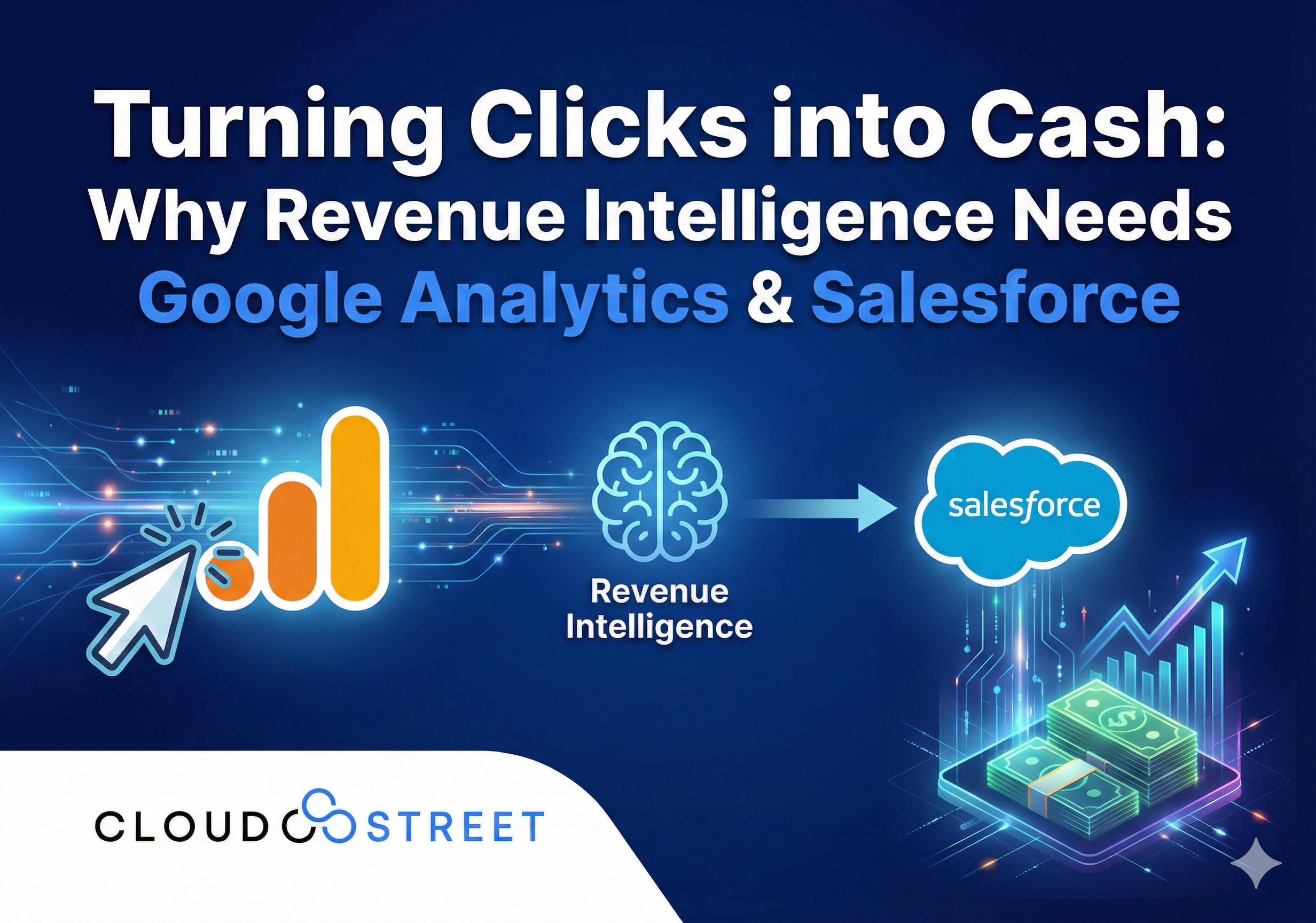
Turning Clicks into Cash: Why Revenue Intelligence Needs Google Analytics + Salesforce
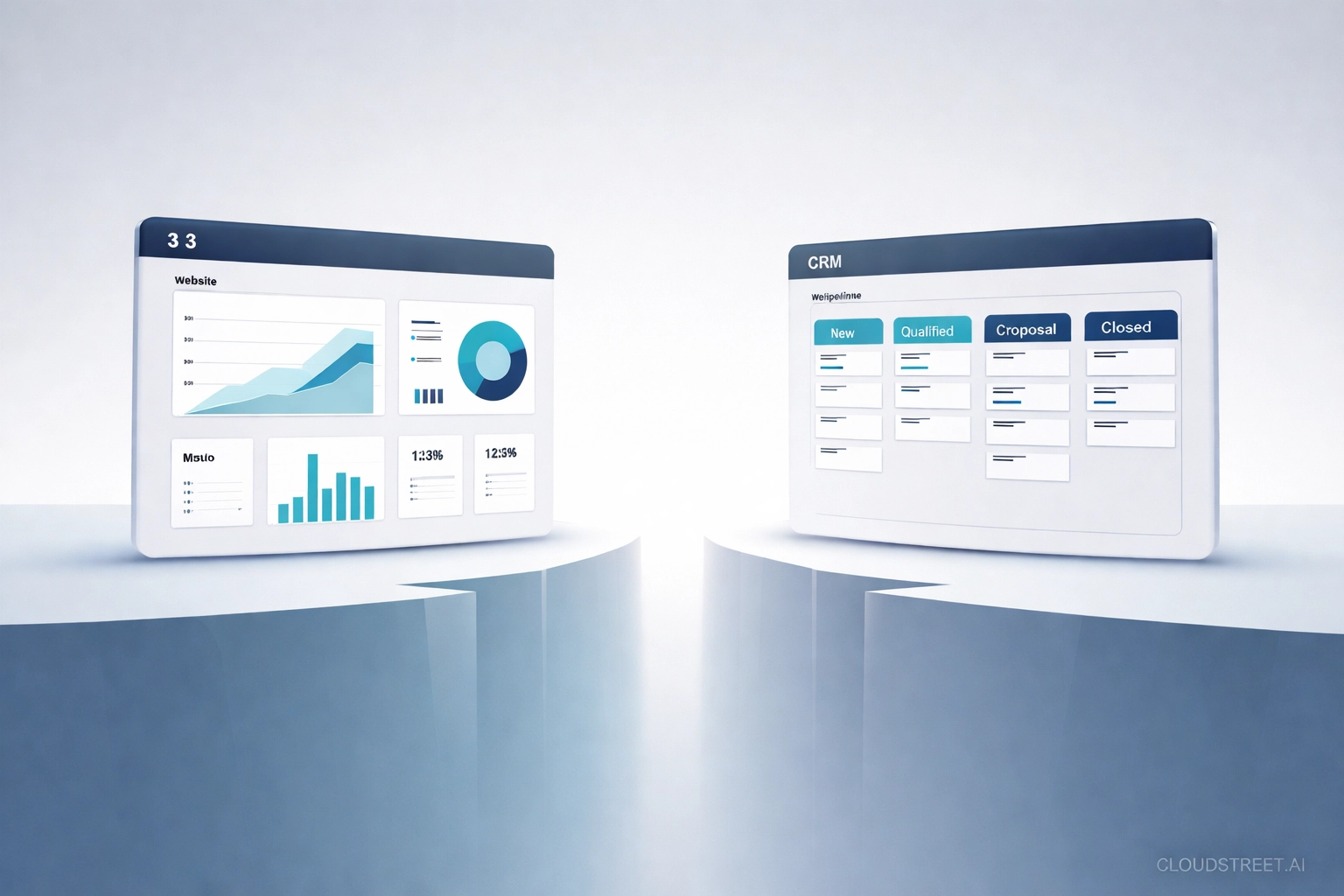
You know those moments when marketing says, “We crushed it this month, look at all that traffic!” and sales responds with, “Cool, but where are the actual deals?”
Yeah. We’ve all been there.
The truth is, your Google Analytics dashboard and your Salesforce CRM are probably living completely separate lives right now. One tracks clicks. The other tracks cash. And somewhere in between, you’re losing the plot on what’s actually driving revenue.
That’s where Revenue Intelligence comes in, and it’s simpler than you might think.
The Great Disconnect: Why Your Data Is Working Against You
Here’s the scenario playing out in businesses everywhere:
Marketing is heads-down in Google Analytics, celebrating page views, session durations, and campaign clicks. Meanwhile, sales is buried in Salesforce, chasing leads and wondering which ones are worth their time.
Neither team has the full picture.
Your GA4 data tells you who visited your site and what they did. But it can’t tell you if that visitor ever became a paying customer. Salesforce knows exactly how much revenue you closed last quarter. But it has no clue which marketing campaign or blog post sparked that initial interest.
See the problem?
Without connecting these two worlds, you’re essentially flying blind. You might be pouring budget into campaigns that generate tons of traffic but zero revenue. Or you could be ignoring channels that quietly produce your highest-value customers.
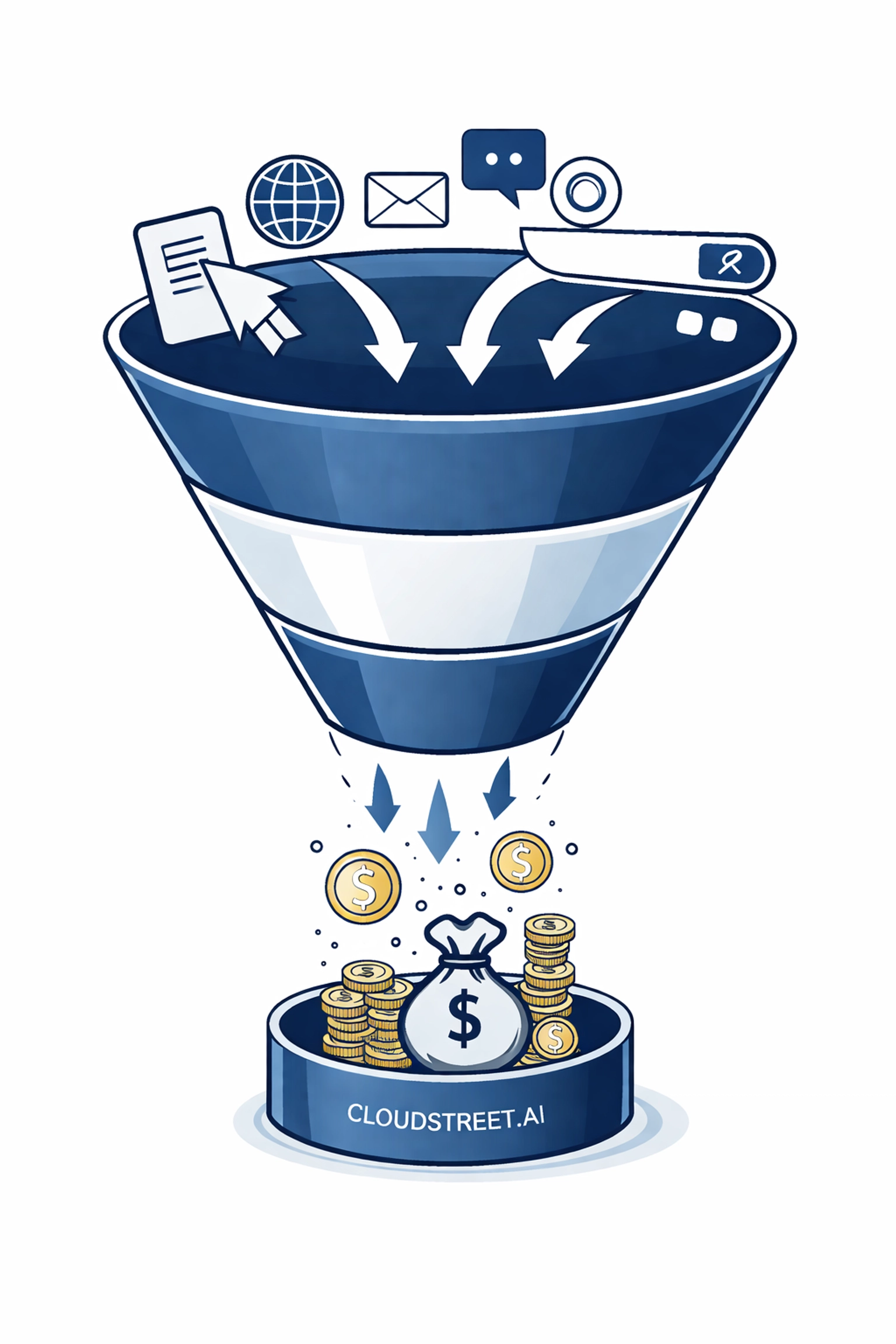
What Is Revenue Intelligence, Anyway?
Revenue Intelligence isn’t some fancy AI buzzword (okay, maybe a little). At its core, it’s about connecting the dots between customer behavior and actual business outcomes.
Think of it this way:
- Google Analytics = What people do on your website
- Salesforce Sales Cloud = What happens after they raise their hand
- Revenue Intelligence = Understanding the full journey from first click to closed deal
When you integrate GA with Salesforce, you create a closed-loop system. You can finally answer questions like:
- Which blog post actually influenced that $50K deal?
- Is our LinkedIn ad spend generating leads that close, or just leads that ghost?
- What’s the real ROI on that webinar we ran last month?
If your business runs on data-driven decisions (and whose doesn’t these days?), this integration is a game-changer.
Ready to connect your marketing and sales data? Our Salesforce services team can help you build the integration that makes sense for your business. Based in Houston, Texas, we work with companies locally and across the globe.
5 Benefits of Integrating Google Analytics with Salesforce
Let’s break down why this integration matters, and what it can actually do for your bottom line.
1. True ROI Attribution
Stop guessing which campaigns work. When GA data flows into Salesforce, you can trace every closed deal back to its original source. That Facebook ad? It brought in 200 clicks and $15K in revenue. That organic search traffic? Even better, $45K from visitors who found you through a how-to guide.
Now you know exactly where to double down.
2. Smarter Sales Prioritization
Not all leads are created equal. With website behavior data in Salesforce, your sales team can see which leads have been binge-reading your case studies versus which ones bounced after 10 seconds.
A lead who visited your pricing page three times this week? Priority one. Someone who stumbled onto your homepage and disappeared? Maybe not so much.
3. Accurate Revenue Forecasting
When you understand which channels produce quality leads (and at what rate they convert), forecasting becomes way less of a guessing game. You can model future revenue based on current pipeline and the marketing activities feeding it.
4. Improved Conversion Rates
Companies that implement this kind of integration often see conversion rate improvements of 30-40%. Why? Because marketing can optimize for leads that actually close, not just leads that look good on paper.
5. Shorter Sales Cycles
When sales knows a lead’s website history, they can have smarter conversations from the jump. No more awkward discovery calls asking questions the lead already answered through their behavior. That efficiency shaves days (sometimes weeks) off the sales cycle.
How the Integration Actually Works
Okay, let’s get a little tactical. How do you actually connect Google Analytics to Salesforce?
The basic flow looks like this:
- Capture GA4 identifiers on your website – This includes the
client_id, UTM parameters, and campaign data that GA tracks automatically. - Pass that data into Salesforce via forms – When someone fills out a contact form, demo request, or any lead capture form, those GA identifiers get attached to their Salesforce Lead or Contact record.
- Sync conversion events back to GA4 – When that lead becomes an opportunity (or better yet, a closed deal), you send that data back to Google Analytics. Now GA knows which sessions generated revenue.
The good news? You don’t need a PhD in data engineering to make this happen.
Tools like Zapier can handle the connection with minimal coding. For more complex setups, custom API integrations or middleware solutions get the job done. The key is choosing an approach that matches your tech stack and your team’s capacity.
Not sure which integration approach is right for you? Let’s chat. CloudStreet specializes in Salesforce integrations that actually move the needle: no over-engineered solutions, just what works.
The Hidden Cost of Staying Siloed
Here’s what happens when you don’t integrate these systems:
- Marketing keeps optimizing for vanity metrics
- Sales keeps complaining about lead quality
- Leadership keeps asking “what’s our real CAC?” and nobody has an answer
- Budget gets wasted on channels that feel productive but aren’t
It’s not just inefficient. It’s expensive.
We’ve seen companies spend months chasing “high-performing” campaigns that generated plenty of leads but almost zero revenue. All because they couldn’t see the full picture.
On the flip side, we’ve helped clients discover that their “underperforming” organic content was quietly responsible for 40% of their pipeline. That insight alone justified years of content investment they were about to cut.
Why CloudStreet? We Live in Both Worlds
At CloudStreet, we’re not just Salesforce consultants. We’re integration nerds who love connecting systems that should’ve been talking to each other all along.
We’ve helped manufacturers, service providers, and growing businesses across industries build the data infrastructure they need to actually understand their revenue. Our team in Houston, Texas works with clients locally and globally: wherever you are, we’ve probably tackled a challenge like yours.
Whether you need a straightforward Zapier setup or a full custom integration between GA4, Salesforce Sales Cloud, and your marketing automation platform, we’ve got you covered.
Want to see what we’ve done for other clients? Check out our Salesforce work and see if it sparks any ideas for your own business.
3 Signs You’re Ready for This Integration
Not sure if this is the right time? Here are three signals that you should probably stop waiting:
- Your marketing and sales teams are pointing fingers – If there’s constant friction about lead quality or campaign performance, it’s a data problem, not a people problem.
- You can’t answer basic ROI questions – When the CEO asks “what’s our cost per acquisition?” and you need three spreadsheets and a prayer to answer, that’s a sign.
- You’re scaling and need to be smarter with budget – Growth without visibility is just gambling. Revenue Intelligence helps you invest wisely.
Let’s Turn Your Clicks into Actual Cash
The gap between traffic and revenue doesn’t have to stay a mystery. With Google Analytics and Salesforce working together, you get the visibility to make smarter decisions, faster.
And you don’t have to figure it out alone.
Reach out to CloudStreet and let’s talk about what Revenue Intelligence could look like for your business. We’ll keep it simple, practical, and focused on what actually moves the needle.
Because at the end of the day, clicks are great. But cash is better.
Category
Discover insights that drive results - explore out latest blog posts now
Case Study: How Highland Cabinetry Colorado Built a Modern Wholesale Powerhouse on Salesforce B2B Commerce Cloud
In the world of high-end cabinetry, timing is everything. When [...]
Agentforce ROI: 7 Ways to Maximize Your Salesforce AI Investment
You've heard the buzz. Salesforce Agentforce is supposed to revolutionize [...]
Salesforce B2B Commerce Cloud Partner & Consultant Guide
You're about to drop serious money on a Salesforce B2B [...]