Traditional Programming vs. Artificial Intelligence: What’s the Difference? (And What It Means for Salesforce)
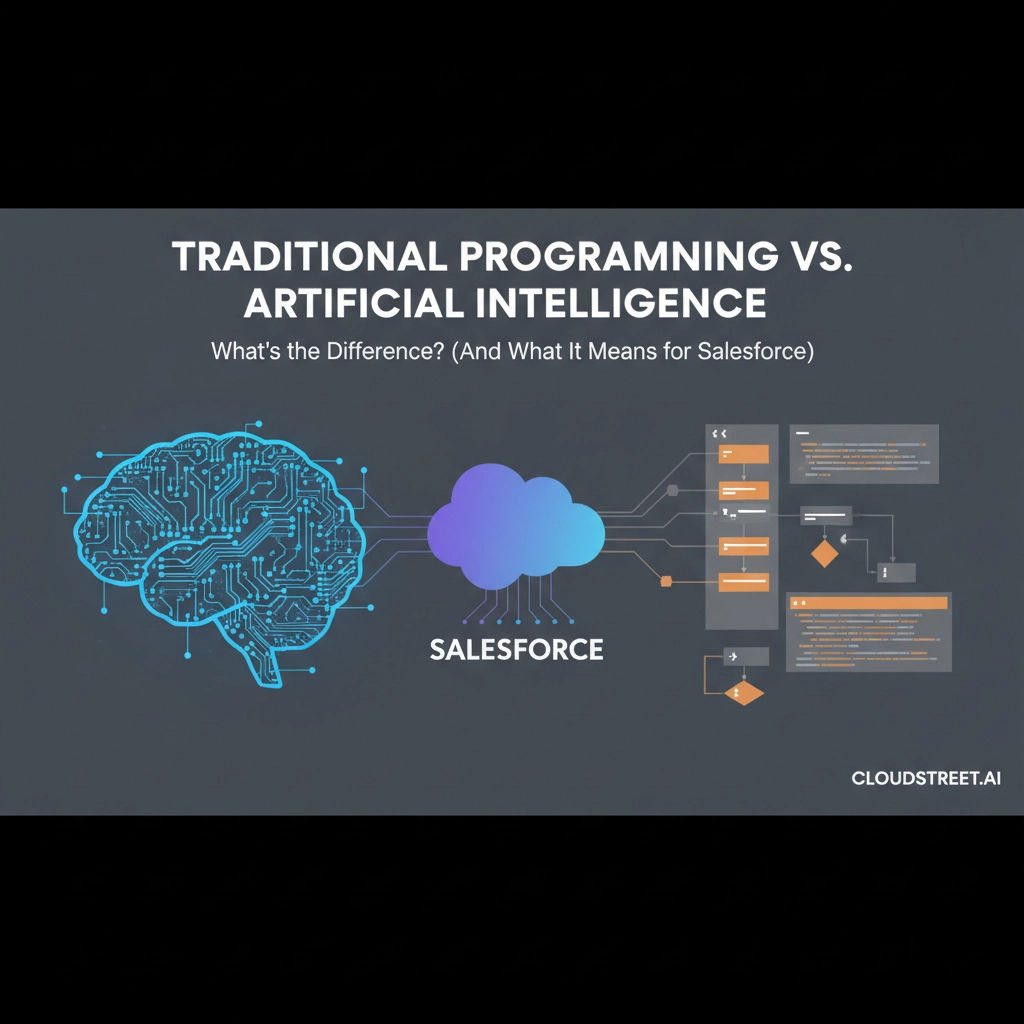
The business world is buzzing about artificial intelligence, but many people still aren’t clear on how AI actually differs from traditional programming. If you’re wondering whether AI is just fancy marketing speak or a genuine game-changer for your business systems, you’re not alone.
The simple truth? Traditional programming and AI represent fundamentally different approaches to solving problems. Traditional programming is like giving someone a detailed recipe: every step is spelled out exactly. AI is more like teaching someone to cook by showing them thousands of different dishes, then letting them create new recipes based on what they’ve learned.
This distinction matters enormously when it comes to platforms like Salesforce, where the choice between traditional functionality and AI-enhanced capabilities can dramatically impact your business results.
Curious what this means for your org? Book a discovery session with our Salesforce Consulting team to map the ROI path. Or explore our ROI-focused Salesforce solutions to see what’s possible.
What Is Traditional Programming?
Traditional programming follows a straightforward, rule-based approach. Developers write explicit instructions that tell computers exactly what to do, step by step. Think of it like programming a coffee machine: you define the water temperature, brewing time, and coffee-to-water ratio. The machine will make coffee exactly the same way every single time.
Here’s what makes traditional programming powerful:
1. Complete Predictability
Every time you run a traditional program, you get identical results. This reliability is crucial for critical business processes like payroll calculations or inventory management.
2. Full Control and Transparency
Developers can trace through every line of code to understand exactly how the system makes decisions. When something goes wrong, you can pinpoint the exact cause and fix it.
3. Proven Stability
Once a traditional program works correctly, it continues working correctly without unexpected behavior changes.
However, traditional programming has significant limitations. It can only handle scenarios that developers explicitly programmed for. If your business requirements change, you need a programmer to update the code. It’s like having an extremely reliable employee who follows instructions perfectly but can’t adapt to new situations without retraining.

Have a complex process to streamline? Schedule a demo to compare rule-based automation vs. AI side-by-side.
How Artificial Intelligence Works Differently
AI takes a completely different approach. Instead of programming explicit rules, AI systems learn patterns from data. You feed them thousands or millions of examples, and they figure out the underlying relationships and principles themselves.
Imagine teaching someone to recognize faces. With traditional programming, you’d have to define rules like “faces have two eyes positioned this way, a nose here, mouth there.” With AI, you show the system 100,000 photos of faces and let it discover what makes a face recognizable.
Key advantages of AI include:
1. Continuous Learning
AI systems improve their performance over time as they process more data. Your system gets smarter without additional programming.
2. Pattern Recognition
AI excels at finding complex patterns in large datasets that would be impossible for humans to identify manually.
3. Handling Uncertainty
AI can make reasonable decisions even when faced with incomplete information or scenarios it hasn’t encountered before.
4. Scalability
Once trained, AI systems can process massive amounts of data and make thousands of decisions simultaneously.
The trade-off? AI systems are less predictable. They might make different decisions in similar situations, and it’s often difficult to understand exactly why they made a specific choice.
Want help figuring out where AI fits? Contact our Salesforce AI experts or book a discovery session.
Traditional Salesforce vs. AI-Enhanced Salesforce
This programming philosophy difference creates a stark contrast in how Salesforce can operate for your business.
Traditional Salesforce Functionality
Standard Salesforce implementations rely on rule-based automation and workflows. Here’s what this looks like in practice:
Lead Assignment: You create rules like “assign leads from Texas to Sarah, leads from California to Mike, and enterprise leads to the senior team.”
Sales Process: You define stage gates where opportunities must meet specific criteria before advancing: like requiring a budget confirmation before moving to the proposal stage.
Customer Service: You set up case routing rules based on product type, customer tier, or issue category.
These traditional approaches work well for predictable, well-defined business processes. They’re reliable, transparent, and easy to audit.
Ready to optimize these flows? Schedule a demo or explore AI integration options.
AI-Enhanced Salesforce with Einstein and Agentforce
AI transforms these same processes by learning from your actual business data and outcomes:
Intelligent Lead Scoring: Instead of manually defining what makes a good lead, Einstein analyzes your historical data to identify patterns among leads that actually convert. It might discover that leads who visit your pricing page three times and download two whitepapers have an 85% conversion rate.
Predictive Forecasting: Rather than relying on sales rep estimates, AI analyzes historical deal patterns, customer behavior, and market trends to predict which opportunities will actually close and when.
Automated Customer Insights: AI can analyze customer communication patterns, purchase history, and support interactions to automatically identify upsell opportunities or customers at risk of churning.
Smart Case Resolution: AI can automatically categorize and route cases based on content analysis, suggest solutions based on similar past cases, and even provide instant answers for common issues.

Exploring integrations between Salesforce and your other systems? Explore integration solutions and see how we connect data for impact.
5 Real Business Impacts of Choosing AI Over Traditional Programming
1. Faster Decision-Making
AI can analyze your entire customer database in seconds to identify trends or opportunities that would take analysts weeks to uncover manually.
2. Personalization at Scale
While traditional systems might segment customers into 5-10 categories, AI can create unique experiences for thousands of individual customers based on their specific behavior patterns.
3. Proactive Problem-Solving
Instead of waiting for problems to occur, AI can predict issues before they happen: like identifying customers likely to churn or deals at risk of falling through.
4. Reduced Manual Work
AI handles routine decision-making automatically, freeing your team to focus on high-value activities that require human judgment and creativity.
5. Continuous Improvement
Traditional systems only get better when someone manually updates them. AI systems automatically improve their performance as they process more data.
Focus on measurable outcomes? See our ROI-focused Salesforce solutions or book a discovery session to build your roadmap.
When to Choose Traditional vs. AI Approaches
Not every business process needs AI. Here’s a practical framework for deciding:
Choose Traditional Programming When:
- You have well-defined, stable business rules
- Compliance requires complete transparency in decision-making
- The process involves sensitive calculations (like payroll or billing)
- Your data volume is relatively small
- Predictability is more important than optimization
Choose AI When:
- You’re dealing with large volumes of unstructured data
- Business conditions change frequently
- You need to personalize experiences for many different customers
- Pattern recognition could reveal valuable insights
- You want systems that improve automatically over time
Not sure which path to choose? Talk to Salesforce Consulting for a quick assessment, or contact our AI experts to explore pilots.
Many successful businesses use a hybrid approach: traditional programming for core operational processes and AI for optimization and insights.
CLOUDSTREET’s Expertise in Both Worlds
At CLOUDSTREET, we understand that the choice between traditional and AI-enhanced Salesforce implementations isn’t one-size-fits-all. Based in Houston, Texas, we work with businesses locally and globally to design solutions that match their specific needs and growth trajectory.
Our approach involves evaluating your current processes, data quality, and business objectives to recommend the optimal mix of traditional reliability and AI innovation. Whether you need a comprehensive Salesforce implementation that follows proven traditional methodologies or want to explore AI-enhanced Commerce Cloud capabilities, we have the expertise to guide your decision.
We’ve seen firsthand how businesses transform their operations by thoughtfully integrating AI capabilities where they add the most value while maintaining traditional approaches for mission-critical processes that require absolute reliability.
The future belongs to organizations that can leverage both traditional programming reliability and AI adaptability strategically. The question isn’t whether to choose one over the other: it’s how to combine them effectively for maximum business impact.
Ready to explore how traditional and AI-enhanced Salesforce capabilities could transform your business? Let’s discuss your specific needs and design a solution that delivers results.
Category
Discover insights that drive results - explore out latest blog posts now
Case Study: How Highland Cabinetry Colorado Built a Modern Wholesale Powerhouse on Salesforce B2B Commerce Cloud
In the world of high-end cabinetry, timing is everything. When [...]
Agentforce ROI: 7 Ways to Maximize Your Salesforce AI Investment
You've heard the buzz. Salesforce Agentforce is supposed to revolutionize [...]
Salesforce B2B Commerce Cloud Partner & Consultant Guide
You're about to drop serious money on a Salesforce B2B [...]