Total Cost of Ownership: Shopify vs Salesforce Commerce Cloud : What Growing Enterprises Should Know
When you’re running a fast-growing enterprise, the “sticker price” of your e-commerce platform is rarely the number that actually matters. At CLOUDSTREET, we’ve seen dozens of businesses fall into the same trap: they choose a platform based on a low monthly subscription, only to find themselves drowning in “shadow costs” eighteen months later.
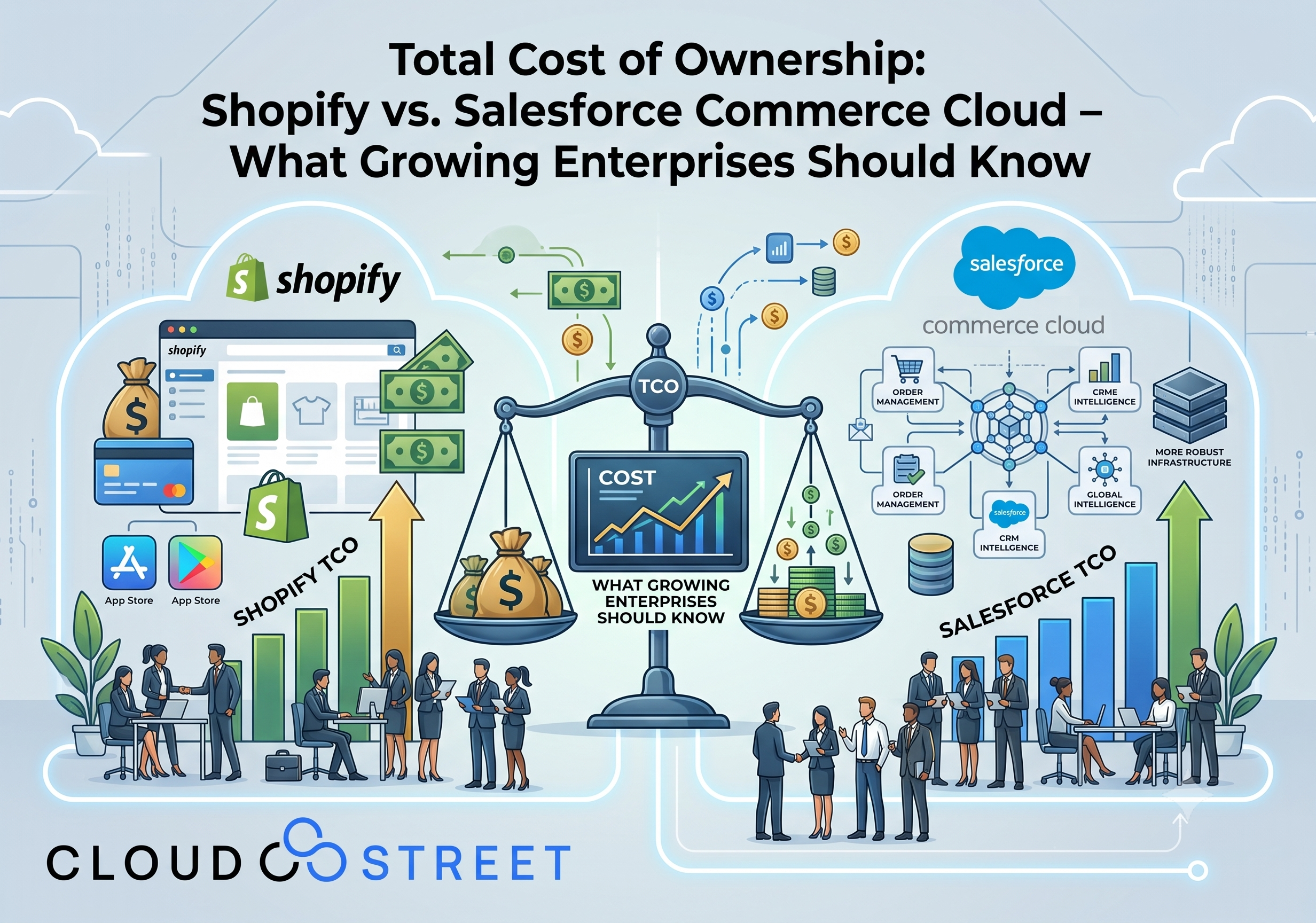
The debate between Shopify vs Salesforce for enterprise usually starts with the monthly fee. Shopify looks like a steal at $2,300/month for Shopify Plus, while Salesforce Commerce Cloud (now often discussed alongside Agentforce Commerce) requires a custom quote that typically scales with your Gross Merchandise Value (GMV).
But here’s the reality we see on the ground: for a complex, mid-to-large-scale business, the Total Cost of Ownership (TCO) tells a very different story. When you look at the “taxes” you pay on a simpler platform: the App Tax, the Middleware Tax, and the Labor Tax: the price gap between Salesforce Commerce Cloud vs Shopify doesn’t just narrow; it often disappears entirely.
In this deep dive, we’ll break down the 5 hidden cost centers that every executive should model before making a platform decision.
1. The “App Tax”: When $2,300/mo Becomes $15,000/mo
Shopify is famous for its “there’s an app for that” ecosystem. For a small merchant, this is a dream. For an enterprise, it can become a financial and operational nightmare.
Salesforce Commerce Cloud is built as an all-in-one enterprise engine. Features like advanced quoting, complex approval workflows, multi-currency tax compliance, and sophisticated search are native. On Shopify, these often require a stack of third-party apps.
The hidden costs of the Shopify App Tax:
- Subscription Bloat: It’s common for enterprise Shopify stores to run 20–35 active apps. At $500–$5,000 per month for critical apps (like wholesale pricing or advanced inventory sync), your “cheap” subscription can easily swell by an additional $10k/month.
- The Vendor Management Headache: Every app is a different company with its own support team, security profile, and update schedule.
- Conflict Risk: When App A updates and breaks App B, your site goes down. You aren’t just paying for the app; you’re paying for the risk it introduces.
Pro Tip: Before deciding, list your “must-have” enterprise features. If you need more than 10 apps to achieve them on Shopify, you’re already paying the Salesforce price without getting the Salesforce stability.
Get a Quote for Your Custom Migration
2. The Middleware Tax: The Price of “Keeping Systems Talking”

An e-commerce platform doesn’t live on an island. It has to talk to your ERP (NetSuite, Oracle, SAP), your CRM, your PIM, and your Warehouse Management System (WMS).
Because Salesforce is part of a unified ecosystem, the integration between Commerce, Sales, and Service is “baked in.” When you choose Shopify for an enterprise setup, you almost always have to introduce a Middleware Tax.
What the Middleware Tax looks like:
- The Platforms: Tools like Celigo, Boomi, or Workato are often required to keep Shopify in sync with a complex ERP. These platforms carry their own licensing fees, often ranging from $1,000 to $5,000+ per month.
- The Setup: Building these bridges isn’t a “one-click” process. Initial implementation for custom enterprise middleware can cost $80,000 to $200,000.
- The Maintenance: Every time you change a field in your ERP, someone has to update the middleware logic to ensure your Shopify store doesn’t start overselling inventory.
At a.CLOUDSTREET, we specialize in Salesforce services that eliminate this friction. By staying within the Salesforce ecosystem, you aren’t just buying a store; you’re buying a unified data model.
3. The Labor Tax: The Myth of “Easy Maintenance”
There is a common misconception that Shopify is “maintenance-free” while Salesforce requires a “small army” of developers. While Salesforce does require specialized expertise, the labor costs for Shopify at the enterprise level are often underestimated.
The Labor Tax includes:
- Liquid Template Maintenance: Shopify uses a proprietary language called Liquid. As your store becomes more complex, you still need specialized (and expensive) developers to maintain custom themes.
- App Orchestration: You need someone to manage the “App Tax” mentioned earlier: testing updates, fixing broken integrations, and auditing permissions.
- Manual Data Entry: Because Shopify is often siloed from the rest of the business, we frequently see teams hiring “human middleware”: employees whose entire job is to manually reconcile orders, update inventory, or copy customer data from one system to another.
In contrast, while a Salesforce developer may have a higher hourly rate, the platform is designed for automation. You spend less on “fixing things” and more on “building things” that drive revenue.
Schedule a Call with our Houston-based Experts
4. The Opportunity Cost: The Revenue You’re Not Making

This is the hardest cost to quantify, but it’s often the largest. When to migrate from shopify to salesforce commerce cloud usually comes down to the moment your current platform starts costing you sales.
Where Shopify’s opportunity costs often hide:
- Limited B2B Capabilities: If your B2B customers can’t see their specific negotiated pricing, view their order history across all channels, or manage their own sub-accounts, they will buy elsewhere. Shopify Plus is improving here, but it still lacks the deep B2B logic native to Salesforce.
- Data Silos: If your marketing team doesn’t know what your customers bought in-store or online because the data is trapped in Shopify, you can’t personalize.
- Global Scaling: Managing 15 different international storefronts as separate Shopify instances is a logistical nightmare. Salesforce handles multi-site, multi-currency, and multi-language global commerce from a single “source of truth.”
5. Comparing the Real Numbers: A 3-Year Outlook
Let’s look at a hypothetical 3-year TCO comparison for a business doing $50M in annual GMV.
| Cost Center | Shopify Plus (Typical Enterprise) | Salesforce Commerce Cloud (Typical) |
|---|---|---|
| Platform Fee | ~$150k / year (0.25% GMV) | ~$250k – $500k / year (Quote-based) |
| App Tax | $120k / year (SaaS fees) | $20k / year (Minor extensions) |
| Middleware | $40k / year (Licensing + Maintenance) | Included / Native to SF ecosystem |
| Labor/Dev | $150k / year (Generalist + Agency) | $250k / year (Specialized Partner) |
| Integration Setup | $150k (One-time) | $200k (One-time) |
| TOTAL 3-YEAR TCO | ~$1.68 Million | ~$1.95 Million |
The Gap: On the surface, Salesforce looks $270k more expensive over three years.
The Reality: If Salesforce’s superior B2B tools and AI-driven personalization (Agentforce) increase your conversion rate by just 0.5%, that’s an extra $250,000 in revenue every single year.
Suddenly, the “cheaper” platform is actually the one that’s costing you money.
Why a.CLOUDSTREET Makes the Difference

We aren’t just here to sell you software. At a.CLOUDSTREET, our mission is to implement real, measurable ROI into our customers’ Salesforce orgs.
Based in the heart of Houston, Texas, we pride ourselves on a “straight-talk” approach. We work with businesses locally here in the South and globally across the world to navigate these complex TCO calculations.
Whether you are debating the right platform for your e-commerce business or you’re ready to unlock the power of AI in your storefront, our team has the data and the experience to guide you.
Your next steps:
- Audit your current “App Tax”: How much are you truly spending on third-party Shopify apps every month?
- Calculate your “Human Middleware”: How many hours is your team spending on manual data entry between systems?
- Talk to us: Let’s run a real business case analysis for your specific GMV and complexity.
Don’t let a low sticker price blind you to the long-term costs of your e-commerce strategy.
Category
Discover insights that drive results - explore out latest blog posts now
DealHub Salesforce Integration for Manufacturers: Connecting CPQ, Contracts, and CRM
About the manufacturer: mid-market industrial equipment company A U.S.-based, mid-market [...]
Salesforce Data 360 and Agentforce: Why Grounding Is What Makes AI Agents Dependable
An AI agent can produce a fluent answer and still [...]
Salesforce Data 360 Governance and Informatica: Managing Data Quality, Access, and Trust in the Agentic Era
Data governance becomes more consequential when business data does more [...]