The Ultimate Guide to Salesforce Consulting for Small and Mid-Sized Businesses
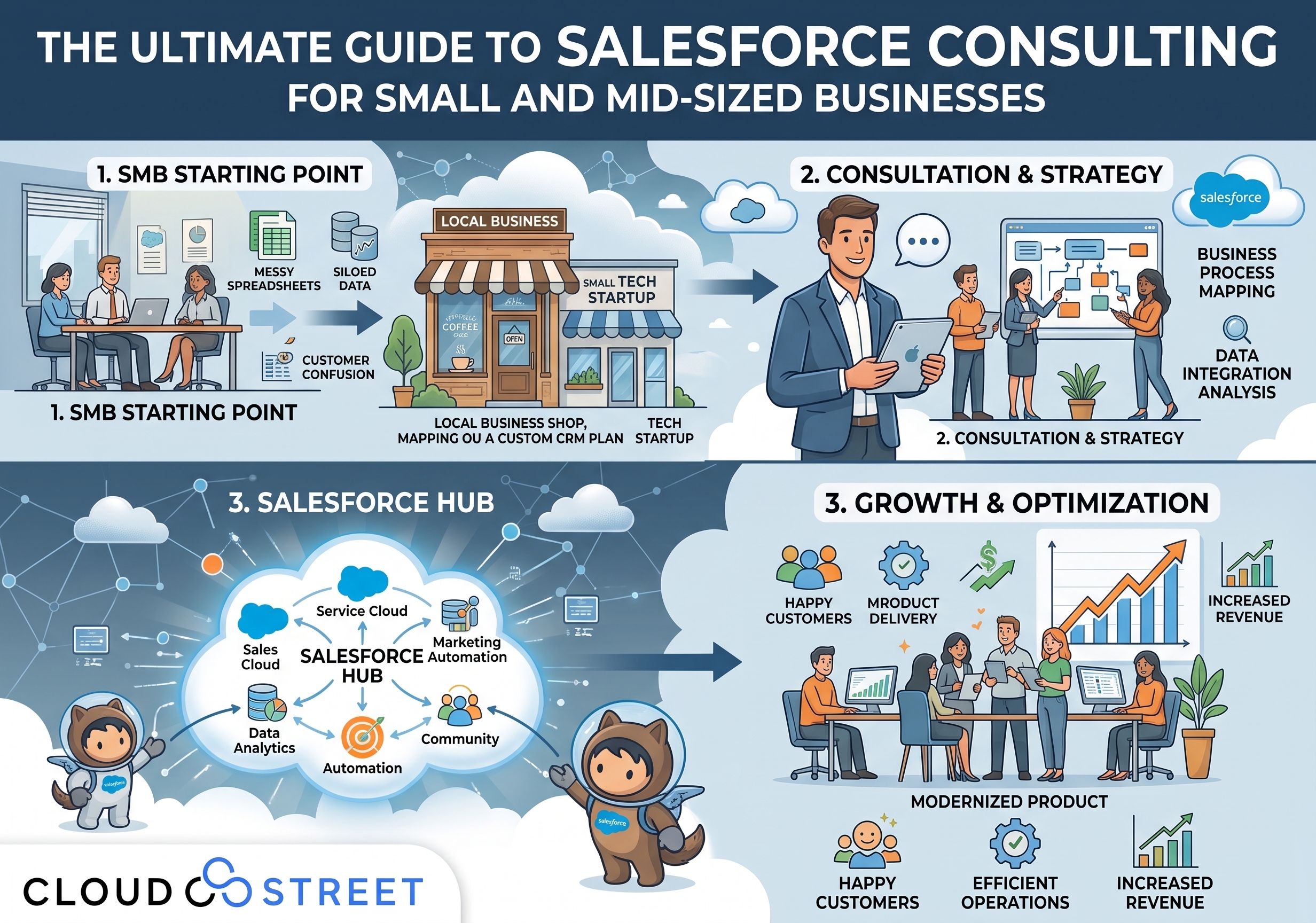
Category: Blog
Salesforce gives growing companies a flexible way to manage customer relationships, sales activity, service operations, marketing data, and more. Yet the platform can feel difficult to set up and manage without a large internal team.
For small and mid-sized businesses, the challenge is rarely whether Salesforce has enough capability. The more practical question is whether the system reflects how the business actually operates.
When Salesforce is poorly aligned with the business, familiar problems appear:
- Users avoid the system or enter incomplete information.
- Teams create spreadsheet workarounds.
- Sales, marketing, service, and finance work from disconnected data.
- Reports become difficult to trust.
- The company pays for features and licenses it does not use effectively.
Salesforce consulting helps address these issues through practical strategy, implementation, integration, custom development, training, and ongoing optimization. At CLOUDSTREET, we implement ROI into Salesforce organizations by connecting technology decisions to measurable business outcomes.
We are based in Houston, Texas, and work with customers locally and globally. Whether your team operates in one market or across multiple regions, the same principle applies: Salesforce should support your business process rather than create another layer of work.
What Is Salesforce Consulting?
A Salesforce consultant helps a company plan, configure, improve, and govern its Salesforce environment. The work combines business analysis, platform knowledge, project management, and change management.
A consultant typically helps answer questions such as:
- Which business processes should Salesforce support?
- Which Salesforce products and features are appropriate for the current stage of the business?
- What data should be migrated, cleaned, or integrated?
- Which workflows should be configured, automated, or custom-built?
- How will leadership measure adoption, efficiency, and return on investment?
A consultant is different from an administrator or developer, although one person may have experience in more than one role.
- Salesforce consultant: Focuses on business requirements, solution design, roadmap planning, implementation oversight, and stakeholder alignment.
- Salesforce administrator: Manages the day-to-day configuration of the org, including users, permissions, fields, reports, dashboards, flows, and routine maintenance.
- Salesforce developer: Builds technical solutions using tools such as Apex, Lightning Web Components, APIs, and custom integrations.
An SMB may have an internal administrator who understands daily operations but needs additional capacity for a major project. In other cases, the business may need strategic guidance before hiring or training an administrator. A consulting partner can fill that gap without requiring a large permanent technology department.
For companies considering advanced functionality, our Salesforce Services overview includes implementation, integration, development, managed support, Sales Cloud, Marketing Cloud, Service Cloud, and Commerce Cloud capabilities.
The 3 Pillars of Salesforce Success
Successful Salesforce programs generally depend on three connected areas: implementation, strategic consulting, and custom development.
1. Implementation: Build a Coherent Foundation
Salesforce implementation is more than creating users and importing contacts. It involves designing a foundation that can support the business as it grows.
A practical implementation approach begins with:
- Documenting the current sales, service, marketing, and operational processes.
- Defining the outcomes Salesforce should improve.
- Cleaning and mapping data before migration.
- Configuring standard Salesforce functionality where it fits.
- Testing with representative users and realistic scenarios.
- Training teams around the workflows they use every day.
This process helps avoid a fragmented “Franken-system”: an org made up of disconnected automations, duplicate fields, inconsistent terminology, and custom features that no one fully understands.
The right scope also matters. Many SMBs benefit from starting with a focused release, such as Sales Cloud pipeline management, core reporting, and a small number of high-value integrations. Additional functionality can follow once users understand the foundation and leadership can evaluate the results.
If you are planning a new rollout or moving from a legacy CRM, contact our team to discuss an implementation approach suited to your business size, timeline, and goals.

2. Strategic Consulting: Align the Platform With the Business
Strategic consulting connects Salesforce configuration to business decisions. Without that connection, a company may build a technically functional system that does not change important outcomes.
Strategic work can include:
- Mapping the customer lifecycle from lead through renewal.
- Defining sales stages and exit criteria.
- Clarifying lead ownership and marketing-to-sales handoffs.
- Establishing reporting definitions and executive KPIs.
- Reviewing user roles, permissions, and data access.
- Creating a roadmap for future clouds, automation, and integrations.
- Establishing lightweight governance for future changes.
For example, “improve sales visibility” is a useful objective but not a complete measurement plan. A more actionable approach may track forecast accuracy, opportunity aging, stage conversion, activity completion, or time from qualified lead to first contact.
Strategic consulting also addresses Salesforce user adoption. If the system adds unnecessary steps or does not help users complete their work, training alone may not solve the problem. Adoption improves when Salesforce is relevant, efficient, and connected to the decisions employees already make.
3. Custom Development: Extend Salesforce When Configuration Is Not Enough
Salesforce provides extensive configuration and low-code capabilities. We generally recommend using standard features and declarative automation before introducing custom code.
Custom development can be appropriate when the business has requirements that configuration, Flow, or an AgentExchange application cannot address effectively.
Common technologies include:
- Apex: Salesforce’s programming language for complex business logic, specialized automation, and transaction processing.
- Lightning Web Components: Reusable interface components for tailored user experiences within Salesforce.
- Custom integrations: Connections between Salesforce and ERP, accounting, commerce, logistics, payment, or other operational systems.
- APIs and middleware: Technical services that synchronize data and coordinate processes across applications.
Examples may include specialized pricing logic, complex approval requirements, a unique customer portal, or integration with a system that does not offer a suitable prebuilt connector.
Custom code brings long-term considerations. It requires testing, documentation, release management, and a clear owner. The question is not whether Salesforce can be customized; it is whether the additional complexity produces enough business value to justify its maintenance.
How Business Leaders Benefit From a Salesforce Partner
Sales Leaders: Better Pipeline Control With Less Administrative Work
Sales leaders often need more reliable pipeline visibility without asking representatives to spend additional hours on data entry.
A Salesforce partner can help establish:
- Consistent opportunity stages and sales processes.
- Automated activity capture and follow-up reminders.
- Dashboards for pipeline coverage, velocity, and aging.
- Forecasting structures that use agreed definitions.
- Approval and notification workflows.
- Guided selling processes that help representatives follow the right steps.
The result is a more consistent operating rhythm. Managers can spend less time reconciling spreadsheets and more time coaching sellers, reviewing risks, and making decisions.
Marketing Leaders: Connect Campaign Activity to Revenue
Marketing teams need a clear view of how campaigns generate and influence business outcomes. Salesforce consulting can support:
- Lead routing and qualification.
- Campaign attribution and response tracking.
- Segmentation based on customer and prospect data.
- Personalized journeys across relevant channels.
- Closed-loop reporting between marketing and sales.
- ROI analysis by campaign, channel, segment, or offer.
The quality of this reporting depends on shared definitions and connected systems. If campaign, opportunity, and customer data do not align, attribution reports may create more debate than insight.
IT Leaders: Improve Architecture, Security, and Governance
IT leaders are often responsible for Salesforce security and architecture while business teams request faster changes. A consulting partner can help balance those needs through:
- Role-based access and permission design.
- Integration architecture and data ownership.
- Release management and sandbox testing.
- Documentation of automations and dependencies.
- Change governance and request prioritization.
- Adoption support that reduces the internal burden on IT.

For organizations evaluating AI capabilities, our Salesforce AI services page explains how Agentforce can support productivity, personalization, and workflows grounded in business data.
Why SMBs Need a Specialized Salesforce Partner
A very large consulting firm may bring broad resources and formal delivery processes. For an SMB, however, the model can involve several tradeoffs:
- Higher costs caused by multiple delivery layers.
- Limited access to senior consultants after the sale.
- Standardized methods that may not fit the company’s operating model.
- More formal project structures than the scope requires.
- Difficulty adjusting priorities when business needs change.
A boutique Salesforce partner can offer a different working model. The practical benefits may include direct access to experienced advisors, right-sized scope, flexible delivery, and closer attention to budget constraints.
The important consideration is not firm size alone. Evaluate whether the partner understands your business, explains its methodology clearly, documents its work, and can support the organization after launch.
For B2B companies with complex catalogs, account-specific pricing, or self-service ordering requirements, our B2B Commerce Accelerator provides more information about Salesforce Commerce Cloud implementation and integration.
How to Know You Are Ready for a Salesforce Consultant: 7 Signals
Consider a Salesforce consulting conversation if one or more of these conditions describe your business:
- Your teams rely on spreadsheets to manage pipeline, forecasts, customers, or service activity.
- You are migrating from a legacy CRM or multiple disconnected databases.
- Salesforce users rarely log in or enter inconsistent information.
- Reports require manual preparation before leadership can use them.
- Your accounting, marketing, support, commerce, or ERP applications do not share reliable data.
- Your sales or service organization is growing faster than its current processes.
- Leadership has concerns about security, compliance, permissions, or data ownership.
You do not need to wait for every signal to appear. A current-state assessment can help determine whether the best next step is configuration, training, integration work, process redesign, or a broader implementation.
A Practical Salesforce Consulting Engagement: 9 Stages
A well-structured engagement usually includes the following stages:
- Discovery: Interview stakeholders and document business goals.
- Current-state assessment: Review the Salesforce org, data, automations, reports, licenses, and integrations.
- Roadmap: Prioritize improvements according to value, effort, risk, and timing.
- Solution design: Define the future-state processes, objects, permissions, and user experience.
- Configuration and development: Build the approved solution using standard features first and custom development where appropriate.
- Data migration and integration: Clean, map, transfer, and synchronize data with connected systems.
- Testing: Complete functional testing, system integration testing, and user acceptance testing.
- Training and deployment: Prepare users, deploy the release, and provide launch support.
- Optimization: Review adoption, data quality, reporting, and business outcomes after launch.
The sequence can be adapted to the size and complexity of the project. A focused SMB implementation may move through these stages in shorter cycles, while multi-cloud programs may require multiple releases.

Conclusion and Next Steps
Salesforce delivers value when it is tuned to the way your business sells, serves, markets, reports, and grows. The goal is not to activate every feature. The goal is to create a practical system that employees use, leaders trust, and IT can govern.
CloudStreet helps small and mid-sized businesses plan, implement, integrate, customize, and optimize Salesforce. We are located in Houston, Texas, with customers locally and globally.
Need a Local Salesforce Consultant in Houston?
If your company is in the Houston area and your team prefers working with a consultant in person, CloudStreet is based in Houston and can provide local, face-to-face Salesforce consulting alongside broader delivery support. For companies comparing options, our article on how to choose a Salesforce consulting partner in Houston, TX offers practical considerations for evaluating fit, experience, and working style.
If you are evaluating your current Salesforce environment or planning a new initiative, choose the next step that fits your situation:
- Schedule a Call to discuss your goals and current challenges.
- Get a Quote for a defined Salesforce project or enhancement.
- Contact Our Team for guidance on implementation, integration, adoption, or ongoing support.
Category
Discover insights that drive results - explore out latest blog posts now
DealHub Salesforce Integration for Manufacturers: Connecting CPQ, Contracts, and CRM
About the manufacturer: mid-market industrial equipment company A U.S.-based, mid-market [...]
Salesforce Data 360 and Agentforce: Why Grounding Is What Makes AI Agents Dependable
An AI agent can produce a fluent answer and still [...]
Salesforce Data 360 Governance and Informatica: Managing Data Quality, Access, and Trust in the Agentic Era
Data governance becomes more consequential when business data does more [...]