The Hidden ROI of Unified Commerce: Why B2B + B2C on One Platform Wins
Category: Blog
If you’re running a medium-to-large business, you probably have a B2C side and a B2B side. For years, the "standard" way to handle this was to treat them like two completely different animals. You’d have one team, one budget, and one tech stack for your retail site, and a totally separate setup for your wholesale or trade portals.
But here’s the reality: that separation is costing you a fortune.
At CLOUDSTREET, based right here in Houston, Texas, we help companies locally and globally realize that the "split" model is outdated. When you unify your commerce strategy on a single platform like Salesforce Commerce Cloud (SFCC), you aren't just making life easier for your IT team: you’re unlocking massive, hidden ROI.
Let’s dig into why putting B2B and B2C under one roof is the ultimate win for your bottom line.
1. 3 Major Ways You’ll Slash Tech Debt
Maintaining two different e-commerce platforms is like paying for two mortgages when you only live in one house. It’s expensive, redundant, and slows you down. When you consolidate onto Salesforce, you see immediate financial relief in three specific areas:
- Lower Licensing and Maintenance Costs: Instead of paying for two separate software subscriptions, two sets of security patches, and two hosting environments, you have one. This alone can often justify the migration cost.
- Unified Development Cycles: When you want to roll out a new feature: like a "Quick Order" button or a better search filter: your developers only have to build it once. It can then be styled and deployed across both your B2C and B2B storefronts.
- Simplified Integration Architecture: You likely have an ERP, a PIM, and a shipping carrier. Integrating these into two separate commerce engines is a nightmare of "spaghetti code." With unified commerce, you build one clean bridge between your back-office systems and Salesforce.
If you're worried about the complexity of this shift, consult with CLOUDSTREET to see how we can streamline your tech stack for maximum efficiency.
2. 4 Benefits of Shared Data and Inventory
Inventory is often a company’s biggest asset: and its biggest headache. If your B2B and B2C systems aren't talking to each other, you're likely sitting on "ghost inventory" or, worse, overselling products you don't have.
Unified commerce gives you a single source of truth for your stock. Here are four ways that pays off:
- Optimized Stock Levels: You don't need to "earmark" 500 units for retail and 500 for wholesale. You have 1,000 units available to whoever buys them first, reducing the risk of dead stock sitting in a warehouse.
- Real-Time Visibility: Your B2B buyers are starting to act like B2C shoppers. They want to know exactly how many units are available before they place a bulk order. Unified data ensures that number is always accurate.
- Reduced Fulfillment Errors: One platform means one order management flow. Whether it’s a pallet going to a distributor or a single box going to a doorstep, the logic remains consistent.
- Agile Pivoting: If retail demand spikes (like during a viral social media moment), you can instantly shift inventory focus without having to manually "transfer" stock between digital systems.

3. The Power of the True "Customer 360" View
In the old world, a customer might buy from you as an individual (B2C) and also be a procurement manager for a large client (B2B). If your systems are separate, you have no idea they are the same person.
By unifying on Salesforce, you get a "Customer 360" view. This isn't just a marketing buzzword; it’s a revenue driver. When your sales reps or customer service agents look at a record, they see every interaction: past retail purchases, bulk wholesale orders, and support tickets: in one place.
This level of insight allows for personalized service that feels like magic. If a B2B buyer is browsing your retail site, you can offer them their negotiated contract pricing even if they aren't logged into the "pro" portal. That’s how you build loyalty that lasts for decades.
4. 3 Ways Einstein AI Wins on a Unified Platform
AI is only as good as the data you feed it. If your data is fragmented across two platforms, your AI is essentially working with one hand tied behind its back. When you unify B2B and B2C, Salesforce’s Einstein AI becomes a powerhouse.
Here is how Einstein drives ROI when it has the full picture:
- Smarter Product Recommendations: Einstein looks at trends across all sales channels. If a specific product is blowing up in B2C, it can proactively suggest that item to your B2B distributors who haven't stocked it yet.
- Predictive Reordering: For B2B clients, Einstein can analyze their purchase history and remind them to reorder before they run out, effectively automating your sales process.
- Personalized Merchandising: Whether someone is shopping for their home or their business, Einstein can tailor the storefront to show the most relevant products first, significantly increasing Average Order Value (AOV).
To see how you can get the most out of these AI tools, check out our guide on maximizing your Salesforce AI investment.
5. Consistent Brand Experience: The B2B "Consumerization"
Let’s be honest: most B2B portals are ugly and hard to use. But the person buying 100 industrial pumps for their company also buys shoes on their phone at night. They expect the same ease of use in their professional life.
A unified platform allows you to bring that slick, high-converting B2C user experience (UX) to your B2B customers. You can offer high-quality imagery, detailed reviews, and mobile-responsive designs that make ordering easy. At the same time, you still maintain the "heavy lifting" B2B features like custom price books, quote requests, and tax-exempt processing.
When your brand looks and feels the same across every touchpoint, you build trust. Trust leads to higher conversion rates and lower customer acquisition costs.

6. Real Numbers: The ROI of Consolidation
Research shows that companies moving to a unified commerce model often see a 15% increase in revenue and a 25% reduction in operational costs within the first 18 months.
Why? Because you’ve removed the friction. Your marketing team can run campaigns that target everyone. Your IT team can focus on innovation rather than just "keeping the lights on" for two different systems. Your warehouse team can ship faster because the data is clean.
At CLOUDSTREET, we specialize in helping businesses in Houston and across the globe move away from "franken-systems" and toward a streamlined Salesforce ecosystem. We don't just "install" software; we implement ROI. Whether you're looking for Salesforce staff augmentation to help with the heavy lifting or a full-scale migration, we ensure your tech stack is working for your wallet.
Stop Managing Chaos, Start Managing Growth
Running a business is hard enough without your own technology working against you. If you are currently juggling separate B2B and B2C platforms, you are leaving money on the table every single day.
The hidden ROI of unified commerce is found in the hours saved by your developers, the inventory that doesn't go to waste, and the AI that actually knows your customers.
Ready to stop the "tech debt bleed" and start growing? Whether you are right here in Texas or halfway across the world, we’re ready to help.
Consult with CLOUDSTREET today to unify your commerce strategy and maximize your Salesforce ROI.
Category
Discover insights that drive results - explore out latest blog posts now
The Hidden ROI of Unified Commerce: Why B2B + B2C on One Platform Wins
Category: Blog If you’re running a medium-to-large business, you probably [...]
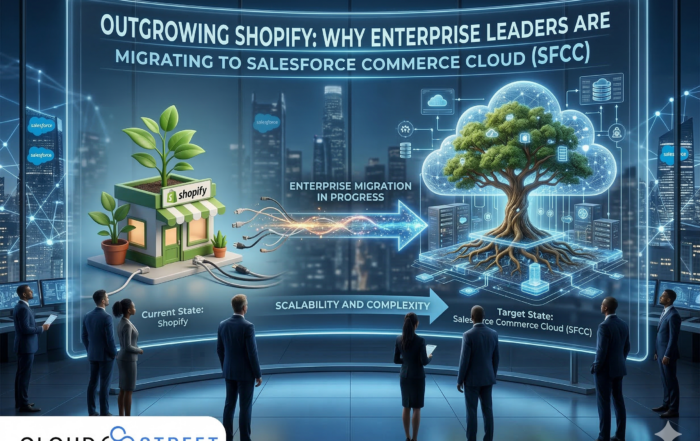
Outgrowing Shopify? Why Enterprise Leaders are Migrating to Salesforce Commerce Cloud (SFCC)
Let’s be real for a second: Shopify is a fantastic [...]
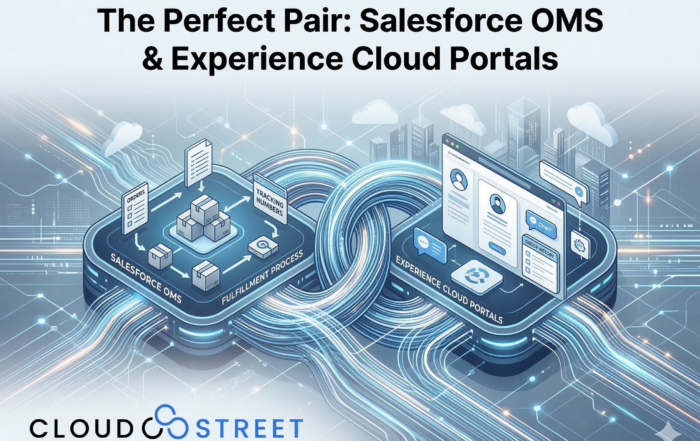
The Perfect Pair: Salesforce OMS + Experience Cloud Portals
You’ve spent months (and a healthy chunk of your budget) [...]