Sunsetting Salesforce CPQ: Your Guide to Migrating to Agentforce Revenue Management (ARM)
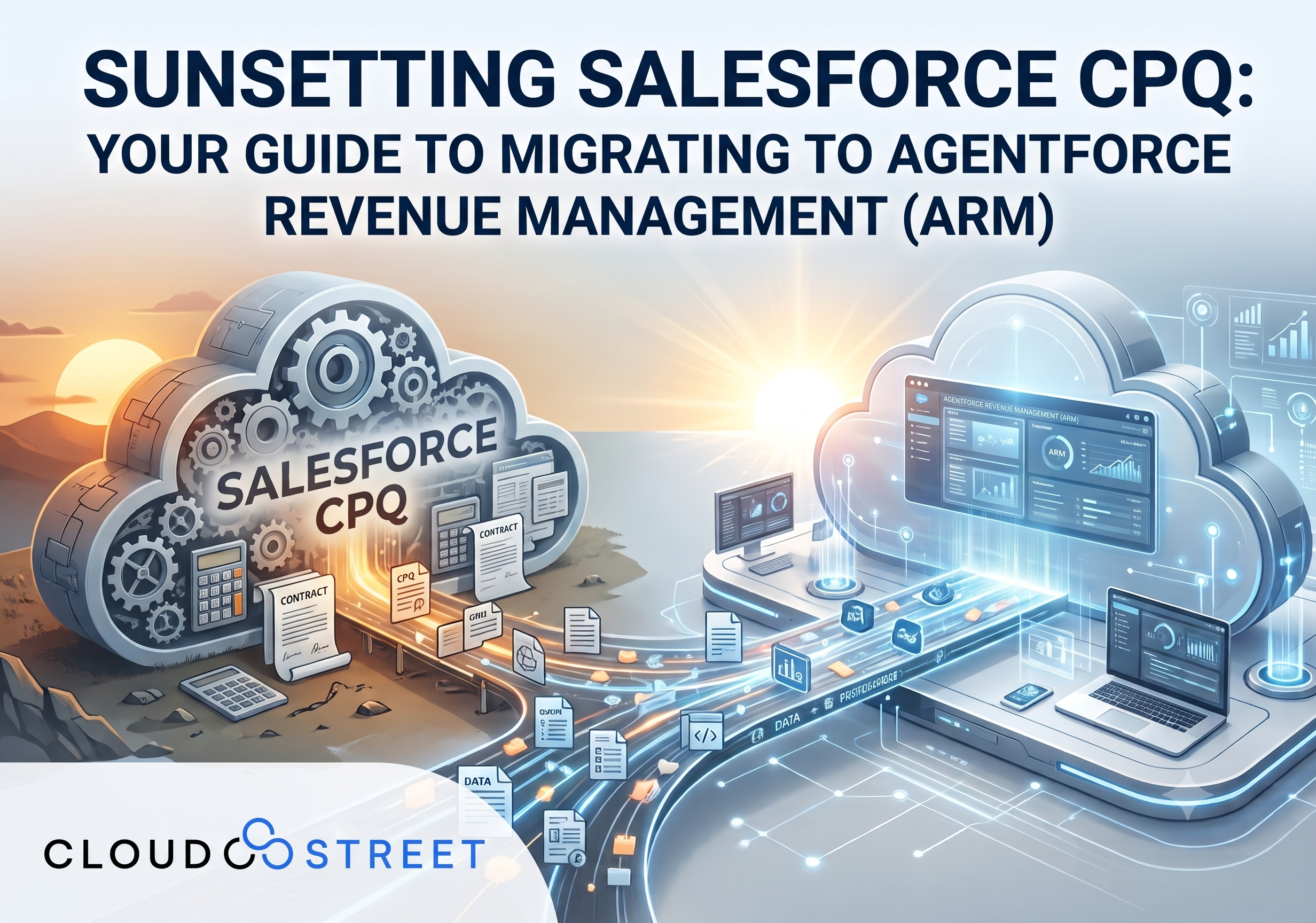
For over a decade, Salesforce CPQ (formerly Steelbrick) has been the gold standard for Configure, Price, Quote (CPQ) operations. However, the technology landscape is shifting rapidly. As of March 2025, Salesforce has officially moved legacy CPQ into an “End of Sale” status. While existing customers can still renew their licenses, the writing is on the wall: the future of revenue operations at Salesforce is now powered by Agentforce Revenue Management (ARM).
At CloudStreet, we are helping our clients navigate this pivotal transition. This isn’t just a minor update or a patch; it is a fundamental re-architecture of how businesses manage their quote-to-cash lifecycle. Based in Houston, Texas, our team serves clients locally and globally, ensuring that this migration doesn’t just “move” your data but maximizes your ROI through the latest Salesforce artificial intelligence capabilities.
Schedule a Call with our Migration Experts
What is Agentforce Revenue Management? (8 Key Innovations)
Agentforce Revenue Management, previously known as Revenue Cloud Advanced (RCA), represents the next generation of revenue operations. Unlike legacy CPQ, which is a “managed package” (essentially an app installed on top of Salesforce), ARM is built natively on the Salesforce Core platform.
Here are 8 defining features of the ARM platform:
- AI-Native Architecture: ARM is powered by Agentforce AI agents. These agents can generate complex quotes via natural language, monitor consumption patterns, and automate the invoicing process without manual intervention.
- Product Catalog Management (PCM): This is a shift from static SKU bundles to an attribute-driven model. It allows for much more flexible and scalable product offerings.
- Core-Native Data Model: Because ARM is built on Salesforce Core, it uses standard objects rather than the
SBQQnamespace. This results in faster performance and deeper integration with the rest of your CRM. - Constraint-Based Configurator: Moving away from the rigid rule-based logic of legacy CPQ, ARM uses a constraint-based system that is significantly more powerful and easier to maintain.
- Composable, API-First Design: ARM is designed for the modern enterprise. Its API-first approach means it can integrate seamlessly with external ERPs, fulfillment systems, and e-commerce platforms like Salesforce B2B Commerce.
- Hybrid Pricing Support: Whether your business uses subscriptions, usage-based consumption, or one-time transactions, ARM handles hybrid models natively.
- Real-Time Revenue Intelligence: Through deep integration with Data Cloud, ARM provides real-time visibility into your revenue lifecycle, from the first quote to the final payment.
- Automated Renewals and Amendments: The lifecycle-aware structure of ARM ensures that renewals and contract amendments are handled with high precision and minimal manual effort.

The Reality of the CPQ Sunset (3 Reasons for Change)
Many businesses ask, “If I can still renew my CPQ licenses, why should I move now?” The answer lies in the growing gap between legacy tech and modern innovation.
1. The End of Innovation
While Salesforce will continue to support legacy CPQ with security patches and bug fixes, all future R&D is going into ARM. If you want access to the latest AI, automation, and data features, you must be on the new platform. Legacy CPQ is effectively a “frozen” product.
2. The Architectural “Great Wall”
Legacy CPQ relies on a JavaScript-based pricing engine (QCP) and a specific managed package namespace. ARM uses server-side Pricing Procedures and standard Salesforce objects. These two systems are not compatible. You cannot simply “port” your QCP scripts to ARM; they must be rebuilt.
3. Native Performance vs. Managed Overhead
Managed packages inherently come with “governor limit” challenges and performance overhead. By moving to a core-native solution, your quote-to-cash process benefits from the full speed and scalability of the Salesforce multi-tenant infrastructure.
Get a Quote for Your Migration Audit
The 7 Phases of a Successful ARM Migration
Migrating from CPQ to ARM is not a “lift-and-shift” project. It is a strategic re-implementation. At CloudStreet, we follow a rigorous 7-step methodology to ensure a smooth transition.
- Audit Existing CPQ: We document every customization, price rule, product rule, and Apex script in your current system. Understanding your “technical debt” is the first step toward a clean slate.
- Define Revenue Goals: We don’t just replicate what you have. we look for ways to improve your Salesforce services by optimizing your pricing strategies and sales workflows.
- Map Data to ARM Objects: Since
SBQQobjects don’t map 1:1 to Core objects, we create a detailed data mapping strategy to ensure your historical and active data remains intact. - Rebuild the Rule Engine: We rewrite your pricing and configuration logic using ARM’s native Business Rules Engine. This is where we replace old, clunky rules with streamlined, constraint-based logic.
- Rebuild Integrations: ARM’s API-first architecture usually requires updated connection patterns for your ERP, billing, and accounting software.
- Phased Cutover: We often recommend a “bridge” approach: keeping legacy contracts in CPQ while starting all net-new business in ARM. This minimizes risk and disruption.
- Stabilization and ROI Optimization: After the go-live, we monitor the system to ensure performance is peak and that the AI agents are delivering the promised efficiency gains.

Why CloudStreet is the Choice to Help
Navigating a platform transition of this magnitude requires more than just technical knowledge; it requires a deep understanding of business logic and revenue operations.
Deep Expertise and Certification
We are a certified Salesforce partner with a proven track record in complex implementations. Our team has spent years mastering the nuances of Quote-to-Cash, and we are already deep into the architecture of Agentforce Revenue Management.
Houston Roots, Global Impact
Based in Houston, Texas, we bring a “down-to-earth” professional approach to our consulting. While we are proud of our local presence, our reach is truly global. We have helped businesses across continents modernize their Salesforce environments, ensuring they stay competitive in an increasingly automated world.
An ROI-First Approach
At CloudStreet, we don’t believe in “technology for technology’s sake.” Every migration we lead is focused on driving a tangible Return on Investment. Whether it’s reducing quote turnaround time by 40% or eliminating manual billing errors, we measure our success by your bottom line.

Moving Toward a Composable Future
The shift to Agentforce Revenue Management is a move toward a more flexible, composable enterprise. By utilizing Product Catalog Management (PCM), you can move away from the “SKU explosion” that plagues so many legacy systems. Instead, you can offer highly personalized, attribute-based products that meet the specific needs of your customers.

The journey from Salesforce CPQ to ARM is an opportunity to declutter your Salesforce org, modernize your sales process, and embrace the power of agentic AI. Don’t wait until your legacy system becomes a bottleneck for your growth.
Whether you are just starting to explore ARM or you are ready to begin your audit, CloudStreet is here to guide you every step of the way. Let’s turn this sunset into a new dawn for your revenue operations.
Category
Discover insights that drive results - explore out latest blog posts now
DealHub Salesforce Integration for Manufacturers: Connecting CPQ, Contracts, and CRM
About the manufacturer: mid-market industrial equipment company A U.S.-based, mid-market [...]
Salesforce Data 360 and Agentforce: Why Grounding Is What Makes AI Agents Dependable
An AI agent can produce a fluent answer and still [...]
Salesforce Data 360 Governance and Informatica: Managing Data Quality, Access, and Trust in the Agentic Era
Data governance becomes more consequential when business data does more [...]