Shopify Plus vs Salesforce Commerce Cloud for B2B: 10 Critical Factors for Handling Complex Business-to-Business Commerce
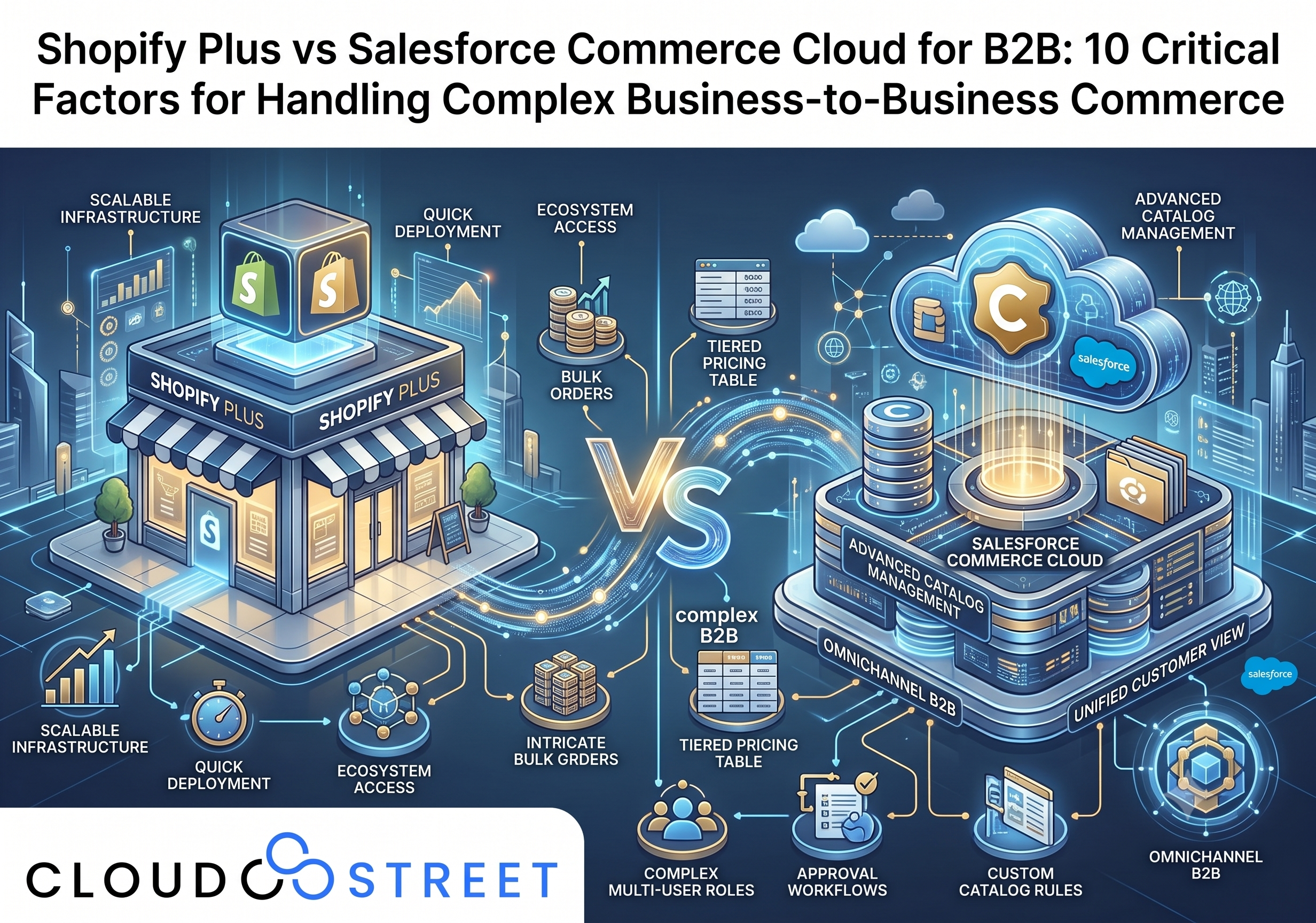
Choosing between Shopify Plus and Salesforce Commerce Cloud (now often referred to as Agentforce Commerce) isn’t just about picking a website builder. For manufacturers, distributors, and wholesalers, it’s about choosing an engine that can actually power the complexity of how you do business.
At a.CLOUDSTREET, we spend our days in the trenches of Salesforce implementation, helping businesses maximize their ROI. We’re based right here in Houston, Texas, but we work with clients locally and across the globe to navigate these exact architectural decisions. We’ve seen the “B2B Gold Rush” where everyone wants to go digital, but many realize too late that their chosen platform can’t handle their specific contract rules or buyer hierarchies.
Is Shopify Plus a great platform? Absolutely. It’s sleek, fast, and has made massive strides in B2B. But is it the right tool for a distributor with 500 accounts, each with its own negotiated price list and multi-level approval chain? That’s where things get interesting.
The “B2C-First” vs. “B2B-Native” Architectures
Shopify Plus is a B2C powerhouse that has added B2B features over time. They’ve done a great job adding things like company profiles, price lists, and net terms. It’s perfect for a brand that is 80% direct-to-consumer but wants to offer a clean portal for their wholesale partners.
Salesforce Commerce Cloud, on the other hand, was architected from the ground up to handle the “alphabet soup” of enterprise B2B: RFQs, CPQ integration, account hierarchies, and complex budgets. Because it lives on the Salesforce platform, it doesn’t just “talk” to your CRM: it is your CRM.
Schedule a Call with our Houston-based Experts
6 Real-World B2B Scenarios Where Shopify Plus Often Struggles
While Shopify Plus can handle “simple” wholesale, it often hits a wall when the business logic gets “messy.” Here are 6 scenarios where we see businesses needing the deeper power of Salesforce Commerce Cloud.
- Multi-Level Buyer Approvals: In many B2B organizations, a junior buyer can place an order, but if it’s over $5,000, it must be approved by their manager. Shopify’s native B2B features are largely flat; building this kind of multi-step approval workflow often requires custom apps or heavy middleware.
- Complex Account Hierarchies: If you sell to a massive conglomerate with five subsidiaries, each with different shipping addresses but a shared credit limit, Salesforce handles this natively. Shopify’s “Company” model is improving, but it still struggles with deep, multi-tiered organizational structures.
- Negotiated Quotes (RFQ Workflows): Many B2B deals aren’t “add to cart.” They start with a Request for Quote (RFQ). Salesforce allows a buyer to submit a cart as a quote, which a sales rep can then edit in the CRM and send back for approval. This seamless loop is difficult to replicate in Shopify without a “middleware tax.”
- Requisition Lists: For manufacturers, buyers often need to order the same 50 parts every Tuesday. Salesforce offers native requisition lists that are easy to manage. While Shopify has “reorder” buttons, the granular management of large-scale procurement lists is less robust.
- Credit Limit Enforcement: In B2B, you aren’t always charging a credit card. You’re checking a “Line of Credit.” Salesforce can lock a checkout in real-time if a customer has exceeded their credit limit across all channels (offline and online) because it’s looking at the live CRM data.
- Granular Budget Controls: Some B2B buyers have monthly or quarterly budgets. Salesforce allows you to set and enforce these budgets at the account or user level, preventing “rogue” spending before the order is even placed.

If your business faces these 6 challenges, you might find that the “simplicity” of Shopify actually creates more manual work for your team. Our team at a.CLOUDSTREET helps global clients determine if they’ve outgrown their current stack: check out our detailed comparison guide on Shopify vs Salesforce Commerce Cloud for a deeper dive.
The Hidden Cost: The “Middleware Tax”
One of the most common arguments for Shopify is its lower upfront subscription cost. However, for a complex B2B business, Shopify often requires 3, 5, or even 10+ third-party apps to function like an enterprise platform.
Every time you add an app for “Advanced Approvals” or “Custom Quoting,” you’re adding a point of failure and an extra monthly fee. More importantly, you often end up needing middleware like Celigo or Boomi to sync these fragmented data points back to your ERP or CRM.
In the Salesforce ecosystem, these features are native. By utilizing Salesforce B2B Commerce Cloud, you eliminate the “glue code” that keeps IT directors up at night.
Get a Quote for Your Salesforce Implementation
4 Cost Factors to Consider Beyond the Subscription
When comparing the Total Cost of Ownership (TCO), don’t just look at the monthly license fee. You have to look at the long-term ROI of the implementation. Here are 4 factors to keep in mind:
- Integration Complexity: If your data is already in Salesforce (Sales Cloud or Service Cloud), the cost to integrate a Shopify store is significantly higher than simply “turning on” Commerce Cloud.
- Internal Productivity: How much time will your sales reps save if they can see a customer’s online cart and convert it to a quote inside their CRM? Salesforce is built for this synergy.
- Maintenance of the “App Stack”: Maintaining 10 Shopify apps plus a middleware layer requires constant oversight. With Salesforce, you are on a unified platform with three major releases a year that don’t break your customizations.
- AI Readiness: With the rise of Salesforce Artificial Intelligence, Salesforce users can leverage Agentforce to automate customer service and sales recommendations natively. This “out of the box” intelligence is much harder to assemble piecemeal on Shopify.

Making the Right Choice for Your Growth
So, which platform wins?
- Choose Shopify Plus if: You are a mid-market business with relatively simple B2B needs, you want to launch in 60 days, and your B2B sales look very similar to your B2C sales.
- Choose Salesforce Commerce Cloud if: You are a manufacturer or distributor with complex contract pricing, multi-layered account structures, and a need for deep CRM integration to drive true Salesforce Services efficiency.
At a.CLOUDSTREET, we don’t just “install” software. We implement ROI. Whether you are a local Houston business or a global enterprise, we help you choose the platform that will scale with your complexity, not against it.

Contact Our Team to Discuss Your Architecture
Category
Discover insights that drive results - explore out latest blog posts now
DealHub Salesforce Integration for Manufacturers: Connecting CPQ, Contracts, and CRM
About the manufacturer: mid-market industrial equipment company A U.S.-based, mid-market [...]
Salesforce Data 360 and Agentforce: Why Grounding Is What Makes AI Agents Dependable
An AI agent can produce a fluent answer and still [...]
Salesforce Data 360 Governance and Informatica: Managing Data Quality, Access, and Trust in the Agentic Era
Data governance becomes more consequential when business data does more [...]