SEO vs GEO: What Modern Businesses Need to Know: and How CloudStreet Can Help
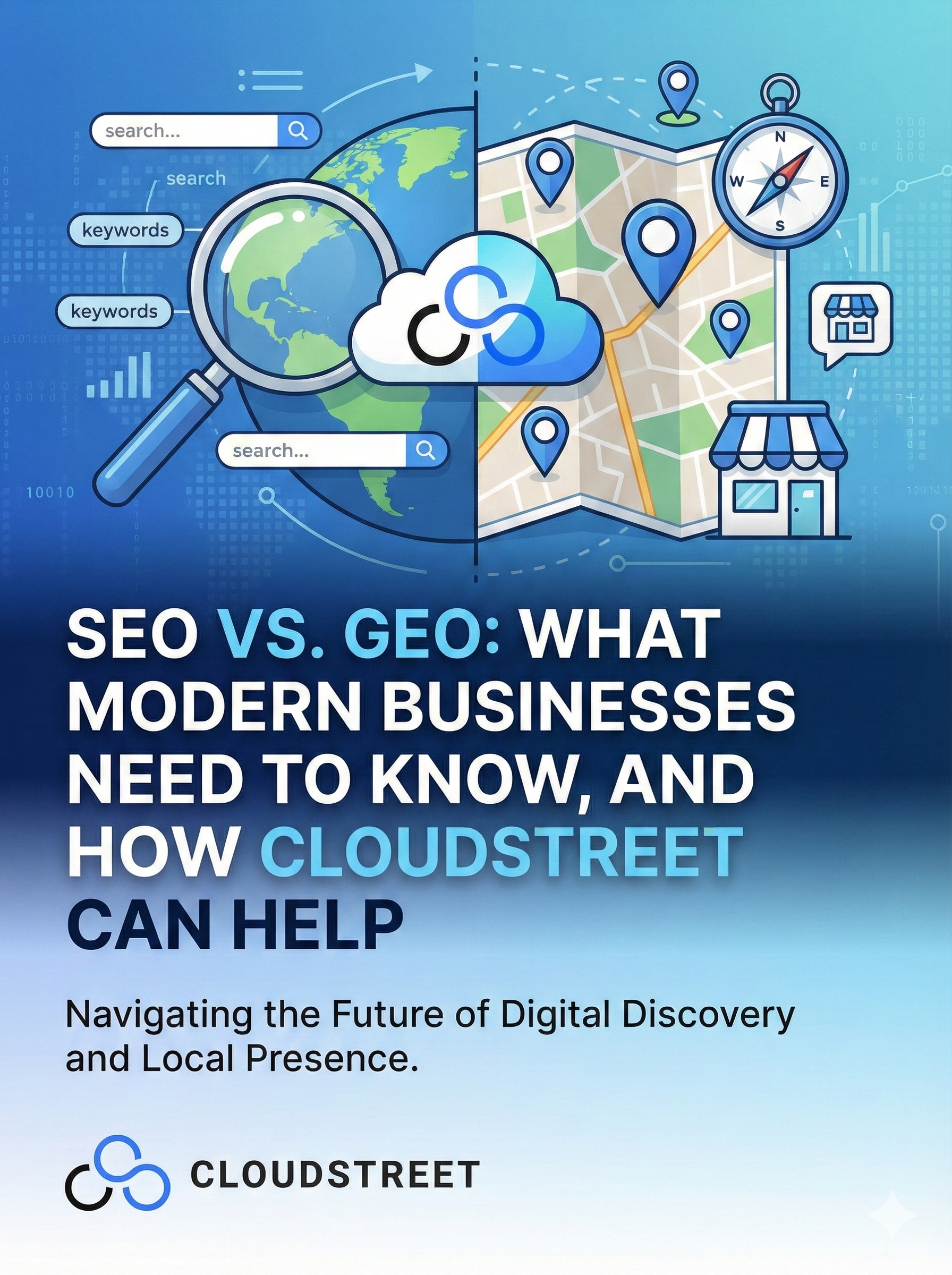
The digital marketing landscape is shifting faster than ever. While traditional SEO still drives millions of clicks daily, a new player has emerged: GEO, or Generative Engine Optimization. If you’re wondering what this means for your business strategy, you’re not alone. Many companies are scrambling to understand how AI-powered search is changing the game.
At CLOUDSTREET, we’ve been helping businesses in Houston, Texas, and around the globe navigate these changes for several years. What we’ve learned is that smart companies don’t choose between SEO and GEO: they master both.
Understanding Traditional SEO: The Foundation That Still Matters
Search Engine Optimization has been the backbone of digital marketing since Google’s early days. The goal is straightforward: rank higher in search results to get more clicks and drive traffic to your website.
Traditional SEO focuses on three core elements:
- Keyword optimization – Targeting specific terms your audience searches for
- Link building – Earning backlinks from authoritative websites
- Technical optimization – Ensuring your site loads fast and works properly
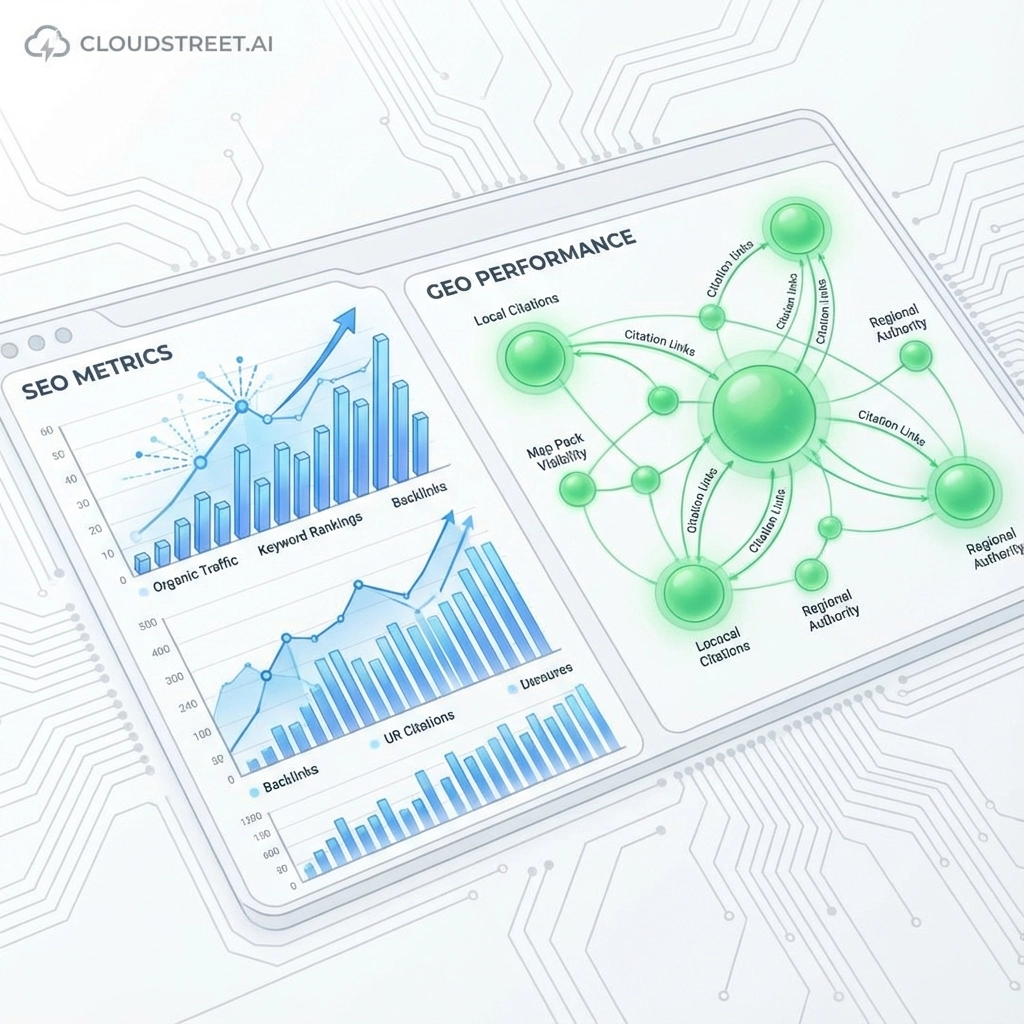
The success metrics are familiar: organic traffic, keyword rankings, click-through rates, and conversions. When someone searches “IT consulting Houston,” you want your business appearing at the top of those results.

What is GEO (Generative Engine Optimization)?
Generative Engine Optimization represents a fundamental shift in how people find information. Instead of clicking through search results, users increasingly get answers directly from AI systems like ChatGPT, Google’s AI Overviews, and Perplexity.
GEO focuses on getting your brand cited and referenced within these AI-generated responses. Think of it this way: instead of competing for position #1 in search results, you’re competing to become part of the answer itself.
Here are the 4 key differences that set GEO apart:
- Answer integration – Your content becomes part of AI responses
- Citation-based authority – Success measured by mentions and references
- Context over keywords – AI systems understand meaning, not just matching terms
- Zero-click satisfaction – Users get answers without visiting your website
The 5 Critical Ways SEO and GEO Differ in Practice
Understanding these differences helps you build the right strategy for each approach:
1. Content Structure and Depth
Traditional SEO content is often designed for quick scanning: headers, bullet points, and short paragraphs that users can skim quickly. GEO content needs to be comprehensive and contextual, giving AI systems rich information to work with while still being human-readable.
2. Authority Signals
SEO relies heavily on backlinks and domain authority. GEO values content clarity, proper schema markup, and demonstrable expertise. AI systems look for authoritative language, data citations, and clear expertise indicators.
3. Success Measurement
SEO tracks rankings, traffic, and conversions. GEO success is harder to measure but includes brand mentions in AI responses, citation frequency, and visibility in AI-generated summaries.
4. Optimization Targets
SEO targets search engines like Google and Bing. GEO targets AI systems that power chatbots, voice assistants, and AI-enhanced search features.
5. User Intent Fulfillment
SEO aims to match user queries and drive clicks. GEO aims to provide comprehensive answers that satisfy user intent immediately, even without a click.
Why Your Business Needs Both SEO and GEO
The biggest mistake we see companies make is thinking GEO replaces SEO. That’s like saying email marketing replaced direct mail: both serve different purposes in your overall strategy.
Here’s why you need both approaches working together:
SEO drives discovery and traffic. When potential customers are actively searching for solutions, you want to appear in those results and capture that high-intent traffic.
GEO builds authority and trust. When AI systems cite your expertise or reference your data, it positions your brand as an authority before users even know they need your services.
At CLOUDSTREET, we’ve seen clients achieve the best results when they integrate both strategies. Our B2B SEO services now include GEO optimization because the two approaches amplify each other.
6 Essential GEO Optimization Strategies for 2025
If you’re ready to optimize for AI-driven search, here are the strategies that work:
1. Create Comprehensive, Authoritative Content
AI systems favor detailed, well-researched content over thin pages. Include statistics, expert quotes, case studies, and original research. Make your expertise obvious and well-documented.
2. Implement Proper Schema Markup
Help AI systems understand your content structure by using schema markup. This structured data helps AI engines identify key information like company details, services, and expert credentials.
3. Focus on Entity Recognition
AI systems recognize entities (people, companies, concepts) rather than just keywords. Clearly establish your brand as an entity in your industry and consistently reference related entities.
4. Develop Original Frameworks and Data
Original research, proprietary frameworks, and unique data sets make your content more likely to be cited by AI systems. Create resources that others in your industry reference.
5. Optimize for Conversational Queries
People ask AI systems questions differently than they search Google. Optimize for natural language queries and conversational patterns.
6. Build Topical Authority Clusters
Instead of focusing on individual keywords, build comprehensive content clusters around your core expertise areas. This helps AI systems understand your authority in specific topics.
The 4-Step Integration Strategy We Use at CLOUDSTREET
Working with clients across Houston and internationally, we’ve developed a systematic approach to combining SEO and GEO:
Step 1: Foundation Assessment
We audit your current SEO performance and identify opportunities for GEO optimization. This includes technical health, content quality, and authority signals.
Step 2: Dual-Purpose Content Creation
We create content that serves both SEO and GEO objectives: keyword-optimized for search engines but comprehensive and authoritative for AI systems.
Step 3: Technical Implementation
We implement the technical elements needed for both strategies: proper schema markup, site speed optimization, and structured data that AI systems can easily parse.
Step 4: Performance Monitoring
We track traditional SEO metrics alongside GEO indicators like brand mention frequency and visibility in AI-generated responses.

Common GEO Mistakes to Avoid
As more businesses discover GEO, we’re seeing several common mistakes:
Neglecting SEO fundamentals. GEO builds on strong SEO foundations. Without good technical SEO, your GEO efforts won’t be as effective.
Focusing only on AI systems. Remember that real humans still need to find and engage with your content. Balance optimization for both AI and human readers.
Expecting immediate results. Like SEO, GEO is a long-term strategy. Building authority and recognition in AI systems takes time and consistent effort.
What This Means for Your Business Strategy
The businesses that will succeed in this evolving landscape are those that adapt their content and optimization strategies now. Whether you’re a local Houston company or serve customers globally, the combination of SEO and GEO gives you the best chance of being found: whether users are searching traditionally or asking AI systems for recommendations.
The key is starting with a solid strategy that addresses both approaches systematically. This isn’t about choosing between old and new methods: it’s about evolution.
Ready to get started? Here are three ways CLOUDSTREET can help you navigate the SEO vs GEO landscape:
Free Strategy Discussion: Schedule a 30-minute call to discuss how GEO could impact your specific industry and current SEO efforts.
Content Audit: Get a comprehensive review of your existing content to identify both SEO gaps and GEO opportunities.
Custom SEO + GEO Strategy: Work with our team to develop an integrated approach that maximizes your visibility across both traditional search and AI-powered platforms.
The future of search is here, and it includes both SEO and GEO working together. The question isn’t whether to adapt: it’s how quickly you can get started.
Contact CLOUDSTREET today to learn how our integrated SEO and GEO strategies can boost your online visibility and drive meaningful results for your business.
Category
Discover insights that drive results - explore out latest blog posts now

Case Study: How Highland Cabinetry Colorado Built a Modern Wholesale Powerhouse on Salesforce B2B Commerce Cloud
In the world of high-end cabinetry, timing is everything. When [...]

Agentforce ROI: 7 Ways to Maximize Your Salesforce AI Investment
You've heard the buzz. Salesforce Agentforce is supposed to revolutionize [...]

Salesforce B2B Commerce Cloud Partner & Consultant Guide
You're about to drop serious money on a Salesforce B2B [...]