Seattle Aviation Solutions Modernizes Aviation Parts Sales with Salesforce B2B Commerce
Category: Blog
Label: Agentforce Commerce
Executive summary: A scalable aviation parts commerce foundation
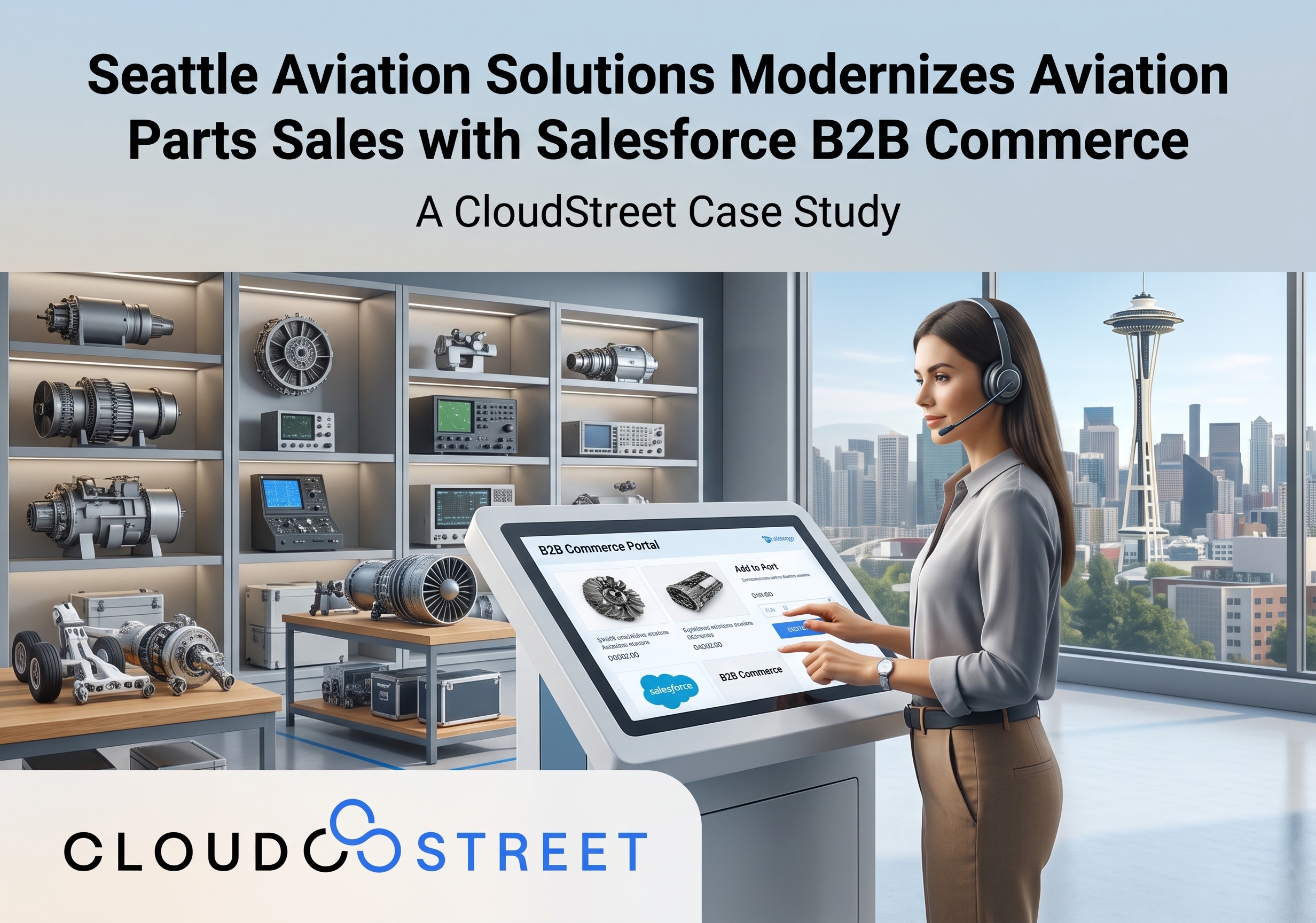
Seattle Aviation Solutions, a global aviation spare-parts and services business, was replacing an existing custom .NET storefront with Salesforce B2B Commerce Lightning Experience (B2B Commerce LE).
The objective was to provide aviation buyers with a more capable, self-service aviation parts e-commerce portal while creating a foundation that could support a very large product catalog, complex customer-specific data, quote requests, inventory visibility, payment processing, and future expansion.
The implementation included more than 430,000 SKUs, several integrations with external systems, and connections to internal managed-package objects already operating within the client’s Salesforce org. We also developed aviation-specific buyer workflows, including CSV cart uploads, custom quote requests for unavailable parts, related-product recommendations, discounts, and heavily customized storefront pages.
At the relevant project reporting point: the end of June: the implementation was still in development, with go-live expected in mid-July. Accordingly, this Seattle Aviation Solutions case study does not claim production performance, completed results, or measured ROI. The benefits discussed are hypothetical, anticipated, or projected benefits based on the solution design.
If your organization is evaluating a similar modernization, Schedule a Call to discuss your catalog, portal, integration, and rollout considerations.
Client context and the legacy storefront challenge
Seattle Aviation Solutions is a global aviation spare-parts and services business serving a market in which buyers often need to find highly specific parts quickly, verify availability, review pricing, and place orders against established commercial terms.
Its existing storefront was custom-built on .NET. While that platform supported Seattle Aviation Solutions’ existing processes, the business was seeking:
- Enhanced commerce features
- Increased functionality for aviation buyers
- A more scalable foundation for future requirements
- Closer alignment between the storefront and Salesforce data
- A more flexible basis for integrations and continued development
Aviation aftermarket commerce is different from a simple product catalog. Buyers may search by part number, manufacturer reference, interchange information, availability, condition, or other technical attributes. They may also need to order many items at once, request quotes for unavailable parts, or work with negotiated discounts.
For leadership, the technology decision was therefore not simply a website replacement. It involved considerations around catalog performance, data accuracy, quoting, order processing, payment, inventory, and the operational dependencies already present in the Salesforce org.
Why Salesforce B2B Commerce LE for aviation parts distribution
Salesforce Commerce solutions can support several commerce models, including:
- B2B Commerce for business buyers, distributors, operators, MROs, and other commercial accounts
- B2C Commerce for direct-to-consumer purchasing experiences
- D2C Commerce for manufacturers or brands selling directly to customers
This specific project was a Salesforce B2B Commerce LE implementation for aviation parts distribution for Seattle Aviation Solutions. The focus was a business buyer portal rather than a consumer storefront.
For this use case, B2B Commerce LE provided a platform for bringing commerce experiences closer to Salesforce account, order, quote, pricing, and inventory data. It also allowed the implementation to extend the standard storefront experience where the client’s aviation buying workflows required additional functionality.
Our B2B Commerce Accelerator outlines how Salesforce storefronts can support self-service ordering, customer-specific pricing, rapid reordering, product relationships, and integrations.
Solution architecture and large catalog considerations

The project was a moderately customized implementation with several integrations and a product catalog exceeding 430,000 SKUs. At that scale, the catalog architecture and data quality become central elements of the commerce experience.
The implementation required careful consideration of:
- Catalog search and performance: Buyers need responsive search and navigation even when the underlying catalog is very large. Part-number search, filters, category structures, and page design all influence usability.
- Part-number and product-data quality: Aviation parts data may contain manufacturer references, alternate identifiers, condition information, descriptions, and other technical attributes. Consistent formatting and data governance can help buyers find the correct item and reduce ambiguity.
- Pricing and stock visibility: The storefront needed to reference pricing from a custom Prices object and stock information from a custom Inventory object. This created a foundation for displaying more relevant customer-specific information during the buying process.
- Salesforce managed-package dependencies: The client already used internal managed packages and custom objects. Commerce records therefore needed to work with existing business processes rather than operate as an isolated storefront.
- Future extensibility: The architecture was designed with future product, account, portal, integration, and AI enhancements in mind. Potential future use cases could include guided search, recommendation experiences, agent-assisted quoting, or other Agentforce Commerce capabilities, subject to appropriate governance and data readiness.
A large aviation catalog also creates a practical testing requirement: performance should be evaluated using representative catalog volumes and realistic buyer searches, not only a small sample of products.
Integrations connecting commerce with operational records

The storefront was connected to external payment processing and several Salesforce objects used by the client’s existing operations.
1. Authorize.net payment integration
Payment processing was integrated with Authorize.net. The project team understood this to be the first known B2B Commerce implementation using this gateway, subject to confirmation by Salesforce and the client.
This integration was important because payment requirements can vary significantly across B2B commerce environments. The implementation needed to support a payment workflow appropriate for the client’s operating model while preserving the broader B2B checkout experience.
2. Commerce Orders replicated into Sales Orders
B2B Commerce Orders were replicated into Sales Orders represented by a managed-package object. This approach was intended to connect the storefront transaction with the client’s existing sales and operational processes.
3. Cart quote requests connected to Customer Quote records
A buyer selecting Request a Quote from the cart could create a Customer Quote record in an existing managed-package Customer Quote object. This gave unavailable or non-standard purchase requirements a path into the client’s established quoting workflow.
4. Pricing lookup from a custom Prices object
Pricing was retrieved from a custom Prices object. This supported a design in which the buying experience could reflect the client’s existing pricing logic rather than rely exclusively on a generic storefront price.
5. Stock lookup from a custom Inventory object
Stock information was retrieved from a custom Inventory object. For aviation buyers, visibility into availability can influence whether an item is purchased immediately, quoted, or sourced through another process.
For a broader view of our integration capabilities, visit Salesforce Services or review our approach to Salesforce and Oracle Fusion integration.
Customizations and buyer workflows

The project extended the standard B2B Commerce experience to address the way aviation parts buyers work.
1. CSV upload for mass-loading cart items
Buyers could upload a CSV file to add multiple items to a cart. For organizations purchasing against provisioning lists, maintenance requirements, or repeat supply schedules, this workflow could reduce the need to search for each line individually.
2. Custom Request a Quote workflow
The storefront included a custom Request a Quote process for items that were not in stock. Rather than presenting an unavailable product as a dead end, the workflow connected the request to the existing Salesforce quoting process.
3. Custom discount functionality
Custom discount functionality was added to support the client’s commercial requirements. The exact rules for discounts, eligibility, and approvals remain business-specific and should be documented and tested as part of ongoing governance.
4. Related-products functionality
A custom related-products feature helped connect a primary part with potentially relevant products or alternatives. In aviation parts distribution, this could support accessory discovery, related maintenance requirements, or alternate purchasing paths when the original item is unavailable.
5. Heavily customized page designs
Several pages were heavily customized to meet the client’s requirements and aviation buying workflows. This allowed the storefront to present catalog and transaction information in a way that was more aligned with how commercial aviation customers research and purchase parts.
Project status and expected benefits
As of the end of June, the implementation remained in development, with go-live expected in mid-July. Because the project had not yet reached confirmed production operation at that point, the following are expected or hypothetical benefits, not measured results:
- A more scalable commerce foundation: Salesforce B2B Commerce LE could provide a stronger basis for growth than a legacy custom storefront as catalog volume, buyer demand, and requirements increase.
- Improved buyer self-service: Aviation buyers could have a more direct way to search a large parts catalog, review availability and pricing, create carts, submit quotes, and place orders.
- Faster bulk cart creation: CSV upload could make large or repeat orders easier to assemble.
- More productive handling of unavailable parts: Quote requests could help convert out-of-stock demand into sales opportunities rather than losing the buyer at the product page.
- Better data alignment: Connecting commerce orders, sales orders, customer quotes, pricing, and inventory records could reduce disconnected workflows and manual reconciliation.
- More relevant pricing and stock visibility: Custom Prices and Inventory objects could support a buying experience that better reflects the customer’s commercial context.
- Reduced manual work: Automated record creation and replication could potentially reduce repetitive entry for sales, operations, and customer service teams.
- Greater payment flexibility: The Authorize.net integration could provide a payment path aligned with the client’s requirements.
- A basis for future enhancements: A Salesforce-centered commerce foundation could support future portal, integration, product, account, analytics, and Agentforce Commerce initiatives when appropriate.
These benefits would need to be validated after go-live through agreed measures such as portal adoption, search performance, quote volume, order processing effort, data accuracy, payment completion, and buyer feedback.
What this means for aviation parts distributors
Aviation distributors considering Salesforce B2B Commerce should approach the project as an operating-model modernization, not only a storefront redesign.
Key implementation considerations include:
- Testing catalog search and page performance at a 430,000-plus SKU scale
- Establishing standards for part numbers, interchanges, manufacturer data, and product attributes
- Defining customer-specific pricing, discounts, stock visibility, and account permissions
- Designing quote workflows for unavailable, non-stock, or special-order parts
- Supporting bulk ordering and repeat purchasing patterns
- Managing dependencies on internal managed packages and custom Salesforce objects
- Testing payment, order replication, quote creation, pricing, inventory, and CSV workflows
- Planning a phased go-live with training, support, monitoring, and operational readiness
Contact Our Team if your organization is assessing a legacy storefront replacement or a new Salesforce aviation parts catalog.
CloudStreet’s aviation B2B Commerce experience
We have deep experience with aviation parts distribution and complex B2B e-commerce portals. Our work includes aviation catalogs, customer-specific pricing, real-time or near-real-time inventory visibility, quoting, backorders, customer self-service, bulk ordering, and integrations between Salesforce and surrounding systems.
This experience informs how we approach Salesforce B2B Commerce aviation projects. We consider the commercial process, the operational data model, the buyer experience, and the integration dependencies together.
Our aviation-related Salesforce commerce experience includes connecting B2B storefronts with specialized aviation software and supporting workflows such as bulk orders, quote requests, related products, custom product displays, inventory visibility, and condition-based purchasing. We also bring broader implementation, integration, development, and managed-support capabilities through our Salesforce Services.
For organizations exploring AI-enabled commerce, Salesforce’s Agentforce capabilities may eventually support product recommendations, guided buying, or assisted quote and service workflows. We discuss those possibilities through our Salesforce AI and Agentforce services, while recognizing that data quality, governance, and process maturity should come first.
Conclusion
Modernizing an aviation parts e-commerce portal requires more than transferring products from one storefront to another. The Seattle Aviation Solutions project described here combined Salesforce B2B Commerce LE with a catalog exceeding 430,000 SKUs, custom pricing and inventory objects, managed-package sales and quote records, Authorize.net payment processing, CSV ordering, quote workflows, discounts, related products, and customized pages.
At the end of June, the implementation was still in development, with go-live expected in mid-July. Its expected value was centered on creating a more flexible and scalable foundation for aviation buyers and the teams supporting them: not on claiming results before production validation.
CloudStreet is based in Houston, Texas, and serves customers locally and globally. If you are evaluating B2B Commerce for aviation distributors or a modernization program similar to Seattle Aviation Solutions, Schedule a Call or Get a Quote to discuss your catalog, portal, data, and integration priorities.
Category
Discover insights that drive results - explore out latest blog posts now
DealHub Salesforce Integration for Manufacturers: Connecting CPQ, Contracts, and CRM
About the manufacturer: mid-market industrial equipment company A U.S.-based, mid-market [...]
Salesforce Data 360 and Agentforce: Why Grounding Is What Makes AI Agents Dependable
An AI agent can produce a fluent answer and still [...]
Salesforce Data 360 Governance and Informatica: Managing Data Quality, Access, and Trust in the Agentic Era
Data governance becomes more consequential when business data does more [...]