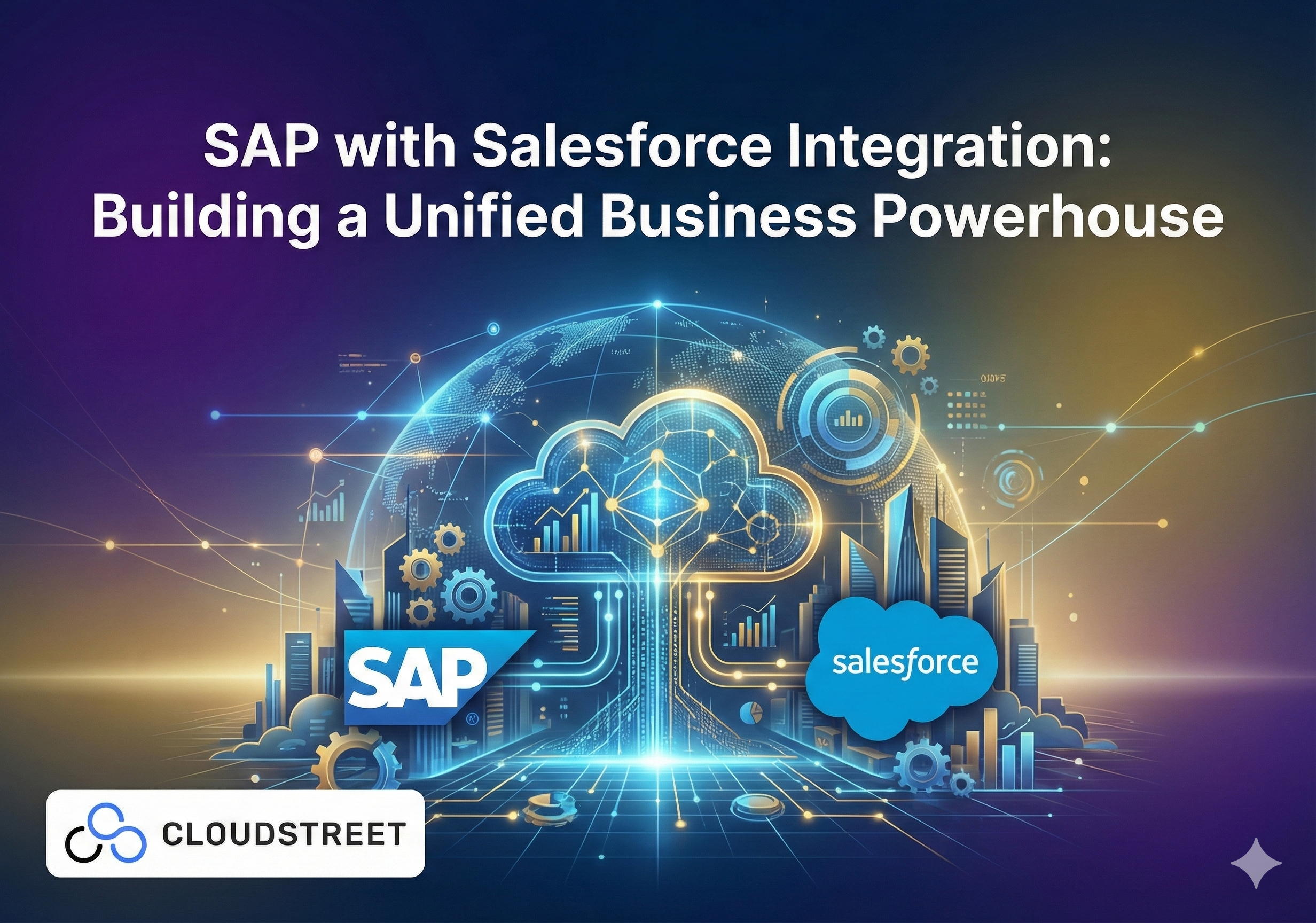
SAP with Salesforce Integration: Building a Unified Business Powerhouse
When your sales team in Salesforce can’t see real-time inventory data from SAP, or when your finance department struggles to match customer orders with actual shipments, you’re dealing with classic business silos. These disconnected systems create inefficiencies, errors, and missed opportunities that can cost your organization thousands of dollars monthly.
SAP with Salesforce integration bridges this gap by connecting your front-office customer relationship management with back-office enterprise resource planning. The result? A unified data environment that eliminates information silos and enables seamless business operations across departments.
At Cloudstreet, we’ve helped businesses from our Houston, Texas headquarters to companies worldwide transform their operations through strategic Salesforce Services integrations. Let’s explore how combining these two powerhouse platforms can revolutionize your business processes.
What Makes SAP-Salesforce Integration So Powerful?
Think of your business as a symphony orchestra. Without integration, your sales, finance, inventory, and customer service teams are like musicians playing different songs. SAP-Salesforce integration acts as the conductor, ensuring everyone plays in harmony with access to the same real-time information.
This integration creates a 360-degree customer view by combining CRM pipeline insights with ERP capacity, inventory, and financial data. Sales representatives can access accurate pricing and inventory information directly within Salesforce, while finance teams see real-time order and revenue data flowing seamlessly from both systems.

Ready to eliminate data silos in your organization? Our Salesforce Services team can design a custom integration strategy that fits your business needs.
5 Game-Changing Benefits of SAP-Salesforce Integration
1. Automated Business Processes That Save Hours Weekly
Integration automates critical workflows like the order-to-cash cycle, including quote creation, order processing, invoicing, and delivery tracking. When a sales order is created in Salesforce, corresponding data automatically updates in SAP, streamlining order fulfillment and inventory management.
This automation eliminates manual data entry between systems, reducing the risk of human error and freeing your teams to focus on strategic initiatives rather than administrative tasks. Companies typically see a 40-60% reduction in manual data processing time within the first quarter of implementation.
2. Real-Time Data Access Across All Departments
Gone are the days of waiting for end-of-day reports or calling different departments for inventory updates. Teams gain access to synchronized, up-to-date information whenever they need it. Sales representatives can check SAP inventory levels while on customer calls, and customer service can access complete order histories spanning both systems.
This real-time visibility enables faster decision-making and more accurate customer communication. Your sales team can confidently commit to delivery dates, knowing they have current inventory and production capacity data at their fingertips.
3. Enhanced Forecasting and Revenue Planning
With unified data flowing between SAP and Salesforce, your forecasting becomes significantly more accurate. Pipeline data from Salesforce combines with production capacity and inventory levels from SAP to create comprehensive revenue projections.
Finance teams can better predict cash flow, while operations can plan production schedules based on actual sales pipeline probability. This integrated approach typically improves forecast accuracy by 25-35% compared to siloed systems.
4. Reduced Errors and Improved Data Consistency
Dual data entry is a recipe for mistakes. Integration eliminates this by ensuring data entered once flows automatically to all relevant systems. Built-in validation rules and audit trails help maintain data quality while reducing compliance risks.
Automated syncing with proper error handling means your teams always work with accurate, consistent information. This data integrity is crucial for financial reporting, customer service, and strategic planning.
5. Significant Cost Savings and ROI
Beyond the obvious savings from reduced manual work, integration delivers ROI through improved customer satisfaction, faster order processing, and better resource utilization. Companies typically see 15-25% cost reduction in administrative overhead within the first year.
Curious about the ROI potential for your specific business? Our team provides detailed cost-benefit analyses as part of our Salesforce Services consulting process.

Real-World Integration Scenarios That Drive Results
Manufacturing Excellence: A Houston-based manufacturing client integrated their SAP production planning with Salesforce opportunities. Sales reps now see real-time production capacity when creating quotes, while production managers receive automatic notifications about high-priority orders. Result: 30% faster quote turnaround and 95% on-time delivery rates.
Global Distribution: An international distributor connected SAP inventory management with Salesforce sales processes. Customer service teams can instantly check stock levels across multiple warehouses, while sales teams receive automatic notifications about low-stock items before making commitments. This integration reduced stockouts by 45% and improved customer satisfaction scores by 28%.
Financial Services Transformation: A financial services company integrated SAP financial data with Salesforce customer accounts. Account managers now have complete visibility into billing history, payment status, and credit limits during customer interactions, leading to more informed conversations and 20% faster contract negotiations.
Implementation Considerations for Success
Technical Architecture Matters
Successful SAP-Salesforce integration requires careful planning of data flows, security protocols, and system architecture. Consider factors like data volume, real-time vs. batch processing requirements, and security compliance needs specific to your industry.
Common integration approaches include middleware platforms like MuleSoft, direct API connections, or ETL tools depending on your specific requirements and existing infrastructure.
Data Mapping and Governance
Establishing clear data mapping between SAP and Salesforce fields ensures information flows correctly and maintains meaning across systems. This includes defining data transformation rules, validation criteria, and conflict resolution procedures.
Planning an integration project? Our experienced team helps map out your data requirements and design robust governance frameworks that scale with your business.

Change Management and Training
Technology integration succeeds when people embrace the new processes. Plan comprehensive training for teams using both systems and establish clear procedures for handling integrated workflows.
User adoption typically increases when teams understand how integration makes their daily work easier and more efficient.
Cloudstreet’s Proven Integration Approach
From our Houston headquarters, we’ve developed a methodology that ensures successful SAP-Salesforce integrations for businesses locally and globally. Our approach includes:
Discovery and Planning Phase: We start by understanding your current business processes, data flows, and integration objectives. This includes mapping existing systems, identifying pain points, and defining success metrics.
Custom Architecture Design: Every business is unique, so we design integration architectures tailored to your specific requirements, including security protocols, data governance, and scalability considerations.
Phased Implementation: Rather than big-bang approaches, we implement integrations in phases, allowing teams to adapt gradually while minimizing business disruption.
Ongoing Support and Optimization: Integration is not a one-time project. We provide ongoing monitoring, optimization, and support to ensure your integrated systems continue delivering value as your business grows.
Want to see how this approach could work for your organization? Schedule a consultation with our Salesforce Services team to discuss your integration goals.
Measuring Integration Success
Successful SAP-Salesforce integration delivers measurable business results. Key performance indicators to track include:
- Process Efficiency: Time savings in order processing, quote generation, and data entry tasks
- Data Accuracy: Reduction in errors, duplicate records, and data inconsistencies
- Customer Satisfaction: Improved response times and service quality metrics
- Revenue Impact: Faster sales cycles, improved win rates, and better forecasting accuracy
- Cost Reduction: Decreased administrative overhead and operational expenses
Most organizations see initial benefits within 60-90 days of implementation, with full ROI typically achieved within 12-18 months.
Future-Proofing Your Integration Investment
As both SAP and Salesforce continue evolving their platforms, your integration strategy should account for future updates, new features, and changing business requirements. Cloud-based integration platforms offer flexibility to adapt as systems change without requiring complete rebuilds.
Consider integration approaches that support scalability, new data sources, and emerging technologies like artificial intelligence and machine learning that can enhance your unified business platform.
The combination of SAP’s enterprise resource planning capabilities with Salesforce’s customer relationship management creates a unified business powerhouse that drives efficiency, accuracy, and growth. Companies that successfully integrate these platforms gain competitive advantages through better data visibility, automated processes, and improved customer experiences.
Ready to build your unified business powerhouse? Contact our Salesforce Services team today to start planning your SAP-Salesforce integration strategy. From our Houston base, we’re ready to help transform your business operations and drive measurable results.
Category
Discover insights that drive results - explore out latest blog posts now
Case Study: How Highland Cabinetry Colorado Built a Modern Wholesale Powerhouse on Salesforce B2B Commerce Cloud
In the world of high-end cabinetry, timing is everything. When [...]
Agentforce ROI: 7 Ways to Maximize Your Salesforce AI Investment
You've heard the buzz. Salesforce Agentforce is supposed to revolutionize [...]
Salesforce B2B Commerce Cloud Partner & Consultant Guide
You're about to drop serious money on a Salesforce B2B [...]