Salesforce Data 360 Explained: The Complete Guide to the Data 360 Product Family
Category: Blog
Label: Agentforce Commerce
When customer records, operational data and business documents live in separate systems, teams and AI agents may each work from a different version of the facts. Salesforce Data 360 is designed to connect that context, govern how it is used and make it available across the Salesforce platform.
In this comprehensive guide, we explain what Salesforce Data 360 is, how its product family fits together, and what organizations should consider before implementing it. Product names, packaging, availability and entitlements change over time, so confirm current details with Salesforce before making purchasing decisions.
What is Salesforce Data 360?
Salesforce Data 360, formerly known as Data Cloud, is Salesforce’s data platform for connecting and harmonizing information from Salesforce and external systems, then making trusted data and context available to business applications, analytics and AI. Its branding has evolved from Genie to Data Cloud and then Data 360; searches and Salesforce materials may still use “Data Cloud.” In other words, Salesforce Data Cloud vs Data 360 is generally a question of naming and product evolution, not two unrelated platforms.
Unlike a traditional customer data platform (CDP) focused mainly on marketing, Data 360 can support sales, service, commerce, analytics and AI use cases. Salesforce has been recognized by Forrester and Gartner in the CDP market; the scope and criteria of analyst reports vary by year.
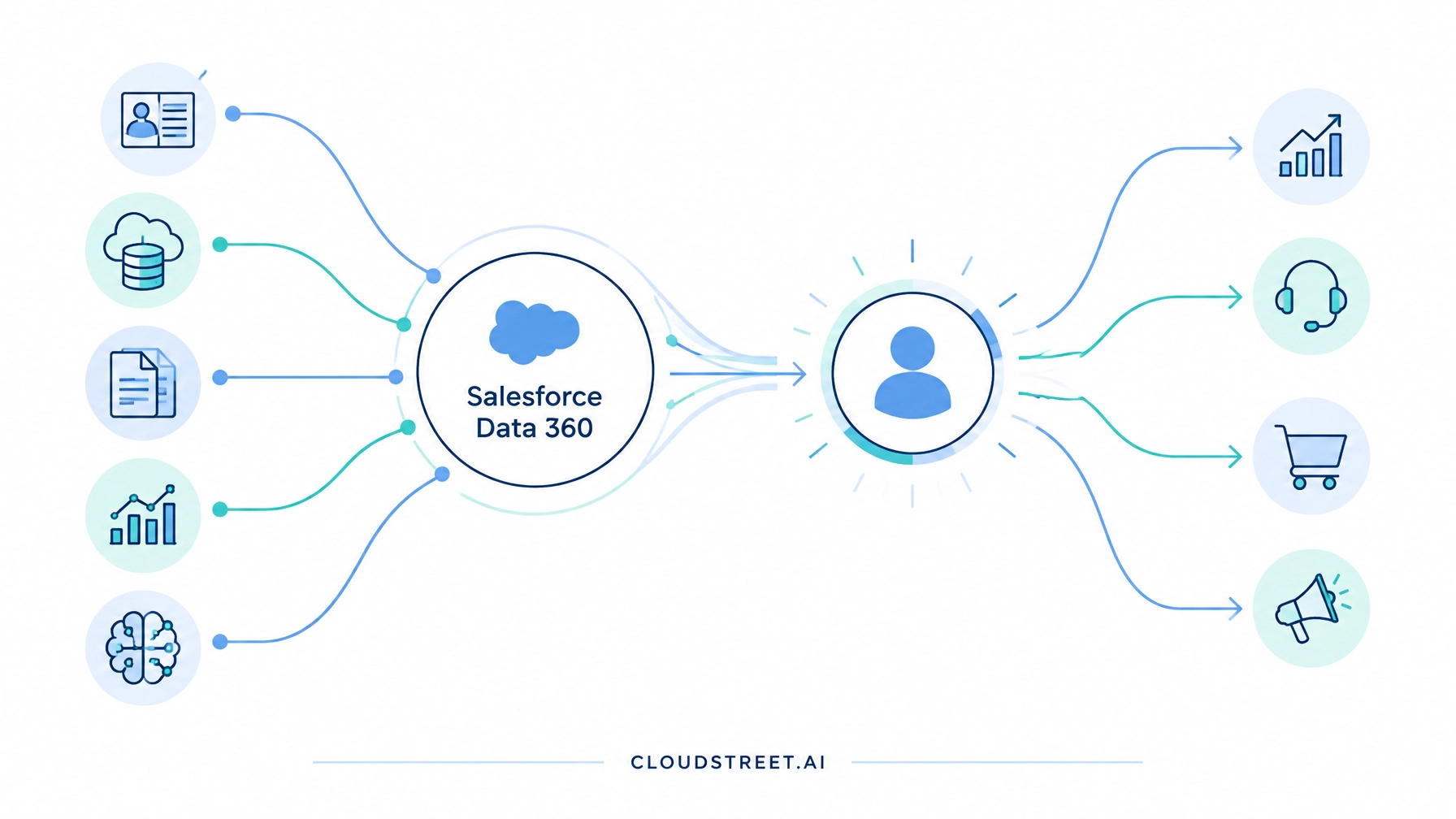
How Data 360 works: 5 connected steps

A Data 360 implementation typically follows five connected steps:
- Connect: Bring in information from Salesforce clouds, websites, legacy platforms and external data environments using connectors, MuleSoft, APIs and SDKs.
- Harmonize: Map incoming information to Salesforce’s metadata framework and data model so different source fields can be understood consistently.
- Unify: Apply identity and reconciliation rules to link records into profiles or other business entities.
- Govern: Apply permissions, classifications and policies to data access and use.
- Activate: Make insights available to Salesforce records, Flows, business applications, real-time actions and supported advertising or messaging destinations.
Zero-copy integrations can provide access to data in supported external platforms (including Snowflake, Databricks, Google BigQuery and AWS services such as S3 and Redshift) without first copying every dataset into Salesforce. Supported configurations and capabilities depend on the integration and customer agreement. Data 360 can also use Data Graphs for focused, high-performance data views; Calculated Insights for metrics such as lifetime value or engagement scores; segmentation; and machine-learning capabilities, including connections to Amazon SageMaker.
The 8 parts of the Salesforce Data 360 product family
| Product or capability | What it does | Who benefits |
|---|---|---|
| Data 360 core platform | Connects, harmonizes, models and activates business data | Salesforce teams, data leaders and application owners |
| Data 360 Headless | Exposes Salesforce context through APIs and MCP for other interfaces | Developers and AI teams |
| Document AI | Extracts and structures information from documents | Operations, finance, service and manufacturing teams |
| Identity Resolution | Matches and reconciles records into unified profiles | CRM, service and marketing teams |
| Marketing and CDP capabilities | Supports audience building, journeys and activation | Marketing teams |
| Tableau Semantics | Gives analytics and agents reusable business definitions | Analysts, data teams and AI builders |
| Data 360 Governance | Helps classify data and apply consistent policies | Security, compliance and data governance teams |
| Agentforce integration | Grounds agents in relevant, governed business context | Agentforce owners and business users |
1. Data 360 core platform
The core platform provides the data foundation: connectors, real-time ingestion, harmonization, Data Graphs, identity resolution, insights, segmentation and activation. It can work with structured records as well as unstructured content such as chat transcripts, PDFs and knowledge articles, including vector-based retrieval use cases. Data can enrich Salesforce objects, support Flow automations and reach supported destinations such as Google, Facebook, Amazon and WhatsApp.
Pricing is consumption-based and can involve credits, storage and premium add-ons. Salesforce says customers can start with limited free storage and credits; check the current pricing information and your contract to understand expected usage.
2. Data 360 Headless
Data 360 Headless extends Salesforce context beyond its standard interface: in this model, the API is the UI. Through APIs and the Model Context Protocol (MCP), an open standard, agents and applications can access approved Salesforce capabilities from surfaces such as Slack, Teams, ChatGPT, Claude or custom apps. Salesforce describes MCP access as included with Enterprise Edition and above without a separate SKU; Flex Credits may apply to Data 360 queries, Agentforce actions or Prompt Builder usage. Salesforce also offers prebuilt agent skills. Review Salesforce’s MCP developer information and confirm availability and entitlements for your org.
3. Document AI
Salesforce Document AI is a native Data 360 capability that uses OCR, large language models and multimodal processing to extract, classify, split and summarize document information into structured, queryable data. Teams configure a schema for the fields they want to capture from supported file types such as PDFs and JPEG, PNG, TIFF or BMP images. The resulting data can connect with Agentforce, Flows and Apex through Data 360 Connect REST APIs. Usage is subject to Data 360 or Flex Credit terms. See Salesforce’s Document AI architecture overview.
Potential uses include processing loan packets, claims, invoices, contracts, dealer documents, certificates and lab results. Third-party document-AI solutions are also available through AgentExchange, so compare fit, integration requirements and governance before selecting an approach.

4. Identity Resolution
Salesforce identity resolution brings records from different devices, channels and systems into unified profiles. Teams configure matching rules, which can use exact or fuzzy comparisons, and reconciliation rules, such as Last Updated or Most Frequent, to determine how conflicting values are handled. Rulesets define how records resolve into profiles. Data quality, source reliability and rule design all affect the results, so test against representative data before broad activation.
5. Data Cloud for Marketing and CDP capabilities
Marketing teams can use unified profiles to build segments, create campaign audiences, personalize journeys and activate data across supported channels. Data 360 connects with Marketing Cloud capabilities, while its wider platform can also make customer context useful to sales, service and commerce, not only marketing. The right architecture depends on the systems, consent requirements and activation destinations already in place.
6. Tableau Semantics
Salesforce Tableau Semantics is a governed semantic layer for reusable business definitions and metrics. It helps analytics and AI work from shared meanings, for example, a consistent definition of customer lifetime value or engagement, rather than relying on each dashboard or agent to interpret raw fields independently. Salesforce also describes AI-powered semantic modeling. Explore Tableau Semantics and assess how its definitions align with existing reporting.
7. Data 360 Governance and Informatica
Data 360 governance supports data classification, policy enforcement and controlled access across use cases such as Agentforce, analytics and segmentation, including governed access to ingested and zero-copy data. Secure transfer and flexible encryption-key management can be part of the broader governance design.
Salesforce completed its acquisition of Informatica in November 2025, strengthening its enterprise data management direction with capabilities in data quality, integration, metadata management, privacy, governance and master data management. The acquisition’s strategic role is to complement Salesforce’s data foundation; specific product integrations and packaging can evolve. Read Salesforce’s acquisition announcement.
8. Agentforce integration
Data 360 can ground Agentforce with structured records, unstructured information, metadata and memory. Trusted grounding helps agents retrieve relevant context and can reduce the risk of unsupported answers; it does not eliminate the need for testing, permissions and human oversight. Supplying relevant context can also avoid passing unnecessary material to a model, which may help manage token and model costs.
This fits Salesforce’s broader Agentic Enterprise architecture: Data 360 for trusted context, Customer 360 for applications and business logic, Agentforce for agents, and AIforce for bringing Salesforce capabilities to other interfaces. Read Salesforce’s AIforce announcement. Agentforce Coworker is another way Salesforce is bringing agent assistance into the employee workflow.
For commerce discussions, Agentforce Commerce applies to B2C, D2C and B2B Commerce. Data 360 can support relevant customer and business context, while commerce architecture, permissions and pricing rules still need deliberate configuration. Talk with our team about how these capabilities could fit your Salesforce environment.
Why Data 360 matters for SMBs, manufacturers and distributors
Manufacturers and distributors often hold business-critical details in dealer spreadsheets, invoices, packing slips, contracts, certificates and lab results. Document AI can extract selected fields from these sources; Data 360 can then harmonize them with CRM, ERP and service context. That can help teams make information available for workflows and decision support, subject to validation and governance.
Our earlier article explains how AI can turn unstructured data into structured information for manufacturers and distributors. At CloudStreet, our experience includes complex commerce environments, including a 430,000-plus-SKU aviation catalog, franchisee marketplaces, customer-specific pricing, Oracle Fusion integrations and quote-to-cash processes. Those projects illustrate why data models and integration choices need to reflect real operating rules, not just the CRM schema.
How CloudStreet helps with Salesforce Data 360 implementation
We assess data readiness, design harmonization and identity resolution strategies, configure connectors and zero-copy integrations, build Document AI schema configurations, implement governance and activate insights across Sales, Service, Commerce and Experience Cloud. For a detailed look at our delivery approach, methodology and cost management, see Salesforce Data 360 Implementation Services. We also help teams align data work with their wider Salesforce services and Salesforce AI and Agentforce plans.
CloudStreet is based in Houston, Texas, and serves customers locally and globally. For related integration and commerce work, explore our Oracle Fusion integration services and B2B Commerce Accelerator. If you are evaluating a project, schedule a call or get a quote.
A practical next step
Salesforce Data 360 can connect data, documents and applications, but value depends on clear use cases, sound data definitions, governance and realistic consumption estimates. Start by identifying where fragmented or unstructured data is slowing a customer or operational process, then determine what context needs to be available, and to whom.
For an outside perspective on planning, see our Houston Salesforce consulting guide. Product names, features, entitlements and pricing can change; validate them with Salesforce as you plan. Contact our team to discuss your Data 360 readiness and implementation options.
Category
Discover insights that drive results - explore out latest blog posts now
DealHub Salesforce Integration for Manufacturers: Connecting CPQ, Contracts, and CRM
About the manufacturer: mid-market industrial equipment company A U.S.-based, mid-market [...]
Salesforce Data 360 and Agentforce: Why Grounding Is What Makes AI Agents Dependable
An AI agent can produce a fluent answer and still [...]
Salesforce Data 360 Governance and Informatica: Managing Data Quality, Access, and Trust in the Agentic Era
Data governance becomes more consequential when business data does more [...]