Salesforce AppExchange Renamed to AgentExchange: 3 Things to Know and the Best AgentExchange Apps in 2026
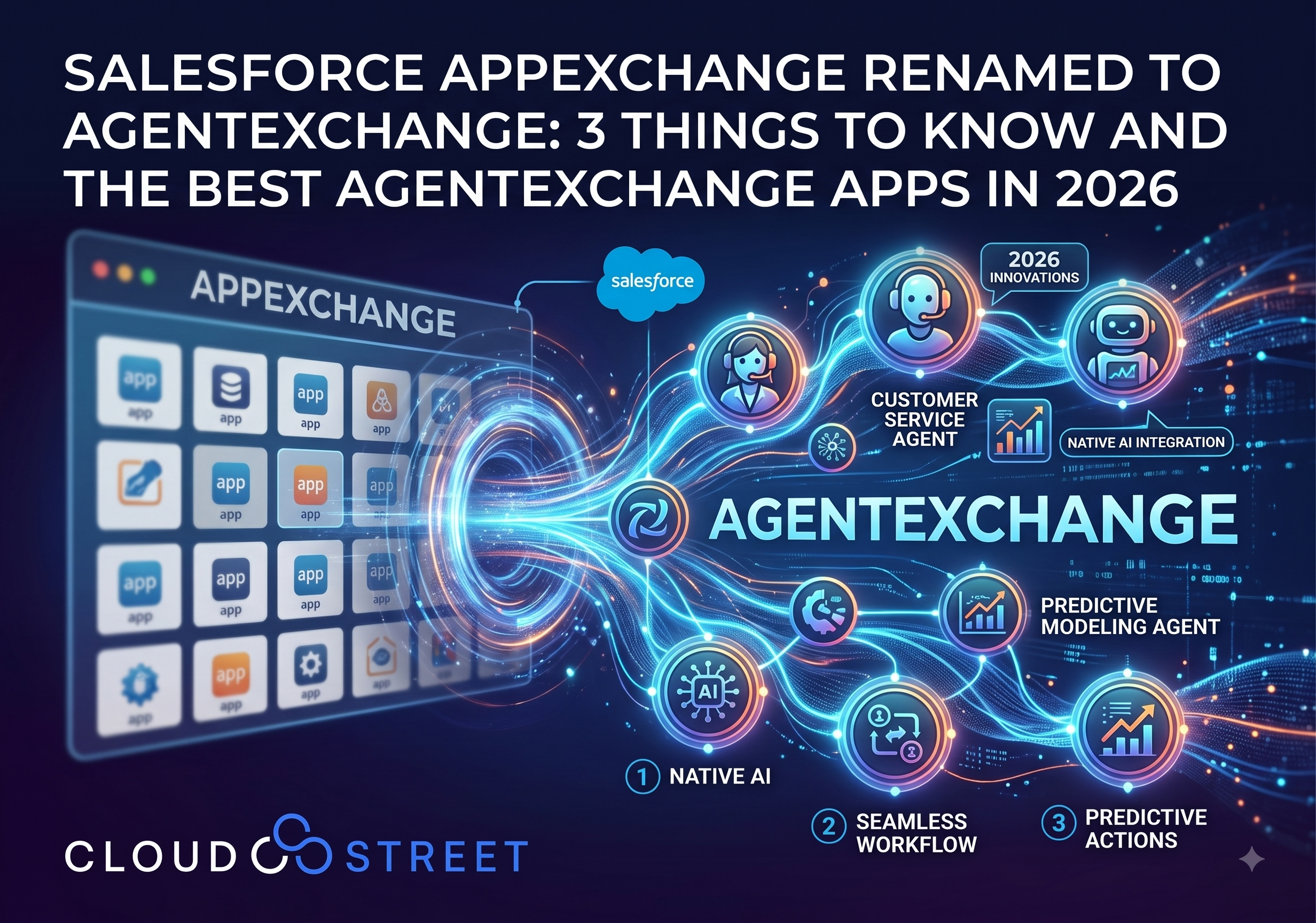
In April 2026, Salesforce made one of the more surprising branding moves the ecosystem has seen in years: it renamed AppExchange to AgentExchange. More importantly than the label itself, Salesforce also unified AppExchange, AgentExchange, and Slack Marketplace into a single marketplace experience. For a platform that had kept the AppExchange name for roughly 20 years, this was not a minor tweak.
The result has been a mix of curiosity, skepticism, and strategic interpretation across the Salesforce community. Some people saw a confusing rename. Others saw a very clear message about where Salesforce is headed next.
At CloudStreet, based in Houston, Texas and serving customers locally and globally, our view is practical: whatever you think of the branding, the unified marketplace matters. It gives buyers one place to evaluate Salesforce apps, Slack apps, and pre-built AI agents without jumping between separate ecosystems. If your team is planning for AI readiness, platform governance, or better app procurement, this change is worth paying attention to.
If you want help evaluating how this shift fits into your Salesforce roadmap, Schedule a Call or Contact Our Team.
1. The Rename News: Why Salesforce Changed AppExchange to AgentExchange
Salesforce renamed AppExchange to AgentExchange in April 2026 as part of a broader marketplace consolidation. Instead of maintaining separate destinations for traditional Salesforce apps, Slack Marketplace listings, and agent-focused offerings, Salesforce brought them together under one marketplace umbrella.
That makes this story bigger than a simple rebrand. It reflects three structural changes:
- One marketplace experience: AppExchange, AgentExchange, and Slack Marketplace now sit in one unified discovery model.
- A broader product mix: Buyers can now browse classic Salesforce apps, Slack apps, and pre-built AI agents from ISVs in one place.
- A strategic signal: The new name aligns the marketplace more directly with Salesforce’s Agentforce narrative and its larger push toward agentic AI.
From a branding standpoint, this is the first name change for the 20-year-old platform, which is part of why the reaction was so strong. AppExchange had decades of recognition behind it. Changing that name was always going to raise eyebrows.
For companies already investing in Salesforce services, the practical takeaway is simple: the marketplace is becoming more centralized around apps, automation, and AI agents together instead of as separate categories.
2. The 6 Community Reactions That Best Capture the Mood
The response covered in Salesforce Ben and echoed in community conversations, including Reddit, was not uniformly negative or positive. It was mostly a blend of confusion, sarcasm, and strategic interpretation.
Here are the six reactions that best summarize what people were saying:
- The top Reddit response was blunt: “why?”
- Another Reddit-style reaction framed it as a joke: “Is this an out-of-season April Fool’s joke?”
- Scott Strong said on LinkedIn: “Some things just don’t need a rename.”
- Matt Pieper asked the obvious question: “So all those apps that aren’t agents are what exactly?”
- Vuk Stajić saw the bigger signal: he interpreted the move as a clear indication of Salesforce’s agentic future.
- Nicolas Vuilamy took the speculation further: he suggested Salesforce may eventually rebrand even more broadly around Agentforce.
Taken together, the general sentiment was this: people were confused by the rename, but many also understood it as Salesforce showing where they are going. That nuance matters. The community was not just reacting to a word change; it was reacting to a roadmap signal.
That is also why this topic matters for buyers, not just ecosystem watchers. If Salesforce is organizing the marketplace around agents as well as apps, then implementation teams need to think earlier about data quality, process design, security, and AI governance. That is the kind of preparation we support through our Salesforce artificial intelligence services.
Need a second opinion on whether your org is ready for more AI-driven tooling? Get a Quote or Schedule a Call.
3. The 7 Types of AgentExchange Apps Worth Knowing About in 2026

The AgentExchange marketplace is now broader than the old mental model of “Salesforce add-ons.” It includes established business apps, Slack-connected tools, and pre-built AI agents. If you are trying to figure out where to start, these seven categories are the most practical ones to know.
1. Document Generation Apps
For teams that need quotes, proposals, agreements, and account documents generated directly from Salesforce, these remain some of the most useful marketplace apps:
- Conga Composer
- DocuSign
- Nintex DocGen
These tools are especially valuable for sales, service, and operations teams trying to reduce manual document handling and speed up approvals.
2. Data Management Apps
If your Salesforce org has duplicate records, bad imports, or inconsistent account hygiene, start here:
- DemandTools
- Cloudingo
- Apsona
Clean data becomes even more important as companies adopt AI-driven search, recommendations, and agent workflows.
3. Sales Productivity Apps
Sales teams looking for better research, email integration, and enablement should know these names:
- Highspot for Agentforce
- ZoomInfo
- Cirrus Insight
These are the kinds of apps that can improve seller efficiency quickly when deployed with a clear workflow strategy.
4. Integration Apps
Unifying systems is still one of the most common reasons businesses turn to the marketplace:
- MuleSoft Composer
- Zapier
- Jira Connector
For many organizations, integration quality determines whether marketplace investments actually produce ROI. If your environment is already complex, that is often a good time to Contact Our Team.
5. Project and Task Management Apps
For post-sale execution, implementation tracking, or internal work management, two long-standing tools still stand out:
- TaskRay
- Mission Control
These apps can be especially useful for customer onboarding, professional services, and internal PMO visibility.
6. Free Community Tools from Salesforce Labs
Not every useful app is enterprise-priced. Salesforce Labs continues to provide free community-built utilities that many admins and consultants use for niche use cases, testing, and productivity improvements.
These tools are worth knowing because they often help teams solve small operational gaps quickly without a large procurement cycle.
7. Slack Apps and Pre-Built AI Agents
This is where AgentExchange becomes meaningfully different from old AppExchange expectations.
Now you are not only looking at traditional Salesforce-native apps. You are also seeing:
- Slack apps now listed in the same marketplace
- Pre-built AI agents from ISVs
- Agentic tools designed for specific workflows and industries
That unified structure reduces friction for discovery and procurement because buyers do not have to treat collaboration tools, Salesforce extensions, and AI agents as completely separate ecosystems.
What CloudStreet Thinks About the Rename
Whether you agree with the rename or not, the unified marketplace is genuinely helpful.
From our perspective, the biggest benefit is not the new word. It is the reduced procurement friction. Having Slack apps, Salesforce apps, and Agentforce agents in one marketplace makes it easier for businesses to compare options, align stakeholders, and move from evaluation to activation.
We also think the community reaction was fair. The confusion is understandable. AppExchange was a durable, widely understood brand. But the strategic message is also hard to miss: Salesforce wants the ecosystem oriented around an agentic future.
At CloudStreet, from Houston, Texas with customers both local and global, we help businesses prepare their Salesforce orgs for that future by focusing on the foundations that matter most:
- Clean data
- Well-designed automation
- Integration readiness
- Security and governance
- Practical AI adoption tied to ROI
That is the real issue behind the rename. Whether the marketplace is called AppExchange or AgentExchange, businesses still need the right architecture and operating model to get value from what they buy.
Final Takeaway: Watch the Marketplace, Not Just the Branding
The phrase “Salesforce AppExchange renamed to AgentExchange” may attract the headline attention, but the larger story is that the AgentExchange marketplace now brings together more of the Salesforce ecosystem in one place.
For buyers, admins, and technology leaders, the most useful question is not whether the rename was perfect. It is whether your team knows how to evaluate the best AgentExchange apps 2026 has to offer, and whether your Salesforce environment is ready for agents, integrations, and modern automation.
If you are sorting through the growing marketplace and want practical guidance on app selection, AI readiness, or Salesforce architecture, CloudStreet can help. Explore our Salesforce services or learn more about our Salesforce artificial intelligence capabilities.
Ready for a practical conversation? Schedule a Call, Get a Quote, or Contact Our Team.
Category
Discover insights that drive results - explore out latest blog posts now
DealHub Salesforce Integration for Manufacturers: Connecting CPQ, Contracts, and CRM
About the manufacturer: mid-market industrial equipment company A U.S.-based, mid-market [...]
Salesforce Data 360 and Agentforce: Why Grounding Is What Makes AI Agents Dependable
An AI agent can produce a fluent answer and still [...]
Salesforce Data 360 Governance and Informatica: Managing Data Quality, Access, and Trust in the Agentic Era
Data governance becomes more consequential when business data does more [...]