Outgrowing Shopify? Why Enterprise Leaders are Migrating to Salesforce Commerce Cloud (SFCC)
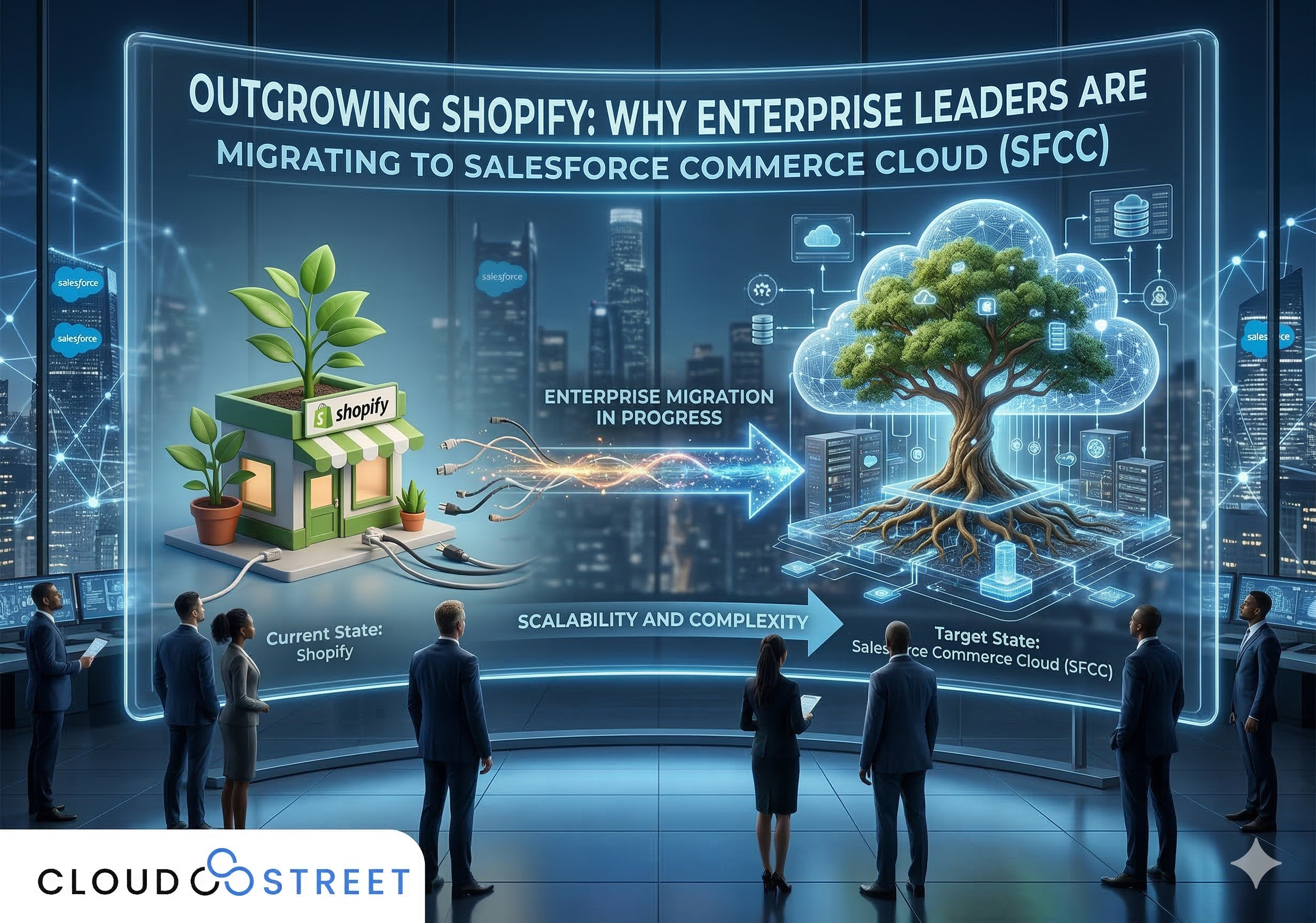
Let’s be real for a second: Shopify is a fantastic platform. It has helped thousands of businesses get off the ground with its user-friendly interface and quick setup. But there comes a day in the life of every rapidly scaling enterprise when “good enough” starts to cost you serious money.
If you’re reading this, you’ve probably felt the “Shopify Ceiling.” Maybe your site slowed to a crawl during your last big product drop, or perhaps you’re tired of managing 15 different apps just to get basic B2B functionality. When your business requirements move from “simple storefront” to “complex global ecosystem,” it’s time to look at Salesforce Commerce Cloud (SFCC).
At CLOUDSTREET, based in the heart of Houston, Texas, we help companies locally and across the globe navigate this exact transition. We’ve seen firsthand how moving to a true enterprise-grade platform can transform a business from a struggling web store into a global powerhouse.
Here are the 6 core reasons why enterprise leaders are making the jump from Shopify to Salesforce.
1. Enterprise-Level Scalability That Doesn’t Break
The biggest nightmare for any e-commerce manager is a site crash during a peak traffic event. On many mid-market platforms, including Shopify, extreme traffic spikes can lead to degraded performance or, worse, complete outages.
We recently worked with a client who experienced this exact pain. They were prepping for a massive seasonal sale. Traffic was projected to jump from their usual 300,000 visitors to a staggering 4 million visitors in just a few hours.
While they were on their previous platform, the results were disastrous:
- Cart Instability: Customers were literally being logged out of their accounts mid-purchase.
- Performance Lag: Page load times climbed into the double digits.
- High Abandonment: Frustrated shoppers left in droves, taking their revenue with them.
After we helped them migrate to SFCC, the story changed. Salesforce’s cloud infrastructure is built to scale dynamically. During the next 4-million-visitor event, the platform didn’t even flinch. Cart stability remained rock-solid, and the checkout process was as smooth for the first visitor as it was for the four-millionth. When you’re playing at this level, scalability isn’t a “nice-to-have”: it’s a survival requirement.

2. Advanced Customization vs. “App Bloat”
One of the most common complaints we hear from Shopify users is “App Bloat.” To get the functionality an enterprise needs, you often end up stacking dozens of third-party apps on top of each other. This creates a “house of cards” effect: one app update breaks another, site speed drops, and your security perimeter becomes a Swiss cheese of third-party code.
SFCC takes a different approach through its modular architecture, known as Cartridges, and its robust APIs (OCAPI and SCAPI). Instead of relying on a random app from a marketplace, you have deep, server-side access to customize the core commerce logic.
This level of control allows you to build a highly tailored experience that aligns with your specific business rules. Whether it’s complex shipping logic, unique product configurations, or custom checkout flows, SFCC handles it natively. If you’re curious about how this looks in a real-world scenario, check out our case study on launching LaMotte’s first e-commerce store, where we transformed their operations by moving away from fragmented systems.
3. Managing a Global Empire from One Dashboard
If you’re running separate Shopify stores for the US, UK, and Canada, you know the administrative headache of syncing inventory, prices, and content across multiple instances.
Salesforce Commerce Cloud is a “multi-everything” powerhouse. From a single login, you can manage:
- Multi-brand operations: Run different brands on the same infrastructure.
- Multi-language and Multi-currency: Localize the experience for every market.
- Region-specific catalogs: Show different products to different countries based on local availability.
This unified management significantly reduces the overhead for your digital team. Instead of doing the same task five times for five different stores, you do it once and deploy it globally.
4. The “VIP Experience” with Advanced Promotions
In the enterprise world, your best customers deserve better than a generic “10% OFF” coupon code. SFCC offers an incredibly sophisticated promotion engine that allows for complex segmentation.
Take another real-world example from our portfolio. We worked with a brand to leverage the SFCC promotion engine for their most loyal shoppers. We created a VIP Customer Group based on purchase frequency and low return rates. Using SFCC, we gave this group:
- Exclusive Discounts: Tailored specifically to their buying habits.
- Early Access: The VIPs were allowed into major sales events several hours before the general public.
The result? Higher engagement, increased “full-price” sales from loyalists, and a massive boost in brand loyalty. This kind of nuanced marketing is where SFCC really outshines the competition.

5. Seamless Integration with the Salesforce Ecosystem (and AI)
When you move to SFCC, you aren’t just buying a commerce platform; you’re plugging into the world’s #1 CRM. The integration with Salesforce Sales Cloud, Service Cloud, and Marketing Cloud is native and powerful.
Imagine a customer calling your support team. Because your commerce site is linked to your Service Cloud, the agent can see exactly what is in the customer’s cart, their order history, and even their AI-predicted “next likely purchase.”
Speaking of AI, Salesforce Einstein is baked directly into the platform. It handles product recommendations, search sorting, and even predictive sorting for your categories. Research shows that customers migrating to Salesforce often see a 27% increase in ROI and a 30% boost in productivity just by leveraging these built-in AI tools.
6. Beyond the Buy Button: Why We Recommend Experience Cloud
Here is a pro-tip from our team of specialists: If your business requires a portal: for B2B customers, distributors, or high-touch VIPs: you should strongly consider Salesforce Experience Cloud.
While SFCC handles the “transaction,” Experience Cloud handles the “relationship.” We are specialists in building Experience Cloud portals that go far beyond simple purchasing. Whether it’s a self-service support hub, a custom warranty registration portal, or a complex B2B ordering interface, Experience Cloud provides a level of engagement that standard e-commerce platforms just can’t touch.
For a deeper dive into what’s possible, read our article on 5 powerful Salesforce Experience Cloud use cases for B2B customer portals.
Comparison Table: Shopify vs. Salesforce Commerce Cloud (SFCC)
| Feature | Shopify | Salesforce Commerce Cloud (SFCC) |
|---|---|---|
| Target Market | Small to mid-size businesses | Enterprise and large-scale businesses |
| Scalability | Good for moderate traffic; struggles with extreme spikes | Built for enterprise-level traffic and massive spikes |
| Customization | Relies heavily on third-party apps | Highly customizable via Cartridges and APIs |
| Multi-Site Management | Requires separate stores for different regions | Manage all brands and regions from one place |
| Promotion Engine | Basic discount codes | Advanced rules, VIP groups, and tiered pricing |
| AI Capabilities | Basic (mostly via apps) | Native AI via Salesforce Einstein |
| Ecosystem | Limited native integration | Fully integrated with CRM, Service, and Marketing |
| Total Cost of Ownership | Low entry cost; high “app tax” over time | Higher initial investment; better long-term ROI |
Is it Time to Make the Move?
Migrating from Shopify to Salesforce Commerce Cloud is a big step, but for growing enterprises, it’s often the step that unlocks the next level of revenue. You stop fighting your platform and start using it as a competitive advantage.
At CLOUDSTREET, we don’t just “install” software. We are a team of IT consultants who specialize in complex B2B Salesforce implementations and high-performance commerce migrations. Whether you are right here in Houston with us or operating halfway across the world, we have the expertise to ensure your migration is seamless and your new platform is optimized for growth.
Ready to stop hitting the Shopify ceiling?
Contact CLOUDSTREET today for an enterprise commerce consultation. Let’s build something that scales as fast as you do.
Category
Discover insights that drive results - explore out latest blog posts now
DealHub Salesforce Integration for Manufacturers: Connecting CPQ, Contracts, and CRM
About the manufacturer: mid-market industrial equipment company A U.S.-based, mid-market [...]
Salesforce Data 360 and Agentforce: Why Grounding Is What Makes AI Agents Dependable
An AI agent can produce a fluent answer and still [...]
Salesforce Data 360 Governance and Informatica: Managing Data Quality, Access, and Trust in the Agentic Era
Data governance becomes more consequential when business data does more [...]