How to Hire a Salesforce B2B Commerce Cloud Developer: 9 Key Skills and Certifications to Look For
At CLOUDSTREET, we talk to business owners every week who are frustrated with their e-commerce performance. They’ve invested in the platform, but the “ROI” just isn’t showing up in their bank account. Usually, the bottleneck isn’t the software: it’s the person behind the keyboard.
Finding a salesforce b2b commerce cloud developer who actually understands the nuances of complex business-to-business transactions is harder than it looks. We’re based in Houston, Texas, but we work with clients locally and globally to solve this exact problem. We don’t just “write code”; we implement ROI into our customers’ Salesforce orgs.
If you are looking to hire salesforce b2b commerce developer talent to scale your storefront, this guide breaks down exactly what you need to look for, what you should pay, and how to avoid the common “red flags” that lead to project delays.
1. Understanding the Role of a B2B Commerce Developer
A Salesforce B2B Commerce Cloud developer is not your average web developer. While a standard developer might be great at making a website look pretty, a B2B specialist focuses on the complex plumbing that makes a multi-million dollar transaction possible.
In the Salesforce ecosystem, especially with the move to Salesforce B2B Commerce on Lightning, this role involves:
- LWR and LWC Mastery: Building high-performance storefronts using Lightning Web Runtime (LWR) and Lightning Web Components (LWC).
- Salesforce B2B Commerce Cloud Customization: Tailoring the checkout flow, pricing logic, and product discovery to match specific business rules.
- Data Model Architecture: Managing the complex relationships between Accounts, Price Books, Entitlements, and Product Media.
- Integrations: Connecting the storefront to ERPs (like SAP or Oracle), payment gateways, and shipping providers via APIs (SCAPI and OCAPI).
Need a team that knows B2B commerce inside and out? Let’s talk about your project.
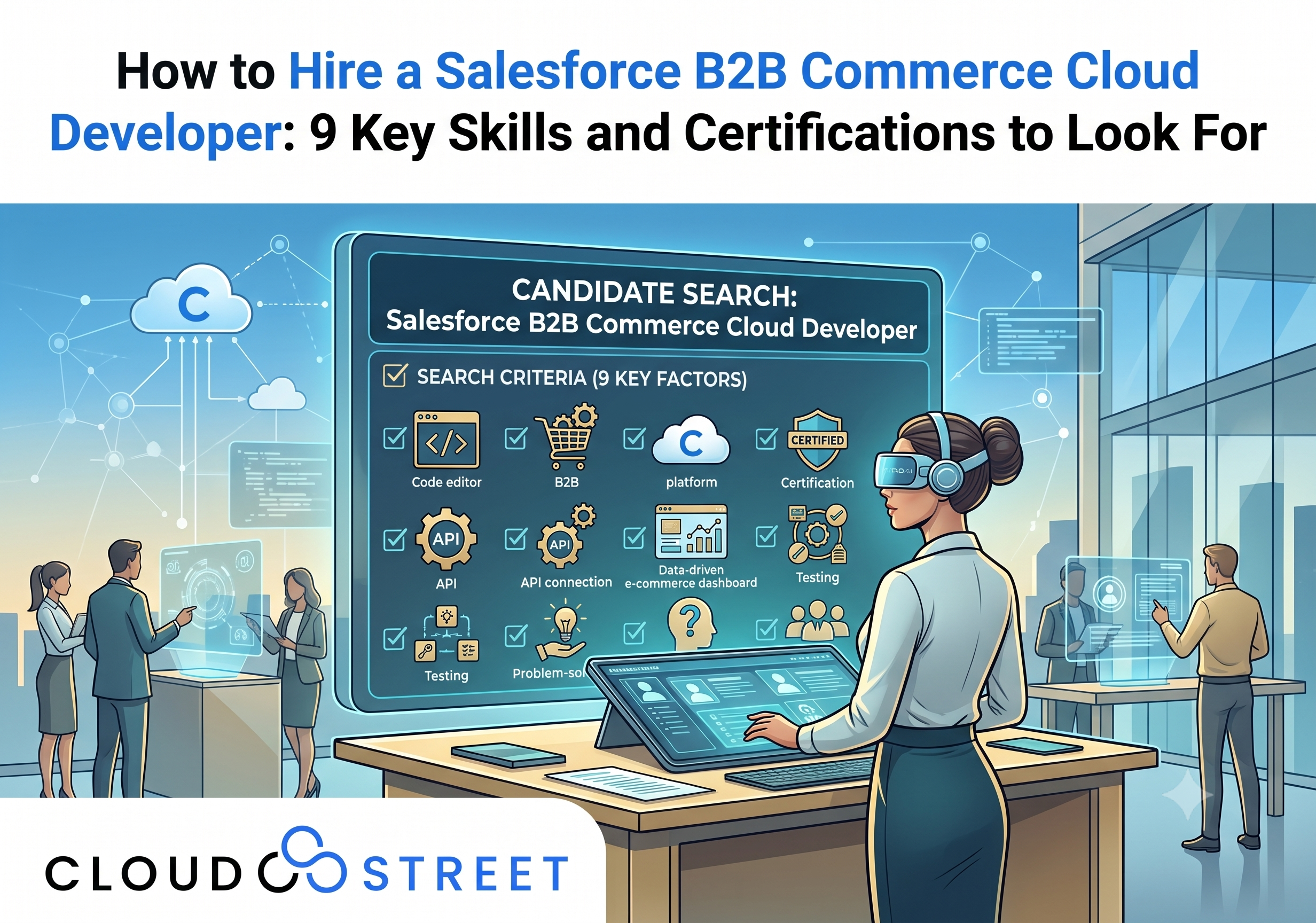
2. 9 Key Skills and Certifications to Look For
When vetting candidates or agencies, you need to look beyond a fancy resume. Here are the 9 specific areas where we vet every developer we bring onto a project.
Technical Proficiency (Items 1-4)
- Salesforce B2B Commerce Developer Certification: This is the gold standard. It proves they understand the “Accredited Professional” requirements for B2B-specific configuration.
- LWC & Javascript Expertise: Modern B2B Commerce (Lightning) is built on Lightning Web Components. If they only know legacy Visualforce or basic Apex, your site will be slow and outdated.
- API & Integration Strategy: B2B sites rarely live in a vacuum. Your developer must know how to handle REST/SOAP integrations to pull real-time inventory from your warehouse.
- Flow Builder for Commerce: Much of the B2B logic is now handled via headless commerce and Flows. They should be able to customize a checkout flow without writing 1,000 lines of unnecessary code.

Business and Data Expertise (Items 5-9)
- B2B Data Model Knowledge: They must understand that in B2B, a “Price” isn’t just a number: it’s a complex calculation based on the account, the contract, and the volume.
- Experience Builder Mastery: They should know how to use the Salesforce Experience Builder to create a seamless buyer experience that doesn’t require a developer for every tiny text change.
- Performance Optimization: Large B2B catalogs can have hundreds of thousands of SKUs. A good developer knows how to optimize indexing so the search bar doesn’t lag.
- Security and Permissions: B2B buyers have specific roles (Buyer, Buyer Manager). Getting the “Entitlement” model right is critical for security.
- Problem-Solving for ROI: At CLOUDSTREET, we believe a developer should ask “Why?” if a customization doesn’t lead to higher conversion or lower support costs.
Check out our B2B Commerce Accelerator to see how we speed up this process.
3. The “General Developer” Trap
One of the biggest mistakes we see companies make is hiring a “General Salesforce Developer” to do a salesforce b2b commerce cloud customization.
A general developer knows how to build triggers and custom objects. But B2B Commerce is a specific product with its own rules. If a developer tries to build a custom “Cart” object from scratch because they don’t know the standard B2B Commerce objects exist, you will end up with a “Frankenstein” system that breaks every time Salesforce releases an update.
Always ask: “How many live B2B Commerce storefronts have you personally launched?” If the answer is zero, they are learning on your dime.
4. What Does it Cost to Hire a B2B Developer?
Because this is a niche skill set, you should expect to pay a premium. In 2026, the demand for B2B specialists is at an all-time high as more wholesalers move away from legacy platforms.
- Hourly Rates: Typically 20-40% higher than a standard Salesforce Admin or Dev. Rates vary wildly by geography and experience level.
- Project Costs: Small implementations or “Quick Starts” might be fixed-fee, while complex global rollouts are usually handled through a Salesforce Managed Services agreement.
Whether you are looking for a local partner in Houston or a global team to support your 24/7 operations, the investment should always be weighed against the ROI of a faster, more reliable checkout experience.

5. Red Flags to Watch For During the Interview
If you hear these things, proceed with caution:
- “I’ve done B2C Commerce, it’s basically the same thing.” (It’s not. The data models are completely different).
- “We don’t need to use the standard objects; I’ll just build a custom UI.” (This kills your ability to upgrade).
- “I’ve never worked with Experience Cloud.” (B2B Commerce runs on top of Experience Cloud).
Ready to skip the vetting headache? Contact us for expert B2B staffing.
6. Where to Find Your Developer
You have three main paths to finding talent:
- Direct Hire: Hard to find, expensive to retain, and they often get bored if you only have one project.
- Freelance Platforms: High risk. You might find a gem, or you might find someone who disappears mid-sprint.
- Specialized Partners: This is where CLOUDSTREET shines. We provide vetted experts who have seen dozens of different B2B configurations. We understand the differences between developers and consultants and can provide the right mix for your specific phase of growth.
7. How CLOUDSTREET Simplifies the Process
We are more than just a staffing agency; we are an IT consulting firm dedicated to ROI. Based in the heart of Houston, Texas, our reach is global. We have built a rigorous internal vetting process where we test developers on:
- Complex pricing logic scenarios.
- Large-scale data migration.
- Integration error handling.
When you work with us, you aren’t just getting a coder; you’re getting a partner who is committed to making your Salesforce org a revenue-generating machine.

Conclusion: Don’t Settle for “Just a Developer”
Hiring the right salesforce b2b commerce cloud developer is the difference between a storefront that just sits there and one that actually scales your business. Look for the certifications, verify the LWC skills, and most importantly, ensure they understand the B2B data model.
If you’re ready to stop searching and start building, we’re here to help. From our home base in Houston to our clients across the globe, we bring the expertise needed to drive real results.
Ready to maximize your Salesforce ROI?
Category
Discover insights that drive results - explore out latest blog posts now
DealHub Salesforce Integration for Manufacturers: Connecting CPQ, Contracts, and CRM
About the manufacturer: mid-market industrial equipment company A U.S.-based, mid-market [...]
Salesforce Data 360 and Agentforce: Why Grounding Is What Makes AI Agents Dependable
An AI agent can produce a fluent answer and still [...]
Salesforce Data 360 Governance and Informatica: Managing Data Quality, Access, and Trust in the Agentic Era
Data governance becomes more consequential when business data does more [...]