How Integrating Salesforce with Servicecore Transformed Operations for One Service Company: A Case Study
The Challenge: Bridging a Costly Operational Gap
Let’s talk about a real-world example from the front lines: a growing service company—think roll-off dumpsters, septic, or portable restrooms—already running their day-to-day operations and accounting through Servicecore. The business was humming, but they faced headaches on two big fronts:
- Struggling to keep track of customer relationships: Servicecore was built for scheduling, routing, and invoices—not managing leads, deals, and long-term follow-ups.
- Siloed data causing double work: Sales and service teams had to enter the same info in multiple places, making for wasted hours and the occasional nasty mistake.
After looking at their options, leadership decided to invest in Salesforce as their CRM. But two questions remained. How could they integrate Salesforce with Servicecore to streamline operations…and who was the right partner for the job?
That’s where CLOUDSTREET stepped in.
3 Key Reasons This Service Company Chose Salesforce (and Why They Integrated It)
Let’s break down what tipped the scales:
1. Purpose-Built CRM Beats Spreadsheets and Workarounds
While Servicecore is fantastic for dispatching trucks, invoicing, and tracking assets, it wasn’t designed to be the company’s sales and customer relationship nerve center. Before Salesforce, reps were:
- Managing leads in spreadsheets
- Losing track of call logs, quotes, and proposals
- Missing out on pipeline and forecasting visibility
With Salesforce, they brought all of this into one powerful, easy-to-customize hub. Now, every prospect and client touchpoint is tracked, and no promising lead slips through the cracks.
2. Automation of Mundane (and Error-Prone) Tasks
Without integration, teams had to re-enter customer and job details into both Servicecore and Salesforce. This led to:
- Duplicate data entry
- Risk of inconsistent details between systems
- Lots of time lost to admin tasks
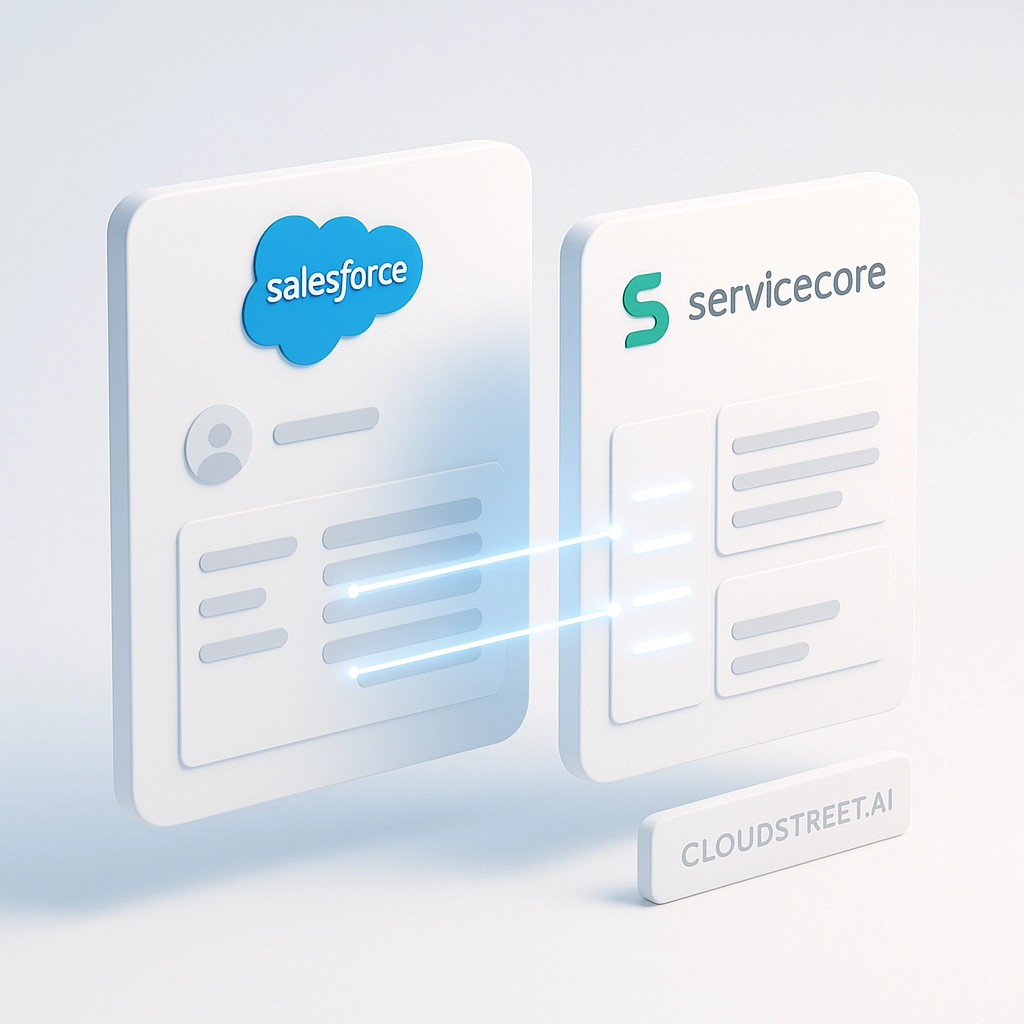
By integrating Salesforce and Servicecore, the company:
- Eliminated manual data re-entry for customer onboarding, job creation, and invoicing.
- Ensured contact and job updates flow automatically between both systems.
- Freed up sales and dispatch teams for higher-value work.
3. Visibility Across the Entire Lifecycle
One of the most powerful results of the integration? The company could finally see the whole customer journey, from a brand-new lead to repeat business and every invoice in between. Executives, sales reps, and operation managers all gained:
- Real-time dashboards showing sales activities and service status.
- Better forecasting, as Servicecore financials were available alongside Salesforce pipeline data.
- Actionable insights for cross-selling and upselling to existing customers.
The CLOUDSTREET Approach: 4 Steps to a Successful Integration
How did CLOUDSTREET make this all work smoothly? Here’s a simplified look at our methodology:
1. Assessing the Process
First, we mapped out both current and “future state” workflows. Where were the bottlenecks? Which teams were double-entering data? We collaborated with everyone from office managers to sales leads to make sure pain points were clearly understood.
2. Custom Salesforce Implementation
Next, we tailored Salesforce to match the company’s specific sales process. That meant:
- Custom “opportunity” stages for their unique quoting and approval flow
- Quick-create forms for speedy lead entry
- Automated reminders to follow up with new prospects
3. Building the Integration
This is where things got technical—but also transformational. Our solution architects:
- Developed secure syncs between Salesforce and Servicecore using available APIs and connectors.
- Automated record creation: when a new customer or order was created in Salesforce, it appeared instantly in Servicecore.
- Established rules for updating key fields (like service addresses, contact info, and payment terms) to keep both systems aligned.
4. Staff Training & Ongoing Support
Change can be tough, so we rolled out user-friendly guides and live training sessions, complete with real-world examples. And, importantly, we set up an ongoing support plan so hiccups could be fixed fast.
The Benefits: 5 Ways Integration Supercharged the Business
Here’s what actually changed for our client, broken down into a quick list:
1. Time Savings (Every Single Day)
No more copying addresses or order notes between two systems. Teams cut hours of busywork each week.
2. Cleaner, More Accurate Data
With automatic data syncing, there were fewer errors, less “dirty” data, and less time wasted correcting mistakes.
3. Faster, Smoother Customer Onboarding
Sales could convert a proposal to a live job in minutes, not hours. New customers were wowed by how “on it” the company was.
4. Better Pipeline Visibility
Management could see, at a glance, how sales were tracking, which jobs were in progress, and whether revenue forecasts matched reality.
5. Improved Customer Relationships
Reps always had the latest info—recent quotes, open jobs, payment history—at their fingertips. This made for smarter conversations and higher close rates.

CLOUDSTREET Pro Tips: 4 Best Practices for Successful Integration
If you’re weighing a similar move for your business, here are a few things we learned along the way:
- Think End-to-End: Map out the entire customer journey. Integration is about more than just the handoff between sales and operations—it’s about tracking lifetime value.
- Customize for Your Workflow: Out-of-the-box integrations are a good start, but real impact comes from adding custom fields, automations, and dashboards that match how your company truly works.
- Train AND Support: A successful transition is about people, not just software. Invest in training up front and offer support on the back end.
- Pick the Right Partner: Choose an IT consultant who understands both the technical nuts-and-bolts and the day-to-day world of service companies. (That’s where we come in.)
Final Thoughts
Integrating Salesforce with Servicecore didn’t just save time—it unleashed new value across departments. It empowered staff, impressed customers, and positioned the company for scalable, sustainable growth.
Interested in learning how CLOUDSTREET can help streamline your own systems? Get in touch with our team. Or check out our other Salesforce success stories on our blog.
Ready to stop feeling stuck between spreadsheets and manual busywork? Let’s talk about how smooth integrations can level up your operations.
Category
Discover insights that drive results - explore out latest blog posts now

DealHub Salesforce Integration for Manufacturers: Connecting CPQ, Contracts, and CRM
About the manufacturer: mid-market industrial equipment company A U.S.-based, mid-market [...]
Salesforce Data 360 and Agentforce: Why Grounding Is What Makes AI Agents Dependable
An AI agent can produce a fluent answer and still [...]
Salesforce Data 360 Governance and Informatica: Managing Data Quality, Access, and Trust in the Agentic Era
Data governance becomes more consequential when business data does more [...]