CloudStreet’s Blueprint for Success: Navigating the Future of Marketing & Commerce with Salesforce Connections ’25 Insights
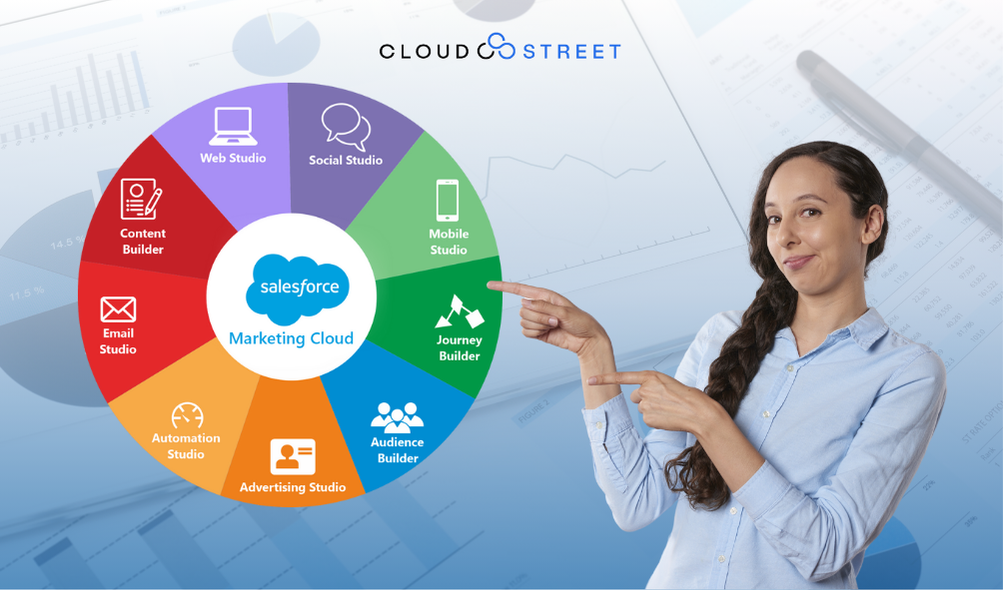
CloudStreet’s Blueprint for Success: Navigating the Future of Marketing & Commerce with Salesforce Connections ’25 Insights
CloudStreet’s Blueprint for Success: Navigating the Future of Marketing & Commerce with Salesforce Connections ’25 Insights
Salesforce Connections ’25 delivered a wealth of strategic insights, particularly around the groundbreaking Marketing Cloud Next. For CloudStreet and our clients, these advancements signal a crucial shift in the landscape of marketing and commerce. Here are eight key takeaways from the event that will shape our approach and drive your success:
1. Marketing Cloud’s Strategic Convergence, Not Migration
Salesforce’s Marketing Cloud now encompasses five offerings, with Marketing Cloud Next as a significant new addition. Salesforce frames this as a “convergence” – a powerful move allowing existing Marketing Cloud Engagement (MCE) and Marketing Cloud Account Engagement (MCAE) users to access “on core” technology while continuing to leverage their current editions. This means your investments in automation and Data Cloud segments can seamlessly integrate with Marketing Cloud Next. While a full transition may take years, the direction is clear: this is Salesforce’s vision for the future.
2. Optimizing Consumption Credits: A New Financial Landscape
The shift to a credit-based consumption model for Marketing Cloud Next introduces new considerations for budgeting and resource allocation. Credits are consumed by actions like messaging (email, SMS, WhatsApp sends) and Data Cloud segmentations and activations. While Salesforce’s Digital Wallet offers improved transparency on credit usage, questions remain about company-wide consumption. CloudStreet will help you navigate scenarios where, for example, sales activity might impact marketing’s allocated credits, ensuring your campaigns remain on budget.
3. The Undeniable Imperative of Data Quality
The impressive demos at Connections ’25 underscore a critical prerequisite: clean and complete data. As the adage goes, “garbage in, garbage out,” and poor data quality can quickly become an unmanageable challenge. At CloudStreet, we emphasize that data quality is a collective responsibility, not solely that of IT or administrators. Understanding your data is the first step towards ensuring its accuracy and maximizing the effectiveness of your Salesforce solutions.
4. Unlocking Deep Personalization Across the Opportunity Lifecycle
Bringing Marketing Cloud onto the core Salesforce platform revolutionizes both B2B and B2C engagement. A significant advantage is the ability to tightly align marketing interactions with the opportunity lifecycle. Previously, working with opportunity data in Account Engagement (Pardot) presented limitations for real-time, deep engagement. Now, with unified infrastructure, CloudStreet can help you leverage faster and smarter customer engagement based directly on opportunity data, eliminating the need for complex connectors.
5. The Evolving Role of APIs and a Data Cloud-First Strategy
Salesforce designed Data Cloud as an open gateway, facilitating connections with any data source in your tech stack. The “zero-copy” feature means data can be referenced without being physically stored on the Salesforce platform, leading to greater speed, reduced computing power, and enhanced data integrity. This innovation suggests a potential reduction in the need for traditional API integrations between MCE/MCAE. CloudStreet advocates for a Data Cloud-first approach to segmentation, as it provides a single, sophisticated, and future-proof method for data ingestion and segmentation, regardless of your Marketing Cloud edition.
6. Prioritizing Upskilling: Embracing the Future of Salesforce
As the demand for traditional API integrations potentially wanes, the technology landscape continues to evolve rapidly. CloudStreet recognizes the importance of continuous adaptation and emphasizes the critical need to upskill in Data Cloud. Data Cloud is the foundational layer not only for Marketing Cloud “on core” but also for all other products within the Salesforce portfolio, making it an essential investment in future readiness.
7. Democratizing Luxury-Tier Commerce Experiences with Agentforce
At its core, shopping is about branding, product, and customer experience. With Agentforce, Commerce Cloud is democratizing a level of personalized customer experience once exclusive to luxury brands. CloudStreet can assist retailers in leveraging Agentforce to analyze customer profile data, detect subtle intent, and comprehend product catalogs to deliver intelligent responses to natural language queries.
8. The Imperative of Rich Product Data for Commerce Agents
For Agentforce to function effectively with Commerce Cloud, agents require rich, descriptive, and contextual product data. This means meticulously tagging products with a comprehensive array of synonyms to enable agents to generate high-quality responses. While Salesforce offers a built-in Product Description generator, CloudStreet encourages exploring third-party solutions like Lily.ai to fully understand the possibilities and requirements for achieving truly “agentic commerce.”
Looking Forward
Connections ’25 provided invaluable insights that are shaping the future of Salesforce technology. CloudStreet is excited to help our clients leverage these advancements, particularly as Marketing Cloud “on core” continues to unfold in the coming years.
Category
Discover insights that drive results - explore out latest blog posts now
Case Study: How Highland Cabinetry Colorado Built a Modern Wholesale Powerhouse on Salesforce B2B Commerce Cloud
In the world of high-end cabinetry, timing is everything. When [...]
Agentforce ROI: 7 Ways to Maximize Your Salesforce AI Investment
You've heard the buzz. Salesforce Agentforce is supposed to revolutionize [...]
Salesforce B2B Commerce Cloud Partner & Consultant Guide
You're about to drop serious money on a Salesforce B2B [...]