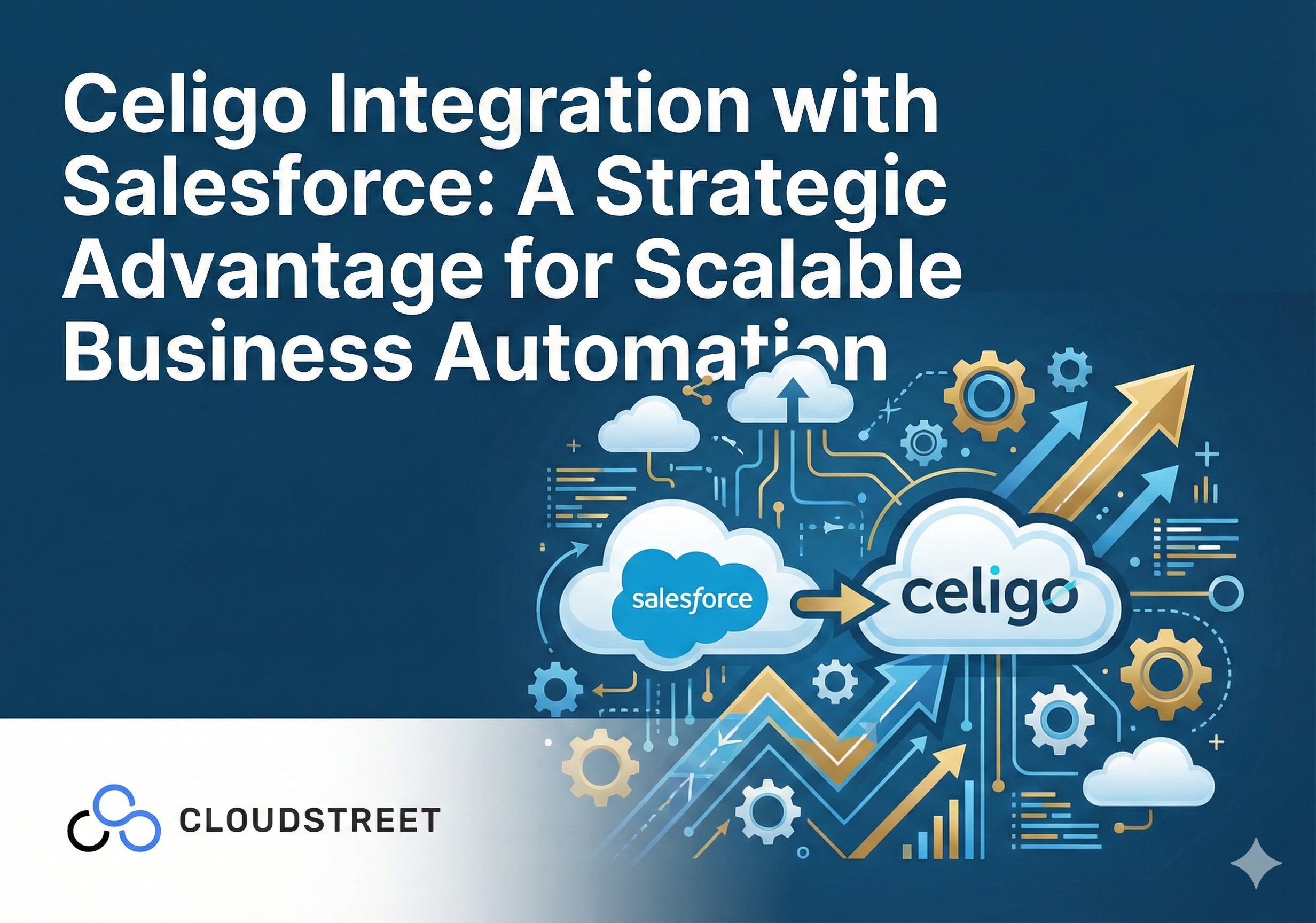
Celigo Integration with Salesforce – A Strategic Advantage for Scalable Business Automation
In today’s fast-moving business world, the gap between your CRM and ERP systems can become a major roadblock to growth. If you’re manually syncing data between Salesforce and NetSuite (or other systems), you’re not just wasting time – you’re missing out on the kind of automation that separates thriving businesses from struggling ones.
That’s where Celigo comes in. As a leading Integration Platform as a Service (iPaaS), Celigo bridges the gap between Salesforce and your other critical business systems, creating seamless workflows that scale with your business.
At CLOUDSTREET, our Houston-based team has helped businesses locally and globally transform their operations through strategic Salesforce integrations. Here’s why Celigo integration might be the game-changer your business needs.
What Makes Celigo Different?
Unlike basic point-to-point integrations, Celigo offers a comprehensive platform designed specifically for complex business needs. Think of it as the intelligence layer that sits between your systems, understanding not just how to move data, but when, why, and in what format.
The platform excels at connecting Salesforce with NetSuite, but it’s flexible enough to integrate virtually any cloud or on-premise system your business relies on.

Ready to explore how Celigo can transform your business operations? Let’s talk about your specific integration needs and create a roadmap for success.
5 Core Benefits of Celigo-Salesforce Integration
1. Real-Time Data Synchronization
Gone are the days of waiting for overnight batch updates or dealing with conflicting information across systems. Celigo ensures that customer records, pricing updates, inventory changes, and order statuses sync in real-time between Salesforce and your ERP.
This means your sales team always has accurate inventory levels when quoting customers, and your finance team sees sales activities reflected immediately in NetSuite.
2. Streamlined Lead-to-Cash Process
The integration transforms your entire lead-to-cash workflow. When a prospect becomes a customer in Salesforce, Celigo automatically creates the corresponding records in NetSuite, including customer accounts, contacts, and initial transaction history.
Orders flow seamlessly from Salesforce to NetSuite for fulfillment, while invoicing and payment information flows back to give your sales team complete visibility into customer account status.
3. Unified Customer Intelligence
Instead of jumping between systems to get a complete customer picture, Celigo creates a true 360-degree customer view. Customer service representatives can see purchase history, payment status, and support tickets all from within Salesforce, while finance teams access sales pipeline data directly in NetSuite.
4. Automated Error Detection and Resolution
Manual data entry inevitably leads to errors, but Celigo’s built-in monitoring and error handling capabilities catch issues before they become problems. The platform provides detailed logs and alerts when data doesn’t sync properly, allowing for quick resolution.
5. Scalable Architecture for Growth
As your business grows, Celigo grows with you. The platform handles increased data volumes, additional users, and new business processes without requiring a complete system overhaul.

Implementation Flexibility: 3 Approaches to Fit Your Needs
Celigo recognizes that not every business has the same integration requirements. That’s why they offer three distinct approaches:
Pre-Built Integration Apps
Perfect for businesses that need quick deployment of common use cases. These apps come with standard field mappings and workflows that work out-of-the-box for most Salesforce-NetSuite integrations.
Best for: Companies with standard processes who need to get up and running quickly.
Customizable Integration Templates
These provide a middle ground – pre-configured workflows that can be modified to match your specific business processes. You get the speed of a template with the flexibility to accommodate your unique requirements.
Best for: Businesses with some customization needs but don’t want to build from scratch.
Low-Code Integration Platform
For companies with complex or highly customized requirements, Celigo’s low-code platform allows complete customization while maintaining ease of use. Both business users and IT teams can manage integrations from a single interface.
Best for: Enterprises with complex workflows or multiple system integrations.
Wondering which approach fits your business best? Our Salesforce experts can help you evaluate your options and choose the right implementation strategy.

Business Impact: What ROI Can You Expect?
The financial benefits of Celigo integration typically show up in several key areas:
Time Savings: Most businesses see 60-80% reduction in manual data entry tasks, freeing up staff for higher-value activities.
Improved Accuracy: Real-time synchronization virtually eliminates data discrepancies, reducing costly errors and customer service issues.
Faster Process Cycles: Automated lead-to-cash workflows can reduce order processing time from days to hours.
Better Decision Making: Unified data means faster, more informed business decisions across all departments.
Reduced IT Overhead: Pre-built connectors and templates mean less custom development and ongoing maintenance.
Industry-Specific Advantages
Different industries see unique benefits from Celigo-Salesforce integration:
Manufacturing: Real-time inventory synchronization ensures sales teams never oversell, while production planning gets immediate visibility into sales forecasts.
Distribution: Complex pricing structures and multi-location inventory management become seamless, with automated updates across all channels.
Professional Services: Project-based billing integrates smoothly with CRM opportunity management, improving cash flow and client relationships.
Technology Companies: Subscription billing, renewal management, and customer success metrics flow seamlessly between systems.
Getting Started: Planning Your Integration Strategy
Successful Celigo implementation starts with understanding your current processes and identifying the biggest pain points. Here’s a practical approach:
Phase 1: Assessment
- Map current data flows between systems
- Identify manual processes that could be automated
- Define success metrics
Phase 2: Design
- Choose the right Celigo approach for your needs
- Plan data mapping and transformation rules
- Design error handling and monitoring procedures
Phase 3: Implementation
- Set up development environment
- Configure and test integrations
- Train users on new workflows
Phase 4: Optimization
- Monitor performance and usage patterns
- Refine workflows based on user feedback
- Plan additional integration opportunities
Why Partner with CLOUDSTREET?
As a Houston-based IT consulting firm, CLOUDSTREET brings deep expertise in both Salesforce and integration technologies. We’ve helped businesses across Texas and around the world implement successful Celigo integrations that drive real business results.
Our team understands that successful integration isn’t just about connecting systems – it’s about optimizing business processes to support growth and efficiency.

Ready to eliminate manual data entry and create seamless workflows between your systems? Contact CLOUDSTREET today to discuss your integration needs and discover how Celigo can accelerate your business growth.
The Bottom Line
Celigo integration with Salesforce isn’t just about making your current processes more efficient – it’s about enabling the kind of scalable, automated operations that allow businesses to grow without proportionally increasing operational complexity.
In an increasingly competitive marketplace, the companies that win are those that can operate more efficiently, respond more quickly to customer needs, and make better decisions with complete, real-time data.
If you’re ready to stop managing multiple systems manually and start leveraging the power of integrated business automation, Celigo-Salesforce integration might be exactly what your business needs to reach the next level.
The question isn’t whether you can afford to implement this integration – it’s whether you can afford not to. Your competitors who are already running integrated operations have a significant advantage. The good news is that with the right partner and approach, you can close that gap quickly and start seeing results in weeks, not months.
Want to learn more about how CLOUDSTREET can help you implement Celigo integration with Salesforce? Visit our Salesforce services page or reach out to our team for a personalized consultation.
Category
Discover insights that drive results - explore out latest blog posts now
Case Study: How Highland Cabinetry Colorado Built a Modern Wholesale Powerhouse on Salesforce B2B Commerce Cloud
In the world of high-end cabinetry, timing is everything. When [...]
Agentforce ROI: 7 Ways to Maximize Your Salesforce AI Investment
You've heard the buzz. Salesforce Agentforce is supposed to revolutionize [...]
Salesforce B2B Commerce Cloud Partner & Consultant Guide
You're about to drop serious money on a Salesforce B2B [...]