Agentic Commerce: The Next Leap in Salesforce AI
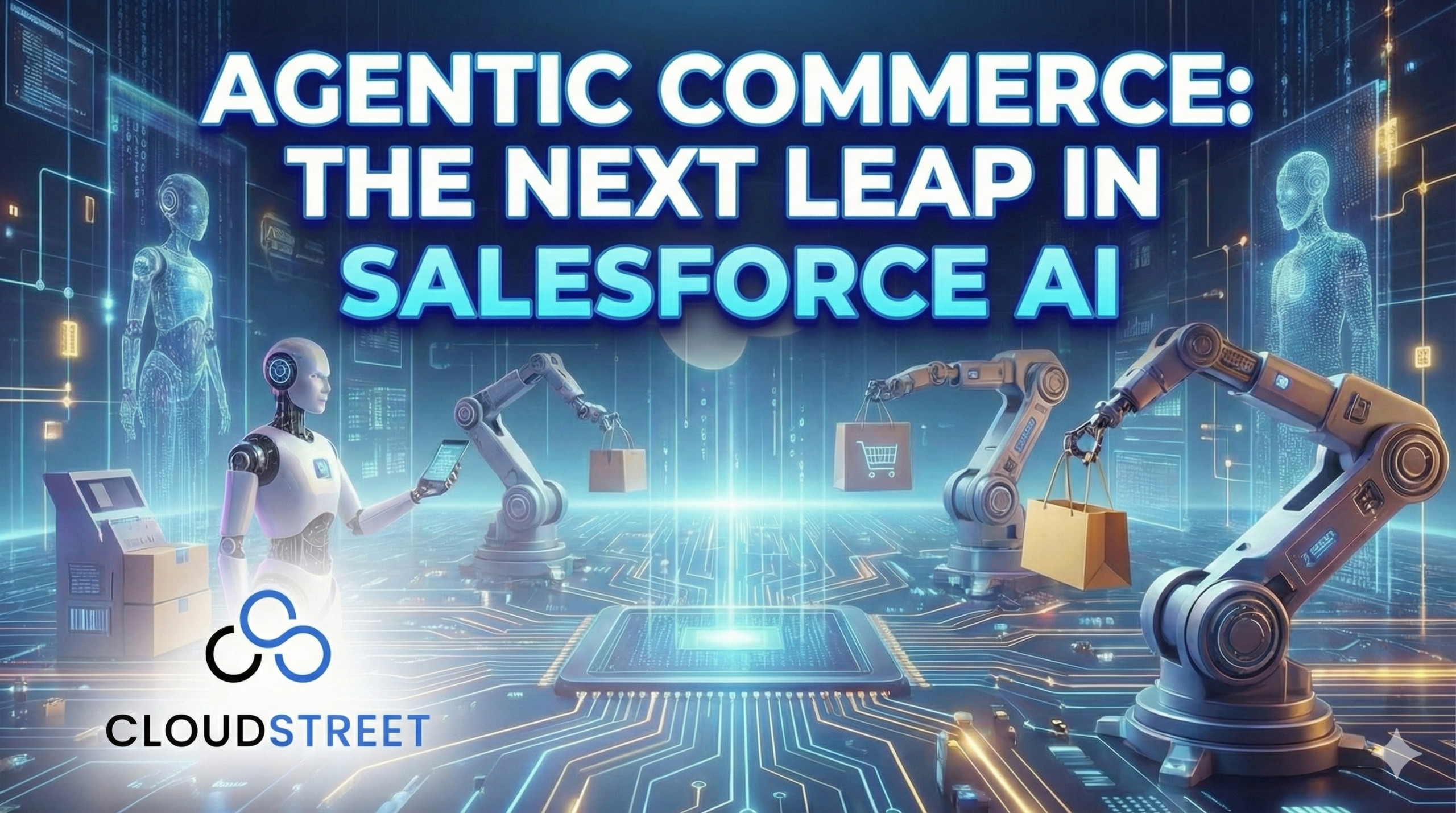
Remember when online shopping meant clicking through endless product pages, comparing features in spreadsheets, and manually tracking orders? Those days are quickly becoming history. We’re entering the era of agentic commerce: where AI agents don’t just recommend products, they actually buy them for you.
At CLOUDSTREET, we’ve been helping businesses in Houston and around the globe navigate digital transformation, and this shift represents one of the most significant changes we’ve seen in how commerce operates. Let’s break down what agentic commerce means and why it’s the next big leap for Salesforce users.
The Problem with Isolated AI Agents
Current AI implementations often work in silos. Your chatbot might answer customer questions, your recommendation engine suggests products, and your inventory system tracks stock: but they rarely talk to each other effectively.
This creates 3 major friction points for businesses:
- Disconnected customer experiences where agents can’t access full context
- Incomplete automation that still requires human intervention at key moments
- Missed opportunities when systems can’t act on insights in real-time
The result? Customers get frustrated with repetitive interactions, and businesses lose sales to competitors with smoother experiences.

What Agentic Commerce Actually Means
Unlike traditional AI that just describes or recommends, agentic AI actually executes actions. Think of it as upgrading from a helpful assistant who gives advice to one who can actually complete tasks on your behalf.
Here’s how it works in practice: A customer says “Order my usual running shoes, but this time in blue.” Instead of showing search results, the AI agent:
- Accesses their purchase history
- Identifies the preferred brand and style
- Finds the blue version
- Checks delivery times against their calendar
- Completes the purchase using stored payment methods
- Sets up tracking notifications
All without any additional clicks or forms to fill out.
Ready to explore how AI can transform your Salesforce implementation? Our Salesforce AI consulting services help businesses unlock these capabilities with strategic implementation and ongoing support.
How Agentforce 360 Creates Unified Context
Salesforce’s approach to solving the isolation problem comes through Agentforce 360: their agentic layer that sits across the entire platform. Instead of separate tools working independently, everything connects through unified customer context.
This unified approach delivers 5 key advantages:
- Complete customer view across all touchpoints and interactions
- Real-time decision making based on current context and preferences
- Seamless handoffs between different AI agents and human team members
- Consistent brand experience regardless of interaction channel
- Continuous learning that improves recommendations over time
The magic happens in how these agents share information. When a customer contacts support about a delivery issue, the agent already knows their recent purchases, preferences, and even their typical communication style.
3 Real-World Examples That Are Changing Commerce
Let’s look at how businesses are already using agentic commerce to transform customer experiences:
1. Conversational Commerce That Actually Converts
Traditional chatbots answer questions but can’t close deals. Agentic commerce changes this completely. A customer might start a conversation asking about winter coats, and the AI agent:
- Asks qualifying questions about size, budget, and style preferences
- Shows personalized recommendations based on past purchases
- Handles sizing questions using the customer’s measurement profile
- Processes the order and schedules delivery
- Sets reminders for seasonal item care
The entire purchase happens within the conversation, with no redirects or separate checkout processes.
2. Contextual Search That Understands Intent
Instead of keyword matching, agentic search understands what customers really want. When someone searches for “something nice for my mom’s birthday,” the AI agent:
- References previous gift purchases and occasions
- Considers the customer’s budget range from past orders
- Factors in delivery timelines for the upcoming date
- Suggests options that match their mom’s preferences (if known from past data)
- Can immediately handle purchase and gift wrapping
3. Two-Way Messaging That Builds Relationships
Agentic messaging goes beyond responding to inquiries. It proactively creates value by:
- Sending personalized reorder reminders based on usage patterns
- Alerting customers to relevant sales on items in their wishlist
- Providing maintenance tips for previous purchases
- Offering upgrades when new versions of owned products launch
Want to implement these capabilities in your business? CLOUDSTREET’s team in Houston has helped companies globally deploy advanced Salesforce AI solutions that drive real ROI.

The Business Impact: Beyond Better Customer Experience
While improved customer satisfaction is important, the business benefits of agentic commerce extend much deeper:
Revenue Growth Through Reduced Friction
Every click, form field, and redirect represents a chance for customers to abandon their purchase. Agentic commerce eliminates most of these friction points, leading to significantly higher conversion rates. Businesses typically see 15-30% increases in completion rates when AI agents can handle the entire transaction flow.
Operational Efficiency at Scale
Human customer service teams can focus on complex problem-solving and relationship building while AI agents handle routine transactions. This doesn’t mean fewer jobs: it means more valuable work for your team members.
Data-Driven Insights That Actually Drive Decisions
When AI agents handle transactions, they capture rich interaction data that traditional analytics miss. This includes customer hesitation points, preference changes over time, and successful persuasion patterns that can inform broader business strategy.
Getting Started: Your Path to Agentic Commerce
Implementing agentic commerce isn’t about replacing everything you’ve built: it’s about enhancing your existing Salesforce investment with smarter automation.
The strategic approach involves 4 phases:
- Assessment: Understanding your current customer journey and identifying automation opportunities
- Foundation: Ensuring your Salesforce data is clean and well-structured for AI consumption
- Implementation: Deploying AI agents for specific use cases with measurable impact
- Optimization: Continuously improving agent performance based on real-world results
Most businesses start with one or two specific use cases: like automated reorders for consumable products or intelligent product recommendations for existing customers. Success with these initial implementations builds confidence and provides the foundation for broader deployment.
The Competitive Advantage of Moving Early
Companies that implement agentic commerce capabilities now gain significant advantages over competitors still relying on traditional approaches. Early adopters benefit from:
- Customer loyalty through superior experience before competitors catch up
- Operational knowledge that takes time to develop and refine
- Data advantages from capturing richer interaction information sooner
- Team expertise in managing and optimizing AI-driven processes
The technology exists today, and the businesses using it effectively are already seeing measurable results.
Transform Your Commerce Experience with CLOUDSTREET
Agentic commerce represents more than just a technology upgrade: it’s a fundamental shift in how businesses and customers interact. The companies that embrace this change thoughtfully and strategically will define the next generation of customer experience.
At CLOUDSTREET, we’ve guided businesses through every stage of this transformation, from initial strategy development to full implementation and ongoing optimization. Our team understands both the technical requirements and the business implications of deploying AI agents that can actually drive revenue.
Ready to explore what agentic commerce could mean for your business? Contact our Houston-based team for a strategic consultation that maps your current Salesforce capabilities to agentic commerce opportunities. We’ll help you identify the highest-impact starting points and develop a roadmap that delivers measurable results.
The future of commerce is here, and it’s more intelligent, more efficient, and more customer-focused than ever before. The question isn’t whether agentic commerce will transform your industry: it’s whether you’ll be leading that transformation or catching up to it.
Category
Discover insights that drive results - explore out latest blog posts now
DealHub Salesforce Integration for Manufacturers: Connecting CPQ, Contracts, and CRM
About the manufacturer: mid-market industrial equipment company A U.S.-based, mid-market [...]
Salesforce Data 360 and Agentforce: Why Grounding Is What Makes AI Agents Dependable
An AI agent can produce a fluent answer and still [...]
Salesforce Data 360 Governance and Informatica: Managing Data Quality, Access, and Trust in the Agentic Era
Data governance becomes more consequential when business data does more [...]