7 Reasons Why a Salesforce Commerce Cloud Implementation Partner Beats Going It Alone
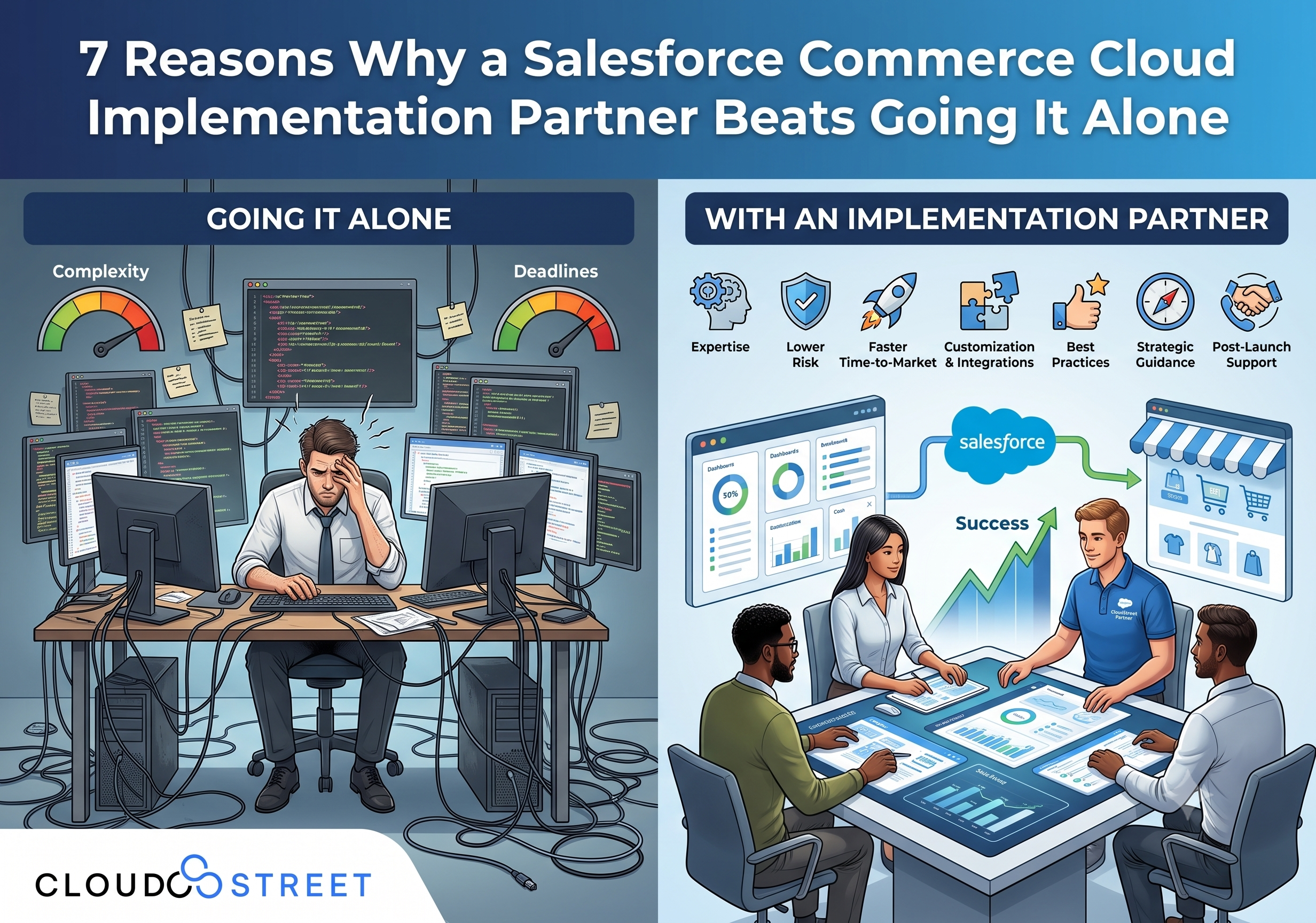
At CloudStreet, we see it all the time. A mid-sized business decides to modernize its digital sales channel. They see the power of Salesforce B2B Commerce Cloud, and they decide to “save” money by handling the implementation in-house or hiring a single independent salesforce b2b commerce cloud developer.
Six months later, they call us. The site is slow, the pricing is wrong, and the complex account hierarchies: the backbone of any B2B business: are a mess.
Based in Houston, Texas, we help companies locally and globally turn these “rescue” projects into high-performing revenue engines. We don’t just build websites; we implement ROI into our customers’ Salesforce orgs.
If you are weighing the options between a DIY approach and hiring a professional salesforce commerce cloud implementation partner, here are 7 reasons why specialized expertise isn’t just a luxury: it is a protective shield for your investment.
1. B2B Commerce is Fundamentally Different from B2C
Many internal teams approach Salesforce Commerce Cloud as if it were a standard B2C storefront or a basic Experience Cloud site. This is the first mistake. B2B commerce involves complex “behind the curtain” logic that standard retail sites never touch.
You aren’t just selling a product to a person; you are selling to a business account with:
- Pre-negotiated contract pricing.
- Custom product catalogs (entitlements) that differ by customer.
- Complex approval workflows for large orders.
- Multi-level account hierarchies.
A generalist developer might understand how to make a page look pretty, but a dedicated salesforce b2b commerce cloud consultant understands the underlying data architecture required to make these B2B-specific features work seamlessly without breaking the platform’s limits.
Discover how to choose the right partner in our detailed comparison guide.
2. The Risk of Building a “Frankenstein” System

When you go it alone, there is a massive temptation to “over-customize.” Without a proven methodology, internal teams often build “Frankenstein” systems: stitched-together pieces of custom code and third-party apps that work for today but fail tomorrow.
The real danger here is when Salesforce releases its seasonal updates. If your architecture isn’t built following “Best Practices,” those updates can break your custom code, leading to days or weeks of downtime. We focus on a “configuration first” approach. As your salesforce commerce cloud implementation partner, we ensure your system is robust, scalable, and upgrade-proof.
3. Solving the Integration Puzzle
B2B Commerce does not live on an island. To be successful, it must talk to your ERP (like Oracle or Epicor), your PIM (Product Information Management), and your warehouse systems.
DIY implementations often fail at the integration layer. We have seen cases where data syncs fail, leading to customers seeing “out of stock” items that are actually in the warehouse, or worse, seeing the wrong pricing. We specialize in complex integrations, including Salesforce and Oracle Fusion, ensuring that your commerce platform is a true extension of your back-office operations.
4. The Hidden Costs of Failed DIY Projects
The most expensive implementation is the one you have to do twice. While a professional partner has an upfront cost, the “hidden” costs of a failed DIY attempt are far higher:
- Months of Lost Revenue: Every month your site isn’t live is a month your competitors are winning.
- Rework Costs: It is significantly harder (and more expensive) to fix a broken data model than it is to build it right the first time.
- Frustrated Users: If your B2B buyers have a bad first experience, they will go back to calling their sales reps, defeating the purpose of digital self-service.
Check out our full range of Salesforce services to see how we prevent these costs.
5. Access to Certified Architects vs. General Freelancers
When you hire a solo salesforce b2b commerce cloud developer, you are relying on one person’s knowledge. If they hit a wall with a complex tax calculation or a shipping API, the project stalls.
An implementation partner brings a “Strike Team” of experts:
- Solution Architects to design the high-level strategy.
- Technical Leads to oversee the code quality.
- Project Managers to keep the timeline on track.
- QA Engineers to break the system before your customers do.
This collective brainpower is what drives the ROI we promise our clients.
6. Strategy + Execution vs. Just a “Consultant”
There is a big difference between a salesforce b2b commerce cloud consultant and a full-scale implementation partner. A consultant might give you a 50-page slide deck on “what” to do. We believe in showing you “how” to do it and then actually doing it.
We bridge the gap between business strategy and technical reality. We don’t just tell you that you need a better checkout flow; we build it, test it, and support it after launch through our salesforce b2b commerce cloud managed services.
Ready to start? Contact our Houston-based team today.
7. Speed to Market with CloudStreet Accelerators

Time-to-value is everything. One of the biggest advantages of working with us is our library of pre-built components and “accelerators.” Instead of your internal team spending weeks coding a custom “Quick Order” form from scratch, we can deploy a proven, high-performing version in a fraction of the time.
Our B2B Commerce Cloud Accelerator is designed to get you live faster, with fewer bugs and a lower total cost of ownership.
When Can You Actually Use Internal Resources?
We aren’t saying your internal team shouldn’t be involved. In fact, they must be. Your internal team knows your products and your customers better than anyone.
The ideal “hybrid” model involves:
- CloudStreet: Handles the architecture, complex integrations, and core commerce configuration.
- Internal Team: Focuses on data cleansing, content creation, and user acceptance testing (UAT).
This partnership ensures that when we hand over the keys, your team is fully trained and ready to manage the day-to-day operations of the store.
From Houston to the Rest of the World

While our roots are in Houston, Texas, our reach is global. Whether you are a local distributor in the Gulf Coast or a multinational manufacturer with storefronts in five different languages, the principles of a successful Salesforce implementation remain the same.
Don’t gamble with your digital transformation. A DIY failure isn’t just a technical glitch; it’s a missed opportunity for growth.
Take the Next Step Toward Your ROI
If you’re tired of “figuring it out” and ready to see real results from your Salesforce investment, let’s talk. We bring the expertise, the tools, and the Houston grit to get your B2B commerce project across the finish line.
- Consult with an Expert: Book a discovery call
- View Our Solutions: Explore our B2B Commerce offerings
- See Our Work: Read our latest case studies
Category
Discover insights that drive results - explore out latest blog posts now
DealHub Salesforce Integration for Manufacturers: Connecting CPQ, Contracts, and CRM
About the manufacturer: mid-market industrial equipment company A U.S.-based, mid-market [...]
Salesforce Data 360 and Agentforce: Why Grounding Is What Makes AI Agents Dependable
An AI agent can produce a fluent answer and still [...]
Salesforce Data 360 Governance and Informatica: Managing Data Quality, Access, and Trust in the Agentic Era
Data governance becomes more consequential when business data does more [...]