6 Salesforce Implementation Roles and How CloudStreet Structures Its Teams
In enterprise software projects, the platform alone does not determine the outcome.
Salesforce can support many business processes, but results depend on how the system is planned, configured, integrated, tested, and maintained. A practical way to evaluate an implementation partner is to understand the roles involved and how responsibilities are divided across the team.
Headquartered in Houston, Texas, CloudStreet works with customers locally and globally. Our delivery model uses US-based leadership for planning and business alignment, with delivery teams in multiple countries for technical execution. This is a practical cost structure designed to match the type of work to the role performing it.
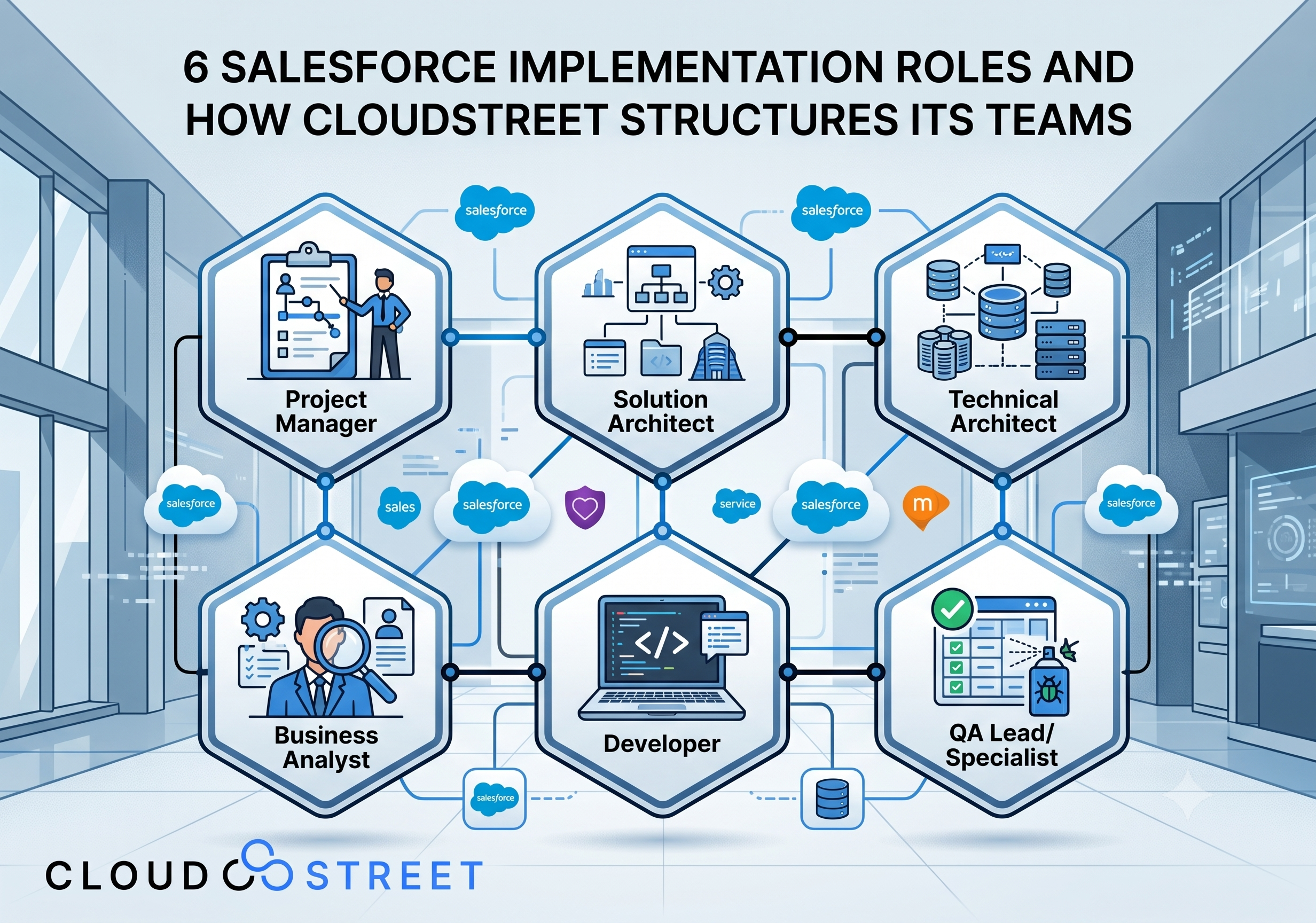
In this guide, we explain the 6 core roles commonly involved in a Salesforce project and how CloudStreet assigns those responsibilities across its team structure.
1. The Solution Architect: Defining the Functional Approach
The Solution Architect (SA) is responsible for translating business requirements into a workable Salesforce design. Before build work starts, the SA reviews business processes, data needs, reporting requirements, and future-state considerations. The goal is to define a solution that fits current operations and can be maintained over time.
At CloudStreet, Solution Architects are US-based and typically work directly with stakeholders during discovery and design. Their scope often includes projects involving Sales and Service Clouds as well as more specialized implementations such as B2B Commerce.
4 Key Responsibilities of the SA:
- Mapping business requirements to native Salesforce capabilities.
- Designing the end-to-end functional solution architecture.
- Leading workshops to align stakeholders on scope and roadmap.
- Defining standards that help reduce rework and technical debt.
If you are assessing team structure for an upcoming project, schedule a call to review architecture and role coverage.
2. The Technical Architect: Designing the Technical Framework
While the Solution Architect defines the functional direction, the Technical Architect (TA) defines how the solution will operate from a systems perspective. This role becomes especially important when Salesforce must connect with ERPs, billing platforms, data warehouses, or custom applications.
CloudStreet’s Technical Architects are also US-based. They typically lead technical design decisions related to integrations, security, scalability, and platform constraints.
4 Key Responsibilities of the TA:
- Designing the data model and system performance approach.
- Defining integration patterns such as REST, SOAP, and middleware-based connections.
- Owning the technical blueprint and platform security model.
- Managing platform limits and technical dependencies across systems.

3. The Business Analyst: Translating Business Needs into Delivery Requirements
The Business Analyst (BA) connects business stakeholders with the delivery team. This role helps make sure requirements are documented clearly, processes are understood before configuration begins, and acceptance criteria are defined in a way that developers and testers can use.
Our BAs are US-based, which supports direct collaboration during discovery, requirements review, and feedback cycles.
4 Key Responsibilities of the BA:
- Running discovery workshops to identify business requirements and process gaps.
- Documenting user stories and acceptance criteria.
- Mapping current-state and future-state processes.
- Validating that delivered functionality addresses the intended business use case.
4. The Developer: Building and Extending the Platform
Developers handle the parts of a Salesforce implementation that go beyond standard configuration. This can include Apex, Lightning Web Components (LWC), integrations, automation, and custom business logic. Depending on project scope, developers may work closely with architects, administrators, and QA during each sprint.
CloudStreet uses a global staffing model for development work. Our developers are based in Costa Rica, Argentina, the Philippines, and India. They are full-time CloudStreet team members working within the same delivery structure as our US-based architects. This model is used as a practical way to manage costs while maintaining role clarity and coordination across the project.
4 Key Responsibilities of the Developer:
- Writing maintainable Apex code and Lightning components.
- Building integrations and API endpoints.
- Developing Salesforce Flows and automation logic.
- Troubleshooting and improving existing custom code.

If you need help scoping custom work, get a quote for development or integration support.
5. Quality Assurance (QA): Validating the Release
Quality Assurance (QA) is responsible for testing the solution before release. QA works alongside developers and analysts to confirm that requirements were implemented correctly, defects are documented, and regressions are caught before deployment.
Our QA specialists work with the broader delivery team in our international delivery centers so testing can happen throughout the build cycle rather than only at the end.
4 Key Responsibilities of the QA Team:
- Designing test plans and regression suites.
- Executing functional testing against acceptance criteria.
- Automating repetitive test cases where appropriate.
- Verifying release readiness before deployment to production.
6. The Project Manager: Managing Scope, Timeline, and Communication
The Project Manager (PM) is responsible for coordinating the delivery process. This includes planning meetings, tracking milestones, managing risks, and keeping communication consistent across stakeholders and delivery roles. In Salesforce projects, the PM helps maintain momentum while making sure open issues are visible and decisions are documented.
4 Key Responsibilities of the PM:
- Managing project timelines, budgets, and milestones.
- Coordinating communication across stakeholders and delivery teams.
- Tracking risks, dependencies, and scope changes.
- Supporting a structured delivery process from kickoff through go-live.

How CloudStreet Structures Its Teams
CloudStreet uses a role-based delivery structure that assigns planning and stakeholder-facing work primarily to US-based team members, while much of the build and test work is handled through global delivery teams. This structure is intended to align costs with the type of work being performed and to keep communication responsibilities clear.
In practice, this means:
- Solution Architects, Technical Architects, and Business Analysts are generally based in the United States and work directly with customer stakeholders.
- Developers and QA specialists are distributed across teams in the Philippines, India, and Latin America.
- Project management coordinates work across both groups to maintain delivery schedules and issue tracking.
For companies evaluating Salesforce support models, this structure can be useful when the goal is to balance business access, technical capacity, and cost control. Whether you are updating an existing org or planning a new B2B Commerce platform, understanding team composition is an important part of project planning.
From our headquarters in Houston, Texas, we support customers locally and globally. If you want to review team structure, delivery responsibilities, or implementation planning, contact us.
Category
Discover insights that drive results - explore out latest blog posts now
DealHub Salesforce Integration for Manufacturers: Connecting CPQ, Contracts, and CRM
About the manufacturer: mid-market industrial equipment company A U.S.-based, mid-market [...]
Salesforce Data 360 and Agentforce: Why Grounding Is What Makes AI Agents Dependable
An AI agent can produce a fluent answer and still [...]

Salesforce Data 360 Governance and Informatica: Managing Data Quality, Access, and Trust in the Agentic Era
Data governance becomes more consequential when business data does more [...]