5 Signs Your Business Has Outgrown Shopify (And When to Consider Salesforce Commerce Cloud)
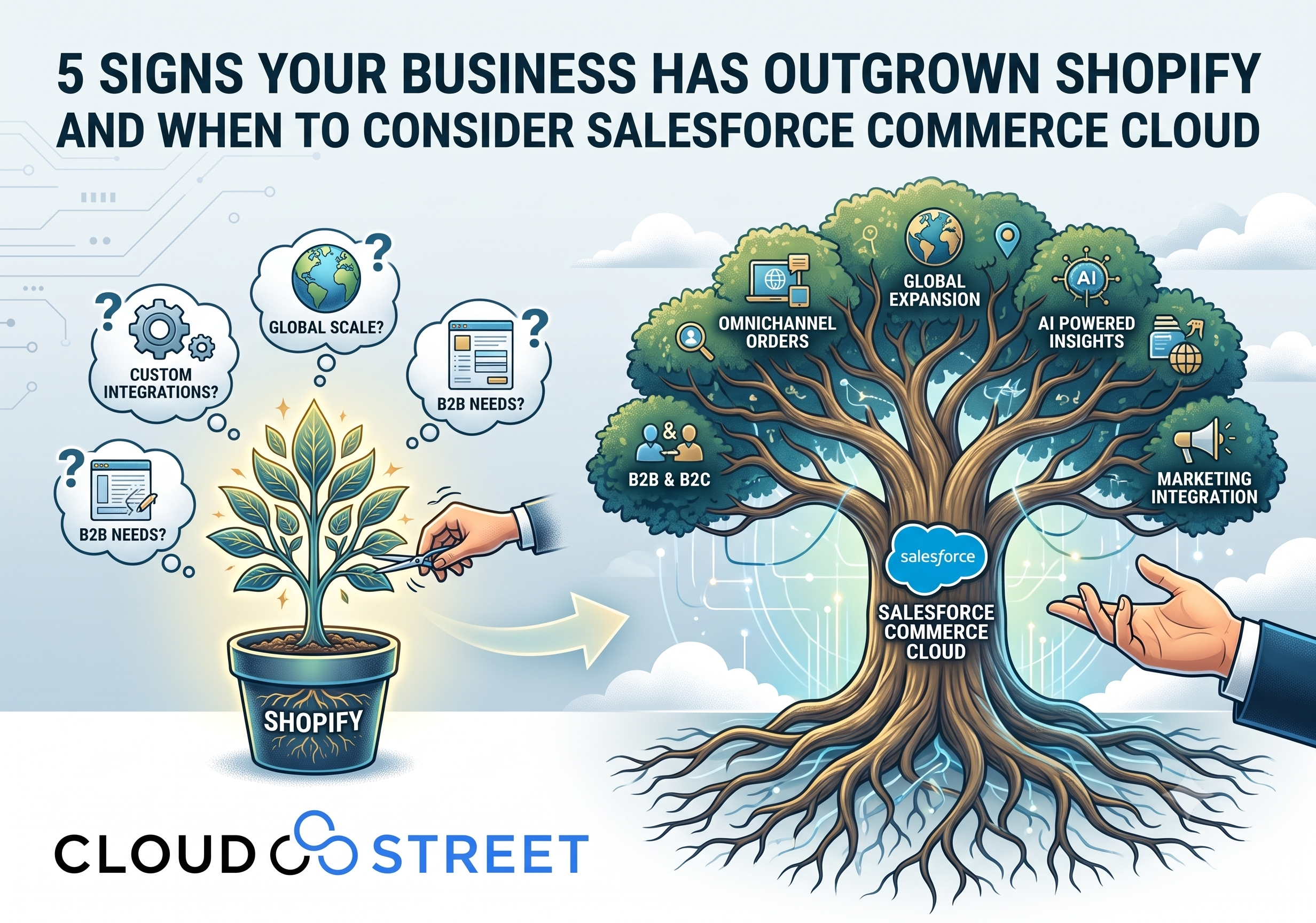
At CloudStreet, we see it all the time. A business starts on Shopify, finds incredible success, and scales rapidly. Shopify is a fantastic platform: it’s user-friendly, quick to set up, and powers thousands of successful brands. But for many mid-market and enterprise businesses, there comes a moment where the very simplicity that made Shopify great starts to become a bottleneck.
We are based in Houston, Texas, but we work with customers locally and globally to help them navigate these exact growing pains. When your operations move from “selling products online” to “managing a complex global enterprise,” the platform you started with might not be the platform that takes you to the next level.
If you’re wondering when to migrate from shopify to salesforce commerce cloud, you aren’t alone. It’s a major strategic move, but for the right business, it’s the difference between hitting a ceiling and achieving true ROI.
Here are the 5 unmistakable signs your business has outgrown shopify.
1. Your B2B Complexity is Outpacing Native Capabilities
One of the most common shopify enterprise limitations we encounter is the “B2B wall.” Shopify has made great strides with its B2B features in Shopify Plus, but it often struggles when business-to-business logic gets truly “enterprise.”
If your business relies on complex contract pricing, intricate customer hierarchies, or multi-step quote-to-order workflows, you’ve likely felt the friction. In Shopify, managing hundreds of different price lists for different customer segments can quickly become a manual nightmare.
The Shopify Limitation:
Shopify is primarily built for a “one-to-many” retail model. While it has B2B features, they are often additions to a B2C-first core. This means that features like account-specific catalogs or complex buyer permissions usually require third-party apps or extensive custom liquid coding.
The Salesforce Solution:
Salesforce Commerce Cloud (specifically Salesforce B2B Commerce) was built from the ground up to handle the “many-to-many” relationships of enterprise B2B. It handles account-based pricing, custom catalogs, and multi-level buyer hierarchies (where a manager must approve a requestor’s order) natively. It doesn’t just “support” B2B; it’s an engine designed for it.
2. Your Team is Drowning in Middleware and “Duct-Tape” Integrations
As businesses grow, they add tools. You need an ERP (Enterprise Resource Planning) system, a sophisticated PIM (Product Information Management) tool, and advanced OMS (Order Management) capabilities.
When you look at shopify vs salesforce for enterprise, the integration landscape is often the deciding factor. If your developers spend more time managing the “glue” between your apps than they do building new features, you’ve outgrown your current stack.
The Shopify Limitation:
Because Shopify isn’t a full CRM or ERP, it relies on “middleware” to talk to the rest of your business. As you scale, you end up with a “spaghetti” of third-party apps to handle things like real-time inventory sync across multiple warehouses or complex tax compliance. Every app is a potential point of failure and another monthly subscription.
The Salesforce Solution:
Salesforce provides a unified ecosystem. When you use Commerce Cloud, your commerce data lives in the same “brain” as your sales and service data. The need for middleware is drastically reduced because the platform is designed to be the central nervous system of your business. We specialize in these Salesforce services to ensure that your integrations drive ROI rather than technical debt.
Ready to see if your tech stack is holding you back? Schedule a Call with our team today.
3. You Need CRM-Native Commerce for a Single Customer View
In a modern enterprise, your commerce platform cannot be an island. Your sales team needs to see what customers are buying online; your service team needs to see order history to solve tickets; and your marketing team needs real-time data to trigger personalized journeys.

The Shopify Limitation:
Shopify is a commerce engine that happens to have some customer data. It is not a CRM. This creates “data silos.” Your sales reps in Houston might be calling a customer who just had a terrible experience with an online order, but they have no way of knowing that because the data isn’t synced in real-time.
The Salesforce Solution:
Salesforce Commerce Cloud is CRM-native. This is the ultimate “cheat code” for enterprise growth. Every transaction, click, and support ticket is tied to a single record. This allows you to offer “Service-First Commerce,” where a support agent can place an order for a customer directly within the service console. When you look at the overall comparison of Shopify vs. Commerce Cloud, this unified data model is often the biggest win for ROI.
4. Your International Expansion is Hitting Walls
Expanding into new territories is one of the most exciting phases of growth, but it’s also where many businesses realize they’ve hit shopify enterprise limitations. Managing multiple regions, currencies, and languages across separate “expansion stores” becomes a logistical hurdle that slows down your go-to-market speed.

The Shopify Limitation:
Historically, Shopify forced you to open separate “instances” or stores for different regions. While “Shopify Markets” has improved this, it still lacks the deep localization and central governance that global enterprises require. Managing five different stores for five different countries means five sets of inventory, five sets of apps, and five sets of headaches.
The Salesforce Solution:
Salesforce is built for the global stage. It allows you to manage a global multi-site architecture from a single login. You can share catalogs across regions while maintaining local pricing, tax rules, and languages. This central governance with local flexibility is why global brands choose Salesforce to scale without multiplying their operational overhead.
5. Your Personalization and AI Capabilities Feel “Bolted-On”
Every commerce platform claims to have AI these days, but there is a massive difference between a basic “recommended products” widget and a truly agentic AI experience.
The Shopify Limitation:
Shopify’s AI features are often general tools applied across their entire user base. They are helpful for small stores, but they lack the ability to be “grounded” in your specific enterprise data. They don’t know your specific B2B contracts, your unique service history, or your complex inventory logic.
The Salesforce Solution:
This is where Salesforce Artificial Intelligence changes the game. With the introduction of Agentforce Commerce, Salesforce is moving beyond “chatbots” to “agents” that can actually perform tasks. These agents are grounded in your Data Cloud: meaning they know exactly who the customer is, what their contract says, and what’s in stock across your 10 global warehouses. This isn’t a bolt-on; it’s a native part of the platform.

Is it Time to Make the Move?
Moving platforms is a big decision, and it’s not one to be taken lightly. Shopify is an incredible tool for many, but if you are checking off three or more of the signs above, you are likely leaving money on the table due to operational inefficiency and missed customer opportunities.
At CloudStreet, we don’t just “install” Salesforce. We implement ROI. Whether you are a business right here in Houston or a global enterprise looking for a partner who understands the nuances of complex commerce, we are here to help you navigate the transition.
How to Move Forward:
- [Schedule a Call]: Let’s walk through your current bottlenecks and see if a migration makes sense for your bottom line.
- [Get a Quote]: If you already know you’ve outgrown Shopify, let us help you map out the cost and the expected ROI of a Salesforce implementation.
- [Contact Our Team]: Have specific questions about B2B complexity or AI? Reach out, and one of our experts will get back to you.
Don’t let your platform be the ceiling for your growth. When you’re ready to move from “running a store” to “leading an industry,” we’re ready to help you get there.
Category
Discover insights that drive results - explore out latest blog posts now
DealHub Salesforce Integration for Manufacturers: Connecting CPQ, Contracts, and CRM
About the manufacturer: mid-market industrial equipment company A U.S.-based, mid-market [...]
Salesforce Data 360 and Agentforce: Why Grounding Is What Makes AI Agents Dependable
An AI agent can produce a fluent answer and still [...]
Salesforce Data 360 Governance and Informatica: Managing Data Quality, Access, and Trust in the Agentic Era
Data governance becomes more consequential when business data does more [...]