5 Powerful Salesforce Experience Cloud Use Cases for B2B Customer Portals (Beyond Purchasing)
When most businesses think about customer portals, they immediately jump to e-commerce and online purchasing. But Salesforce Experience Cloud offers so much more potential for B2B organizations looking to strengthen customer relationships and streamline operations.
Experience Cloud’s flexibility allows companies to create tailored digital experiences that go far beyond transactions. From our experience working with clients both locally in Houston, Texas, and globally, we’ve seen how these portals can transform how businesses interact with their customers, partners, and employees.
Let’s explore five powerful use cases that can revolutionize your B2B customer experience without involving a single purchase transaction.
1. Self-Service Support Portals and Help Centers
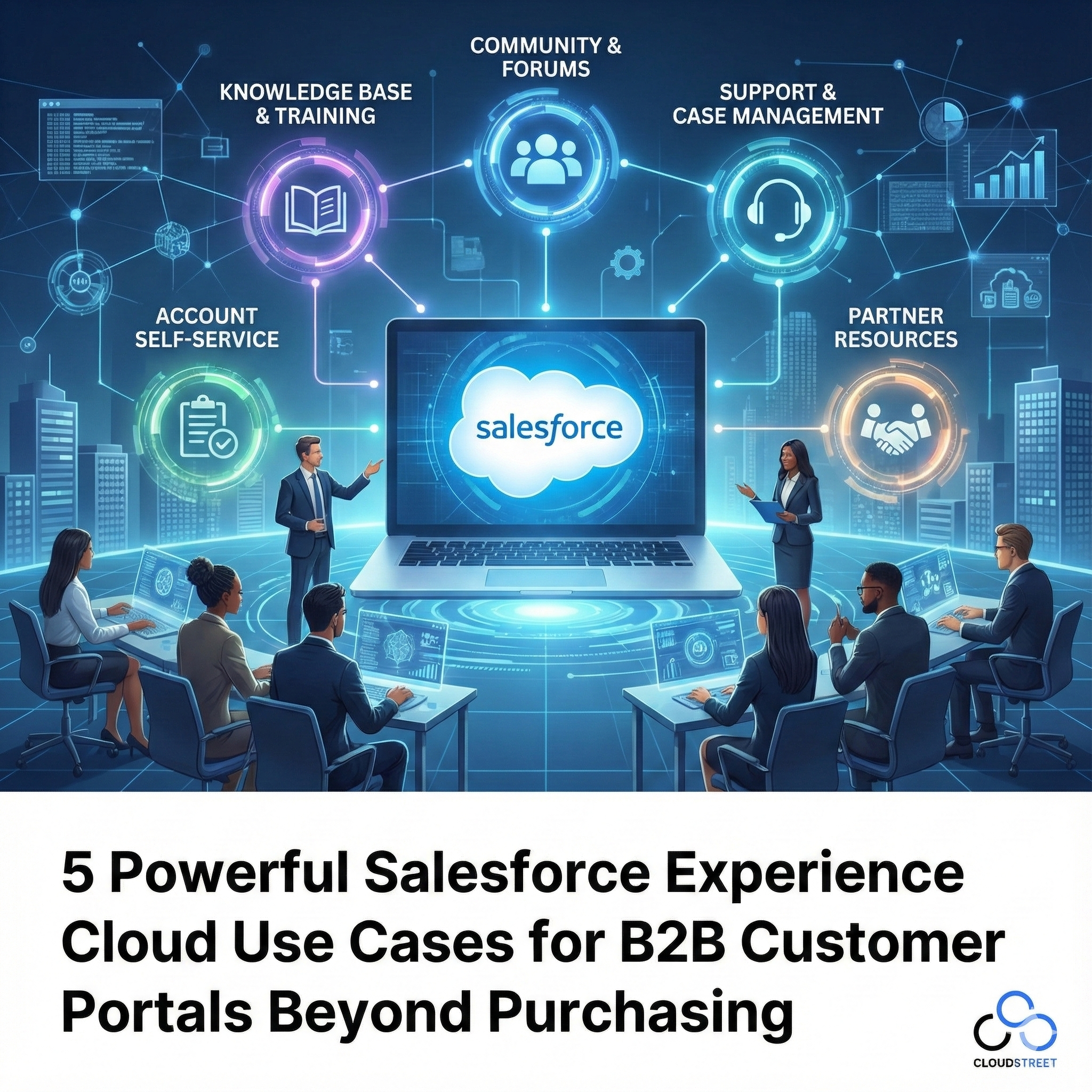
One of the most impactful applications of Experience Cloud is creating comprehensive self-service support environments. These portals empower your B2B customers to resolve issues independently, reducing the burden on your support team while improving customer satisfaction.

A well-designed self-service portal includes:
- Searchable knowledge base with articles, FAQs, and troubleshooting guides
- Case management system where customers can submit, track, and update support tickets
- Community forums where customers can ask questions and share solutions
- AI-powered chatbots for instant responses to common inquiries
- Video tutorials and documentation for complex products or services
The benefits are immediate and measurable. Customers get faster resolution times since they’re not waiting in support queues, and your support team can focus on more complex issues that truly require human intervention. We’ve seen clients reduce their support ticket volume by 40-60% after implementing robust self-service portals.
For B2B companies with complex products or services, this approach is particularly valuable. Technical users often prefer finding answers themselves rather than explaining their specific setup to a support agent who may not have the same level of technical expertise.
2. Partner Relationship Management (PRM) Portals
B2B organizations often rely heavily on partner networks – distributors, resellers, vendors, and other third-party relationships. Experience Cloud can serve as a centralized hub for managing these critical partnerships.
A PRM portal typically includes:
- Lead and opportunity sharing between your organization and partners
- Marketing resource center with co-branded materials, campaign assets, and sales collateral
- Training and certification programs to ensure partners are knowledgeable about your products
- Deal registration and protection systems to prevent channel conflicts
- Performance dashboards showing partner metrics and achievements
- Communication tools for real-time collaboration on shared initiatives

The power of a PRM portal lies in its ability to create transparency and alignment across your entire partner ecosystem. Partners have clear visibility into their performance, access to the resources they need to be successful, and direct communication channels with your team.
From our Houston-based practice, we’ve helped manufacturing companies create portals where distributors can access real-time inventory data, submit warranty claims, and collaborate on large enterprise deals. The result is stronger partnerships and increased revenue through improved partner performance.
3. Customer Account Management and Data Access
B2B customers need ongoing access to their account information, contract details, and business data. Rather than forcing them to call or email for basic information, Experience Cloud can provide secure, personalized account portals.
These portals give customers direct access to:
- Account profiles and contact information that they can update themselves
- Contract and subscription details including renewal dates and terms
- Historical transaction data and order history
- Custom reporting and analytics relevant to their specific needs
- Document libraries with contracts, invoices, and compliance documentation
- Service level agreement (SLA) tracking and performance metrics

This level of transparency builds trust and reduces administrative overhead for both parties. Customers feel more in control of their business relationship, while your team spends less time fielding requests for basic account information.
The key is personalizing the experience based on the customer’s role and permissions. A procurement manager might need access to purchasing history and budget tracking, while a technical administrator needs access to system configurations and support documentation.
4. Community Knowledge Sharing and Peer Support
Some of the most valuable support comes not from your internal team, but from other customers who have faced similar challenges. Experience Cloud can facilitate these peer-to-peer interactions through dedicated community spaces.
Effective customer communities include:
- Discussion forums organized by product, industry, or use case
- User-generated content like tips, best practices, and case studies
- Expert programs that recognize and reward your most helpful customers
- Idea exchanges where customers can suggest product improvements
- Regional or industry-specific groups for more targeted discussions
- Integration with your knowledge base so community solutions become searchable resources

The beauty of community-driven support is that it scales naturally. As more customers participate, the value increases for everyone. Advanced users enjoy helping others and being recognized as experts, while newer customers get faster, more practical answers to their questions.
We’ve seen this work particularly well for software companies and professional services firms, where customers often have creative solutions to common challenges that your internal team might not have considered.
5. Training and Onboarding Portals
For B2B companies with complex products or services, customer success often depends on proper training and onboarding. Experience Cloud can serve as a comprehensive learning management system tailored to your customers’ needs.
A robust training portal includes:
- Role-based learning paths that adapt to different user types and experience levels
- Interactive tutorials and simulations for hands-on learning
- Certification programs with badges and credentials
- Progress tracking so customers and their managers can monitor completion
- Resource libraries with quick reference guides and cheat sheets
- Live and recorded webinars for ongoing education
This approach is particularly valuable for enterprise software companies, where user adoption directly impacts customer retention and expansion opportunities. When customers are properly trained, they’re more likely to use your product effectively, see value, and renew their contracts.
From our global client experience, we’ve found that customers who complete structured onboarding programs have significantly higher satisfaction scores and lower churn rates compared to those who receive only basic setup support.
Getting Started with Experience Cloud
The flexibility of Salesforce Experience Cloud means you’re not limited to just one of these use cases. Many successful implementations combine multiple approaches – starting with a self-service support portal and gradually adding partner management, community features, and training capabilities.
The key is starting with your customers’ most pressing needs and building from there. What questions do they ask most frequently? What processes require the most back-and-forth communication? Where do you see the biggest opportunities to improve efficiency or satisfaction?
Transform Your B2B Customer Experience
These five use cases represent just the beginning of what’s possible with Salesforce Experience Cloud. Whether you’re looking to reduce support costs, strengthen partner relationships, or improve customer onboarding, a well-designed portal can deliver measurable results for your business.
At CLOUDSTREET, we’ve helped businesses across Houston and around the world implement customer portals that go far beyond basic purchasing functionality. Our team understands both the technical capabilities of Experience Cloud and the business processes that drive B2B success.
Ready to explore how a custom B2B portal could benefit your organization? Contact our team to discuss your specific needs and learn how we can help you create a portal that truly serves your customers and grows your business.
Category
Discover insights that drive results - explore out latest blog posts now
Case Study: How Highland Cabinetry Colorado Built a Modern Wholesale Powerhouse on Salesforce B2B Commerce Cloud
In the world of high-end cabinetry, timing is everything. When [...]
Agentforce ROI: 7 Ways to Maximize Your Salesforce AI Investment
You've heard the buzz. Salesforce Agentforce is supposed to revolutionize [...]
Salesforce B2B Commerce Cloud Partner & Consultant Guide
You're about to drop serious money on a Salesforce B2B [...]