250 Years of ROI: The 5 Biggest Business Shifts in US History (And Yes, AI Made the Cut)
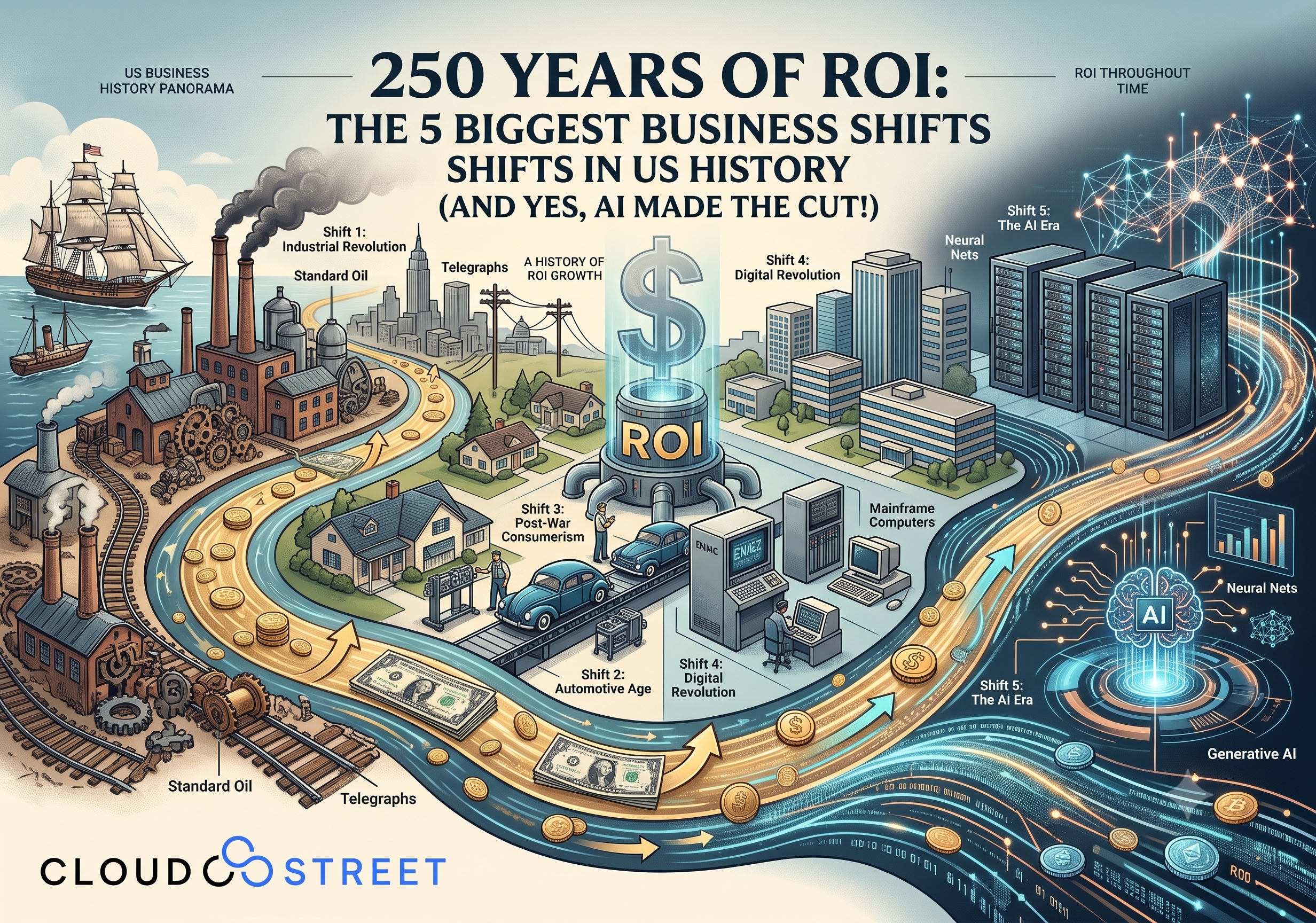
As America approaches its 250th anniversary, it’s incredible to look back at how the landscape of commerce has transformed. At CloudStreet, we spend our days in Houston, Texas, helping local and global businesses maximize their ROI through Salesforce, but our work is really just the latest chapter in a long story of American innovation.
From the first steam-powered factories to the rise of autonomous AI agents, the goal of business has always been the same: scale, efficiency, and return on investment. However, the way we achieve those goals has shifted dramatically.
In this post, we’re breaking down the 5 biggest business shifts in U.S. history that paved the way for the modern enterprise. We’ll look at how these revolutions changed the game and why Artificial Intelligence is the definitive “fifth wave” of ROI.
1. The Industrial Revolution & Interchangeable Parts (Early 19th Century)
The first massive shift was the transition from custom, agrarian craftsmanship to mechanized manufacturing. Before this, if your wagon broke, a blacksmith had to custom-forge a new part. It was slow, expensive, and impossible to scale.
The introduction of standardized, interchangeable parts changed everything. Suddenly, machines could produce goods exponentially faster and cheaper. This was the birth of the modern manufacturing and wholesale distribution sectors. It allowed businesses to move from “bespoke” to “bulk,” creating the foundation for the massive industrial economy we know today.
Key Impact:
- Scale: Production moved from units per week to units per hour.
- Cost Reduction: Mass production drove down the price of goods for consumers.
- Foundation: Established the need for organized labor and supply chain management.
2. Transcontinental Infrastructure & The Telegraph (Mid-to-Late 19th Century)
If the Industrial Revolution gave us the goods, the second shift gave us the reach. The completion of the Transcontinental Railroad and the invention of the telegraph effectively “shrunk” the United States.
Localized businesses that previously served a single town could suddenly become national enterprises. You could take an order in New York and fulfill it with inventory moving across the country by rail. This period created the first complex B2B supply chains and logistical networks, establishing the need for rigorous inventory and distribution management.
Key Impact:
- National Markets: Businesses could target customers thousands of miles away.
- Real-Time Communication: The telegraph allowed for instantaneous coordination across distances.
- Complexity: Managing national logistics required new levels of organizational structure.
Is your business ready for the next shift? Schedule a free ROI consultation with our Houston-based experts today.
3. Enterprise Computing & The Birth of the ERP (Late 20th Century)
For most of American history, business was recorded in physical paper ledgers. The third major shift occurred when those paper stacks were replaced by digital mainframes and relational databases.
The birth of Enterprise Resource Planning (ERP) systems, pioneered by giants like SAP and Oracle, allowed massive industrial corporations to track inventory, finance, and operations across global footprints in real-time. Data officially became a primary, trackable business asset.

However, as many businesses found out, having a powerful ERP is only half the battle. To truly drive ROI, your back-office data needs to talk to your front-office sales team. This is where Salesforce and Oracle Fusion integration becomes a game-changer, allowing companies to bridge the gap between their legacy records and modern customer relationships.
Key Impact:
- Digital Accuracy: Eliminated the human error inherent in paper bookkeeping.
- Operational Visibility: Leaders could see the health of the entire company from a single screen.
- Integration Needs: Created the requirement for connected systems to avoid “data silos.”
4. The Cloud & Digital Commerce (Late 1990s–2010s)
The fourth shift moved the “brain” of the company from expensive on-premise hardware to the cloud. Platforms like Salesforce democratized enterprise software, making world-class tools available to businesses of all sizes without the need for a massive IT department.
This era also saw the explosion of digital commerce. B2B companies realized that their customers wanted the same “Amazon-like” experience they had at home. The shift toward Salesforce B2B Commerce removed the friction of traditional sales cycles, allowing for self-serve portals, unified CRM data, and 24/7 ordering.

Key Impact:
- Accessibility: Cloud (SaaS) lowered the barrier to entry for high-end tech.
- Customer Autonomy: B2B buyers can now research and purchase on their own terms.
- Agility: Businesses can update their digital storefronts and sales processes in real-time.
Don’t get left behind. Download our B2B Commerce ROI Checklist to see how your tech stack measures up.
5. Artificial Intelligence & Predictive Automation (Present)
We are currently living through the fifth and perhaps most profound shift: the transition from software that simply stores data to software that interprets and acts on it.
AI makes the cut as a historical shift because it solves the “manual bottleneck” problem. Even with the cloud, humans still had to spend hours analyzing reports, writing emails, and updating records. With Salesforce Artificial Intelligence and Agentforce, the system can now predict customer needs, automate complex workflows, and act as an autonomous member of your team.

At CloudStreet, we’re seeing AI fundamentally change how our customers extract ROI. Whether it’s predictive maintenance in industrial manufacturing or hyper-personalized catalogs in B2B commerce, AI is the engine driving the next 250 years of American business.
Key Impact:
- Predictive Power: Moving from “what happened?” to “what will happen next?”
- Efficiency: Automating the 80% of mundane tasks so humans can focus on the 20% that requires strategy.
- Personalization at Scale: Delivering a unique experience to every customer, every time.
Summary: The 5 Shifts That Built the U.S. Economy
To recap, here are the 5 major shifts that have defined the last two and a half centuries of business:
- Industrial Revolution: Mechanization and standardized parts for mass scale.
- Infrastructure & Telegraph: National connectivity and logistical networks.
- Enterprise Computing (ERP): The transition from paper ledgers to digital data.
- The Cloud & Digital Commerce: SaaS-based agility and self-serve B2B portals.
- AI & Predictive Automation: Software that thinks, predicts, and acts.
Partnering with CloudStreet for the Next Century
Based in Houston, Texas, CloudStreet serves a diverse range of clients locally and globally. We understand that navigating these shifts, especially the rapid rise of AI, can feel overwhelming. Our mission is to ensure your Salesforce investment isn’t just a cost center, but a major driver of ROI.
Whether you need to integrate a legacy ERP or deploy the latest Agentforce AI agents, we have the expertise to help you lead the “fifth wave” of business innovation.

Ready to maximize your Salesforce ROI?
Frequently Asked Questions (FAQ)
What is the biggest business shift in US history?
While the Industrial Revolution started it all, many experts argue that Artificial Intelligence is the most significant shift because it represents the first time technology can interpret data and make decisions without constant human intervention.
How does Salesforce help with the AI business shift?
Salesforce provides tools like Agentforce and Data Cloud that allow businesses to harness their own data to power autonomous AI agents, improving customer service and sales efficiency.
Why is Salesforce and Oracle integration important?
Many established businesses use Oracle as their ERP (back-office) and Salesforce as their CRM (front-office). Integrating the two ensures that sales teams have real-time access to inventory and financial data, which is essential for ROI.
Is CloudStreet a local Houston company?
Yes, CloudStreet is headquartered in Houston, Texas. However, we support customers both locally in the Houston area and globally across various industries.
Category
Discover insights that drive results - explore out latest blog posts now
DealHub Salesforce Integration for Manufacturers: Connecting CPQ, Contracts, and CRM
About the manufacturer: mid-market industrial equipment company A U.S.-based, mid-market [...]
Salesforce Data 360 and Agentforce: Why Grounding Is What Makes AI Agents Dependable
An AI agent can produce a fluent answer and still [...]
Salesforce Data 360 Governance and Informatica: Managing Data Quality, Access, and Trust in the Agentic Era
Data governance becomes more consequential when business data does more [...]