Integrating Salesforce and Sage Intacct – A Case Study

Case Study: Integrating Salesforce and Sage Intacct to Accelerate Growth
An Analysis of the CloudStreet Salesforce and Sage Intacct Integration for a National IT Services Provider
Executive Summary
Problem
The client operated with disconnected Salesforce and Sage Intacct systems, creating critical data silos between sales and finance. This forced a reliance on slow and error-prone manual data entry to move information between the departments. The resulting data inconsistencies led to an inefficient Order-to-Cash cycle, delayed cash flow, inaccurate financial forecasting, and a fragmented customer experience that ultimately constrained the company’s ability to scale.
Solution
CloudStreet implemented a bidirectional integration between Salesforce and Sage Intacct to establish a single, automated source of truth for core business data. The solution synchronized key entities—Customers, Products, Sales Orders, and Invoices—to automate the entire quote-to-cash workflow. When a deal was closed in Salesforce, a sales order was automatically created in Intacct, and conversely, invoice and payment statuses from Intacct were made visible in Salesforce, eliminating manual processes and data duplication.
Results
The integration yielded significant improvements in efficiency and visibility. It dramatically accelerated the Order-to-Cash cycle, which improved cash flow and reduced billing errors. By eliminating manual data entry, employee productivity increased, freeing staff for higher-value strategic work. The unified system provided both sales and finance teams with a real-time, 360-degree view of the customer, leading to more accurate forecasting, enhanced customer service, and a scalable operational foundation to support future growth.
Introduction: The Strategic Imperative for a Connected Enterprise
For growing businesses, a common and critical inflection point is reached when the specialized software systems that once fueled their success begin to create operational friction. As companies scale, best-in-class platforms are often adopted by different departments to optimize specific functions: a powerful Customer Relationship Management (CRM) system for the sales team and a robust Enterprise Resource Planning (ERP) solution for the accounting and fulfillment teams. While each system excels in its domain, their operation in isolated silos can inadvertently erect barriers to efficiency, erode data integrity, and ultimately constrain the very growth they were meant to support. This scenario represents a significant challenge where departmental excellence fails to translate into enterprise-level agility.
This case study dissects the challenges faced by a national IT solutions and services provider operating with disconnected Salesforce and Sage Intacct platforms. It will provide a detailed analysis of the strategic integration architected and implemented by CloudStreet, a project designed not as a mere technical fix, but as a fundamental business process re-engineering initiative. The report will examine the specific methodologies used to create a unified, automated, and data-driven operational ecosystem. Finally, it will analyze the transformative business outcomes that emerge when a company successfully bridges the divide between its commercial and financial operations, unlocking new levels of efficiency, visibility, and strategic potential.
Section 1: The Problem – The High Cost of Disconnected Operations
The core of the client’s operational inefficiency stemmed from the fundamental disconnect between its two most critical business systems. The sales and customer-facing teams relied on Salesforce as their primary tool, while the accounting and fulfillment teams operated within Sage Intacct. This separation created significant data silos, which manifested as a series of compounding problems that impacted productivity, data accuracy, interdepartmental trust, and the overall customer experience.
Defining the Core Systems: Two Powerhouses at Odds
To understand the friction, it is essential to first define the roles of these two powerful, yet disparate, platforms.
Salesforce: The Engine of Sales and Customer Engagement
Salesforce is the world’s leading cloud-based Customer Relationship Management (CRM) platform, providing a centralized system for managing all interactions with current and potential customers. Its primary function is to equip front-office teams—sales, marketing, and customer service—with the tools to find prospects, close deals, and provide exceptional service. For the client, Salesforce was the system of engagement, the dynamic environment where all customer activities, sales pipeline data, and relationship histories were captured and managed. It served as the single source of truth for all commercial activities, from initial lead generation through to the final handshake on a deal.
Sage Intacct: The System of Record for Financial Operations
Sage Intacct is a best-in-class, cloud-native financial management and Enterprise Resource Planning (ERP) software, distinguished as the only solution of its kind endorsed by the American Institute of Certified Public Accountants (AICPA). It functions as the back-office command center, meticulously managing core financial operations such as accounts payable, accounts receivable, the general ledger, order management, and complex revenue recognition. For the client, Intacct was the system of record, the authoritative source for all financial data. It governed everything from the generation of invoices and the processing of payments to the creation of official financial reports and the assurance of regulatory compliance.
The Operational Friction of Data Silos
While both platforms delivered exceptional value within their respective departments, their inability to communicate created a persistent and costly operational drag on the entire organization.
Manual Processes and Duplicated Effort: A Drain on Productivity
The most immediate and visible problem was the daily, tedious ritual of manual data transfer. Upon closing a deal, the sales team would finalize the opportunity in Salesforce. This action, however, did not trigger any corresponding process in the financial system. Instead, it initiated a cumbersome, multi-step manual workflow. Sales administrators were required to export deal information from Salesforce, often into spreadsheets, clean it, and then forward it to the accounting department. The accounting staff would then have to manually re-enter this same information—customer details, product SKUs, quantities, and pricing—into Sage Intacct to generate a sales order and, eventually, an invoice.
This duplicated effort was a significant drain on productivity. Industry analysis suggests that such inefficiencies can cost an organization up to 350 hours per employee per year, which is equivalent to losing one full day of productivity each week to silo-related friction. This constant, low-value work not only consumed valuable staff time that could have been allocated to more strategic activities but also contributed to lower employee morale, as skilled professionals were relegated to repetitive data entry tasks.
Data Integrity Under Siege: The Dangers of Inconsistency and Error
Manual data entry is widely recognized as a primary source of “bad data” within enterprise systems. Each manual transfer of information from Salesforce to Intacct introduced a new opportunity for human error. A simple typo in a customer’s billing address, an incorrect product code, or a misplaced decimal in a price could cascade into significant downstream consequences. These errors led to incorrect invoices, which in turn caused payment delays, customer disputes, and time-consuming reconciliation efforts.
Furthermore, maintaining two separate databases for what was often overlapping information—particularly customer records—made inconsistencies inevitable. A customer might update their contact information with their sales representative, but if that change was not manually communicated and updated in Intacct, the accounting department would continue to send invoices to an old address. Over time, this leads to data decay, where neither system can be fully trusted as the single, reliable source of truth.
The “Trust Gap”: When Sales and Finance Operate in Different Realities
This persistent data inconsistency created a more insidious problem: a “trust gap” between the sales and finance departments. Sales teams operated from the reality presented in Salesforce, while the finance team relied exclusively on the data within Intacct. When discrepancies inevitably arose—for example, a dispute over the final approved price of a deal—it fostered a culture of mistrust and defensiveness. Finance teams began to view data coming from the sales department as inherently unreliable, forcing them to spend an inordinate amount of time on reconciliation and verification rather than strategic financial analysis.
Conversely, sales teams grew frustrated by their lack of visibility into the financial side of their accounts. They were often blind to whether an invoice had been sent, when it was paid, or if an account was delinquent. This not only complicated their customer relationship management but could also directly impact their commission payments, which were often tied to collected revenue, not just closed deals. This lack of shared data created a dysfunctional dynamic where departments, instead of collaborating, spent valuable time in meetings arguing over whose numbers were correct, a clear symptom of a “silo mentality” that undermines organizational cohesion.
The Strategic Impact on Customers and the Bottom Line
The internal friction caused by these disconnected systems was not contained within the company’s walls; it was externalized, creating tangible negative impacts on the customer experience and the company’s financial health.
A Fractured Customer Experience
Data silos are a direct cause of poor customer service interactions. When a customer contacted their account manager with a question about a recent invoice, the sales representative, working within Salesforce, lacked access to real-time financial data. To answer the question, the representative would have to put the customer on hold, contact someone in the finance department, wait for them to look up the information in Intacct, and then relay the answer. This process resulted in long wait times, multiple transfers between departments, and the common customer frustration of having to repeat their issue to different people. The customer, who sees the company as a single entity, experiences this internal disconnect as poor, fragmented service, which directly erodes satisfaction and loyalty.
A Stalled and Error-Prone Order-to-Cash Cycle
The Order-to-Cash (O2C) cycle—the complete process from a customer placing an order to the company receiving and processing payment—is a critical measure of a company’s operational efficiency and financial health. Disconnected systems created significant bottlenecks at every stage of this cycle for the client. The manual handoff from a “Closed-Won” opportunity in Salesforce to an order in Intacct introduced an immediate delay, pushing back the invoice date. Data entry errors led to invoice inaccuracies, which in turn created disputes and further delayed payment. The lack of visibility for the sales team into outstanding invoices hampered proactive collections efforts.
This accumulation of delays and inefficiencies extended the O2C cycle, which had a direct negative impact on the company’s cash flow. It also made accurate financial forecasting nearly impossible. The finance team was perpetually operating on outdated information, basing their projections on data that was days or even weeks old. This created a reactive business posture, where the organization was constantly trying to reconcile past errors instead of proactively analyzing current data to innovate, adapt to market changes, and seize new opportunities. The company’s ability to grow was being fundamentally constrained by its own internal, system-driven inefficiencies.
Section 2: The Solution – Architecting a Unified Commercial and Financial Ecosystem
To address the deep-seated operational challenges, CloudStreet designed and implemented a comprehensive integration solution. The project’s objective was not merely to connect two software applications but to re-architect the flow of information between the commercial and financial functions of the business. The solution involved creating a robust, near real-time, bidirectional data synchronization between Salesforce and Sage Intacct, establishing a shared system of record that would serve as the single source of truth for core business data.
Project Blueprint: A Two-Way Integration Strategy
The architectural approach was to build a seamless data bridge between the two platforms. This was achieved using a combination of pre-built connectors available on the Salesforce platform and customized API configurations to meet the client’s specific business logic. The integration was designed to automate the entire quote-to-cash process, eliminating the need for manual data entry and ensuring that both the sales and finance teams were operating from the same, consistently updated dataset. This unified environment was the cornerstone of the strategy to break down the existing data silos and foster true cross-departmental collaboration.
Synchronizing Core Business Entities for Seamless Flow
The technical core of the solution was the meticulous mapping and synchronization of four key business entities. Each data flow was designed to automate a critical business process and eliminate a specific point of friction.
Customer & Product Masters: Creating a Single Source of Truth (Bidirectional)
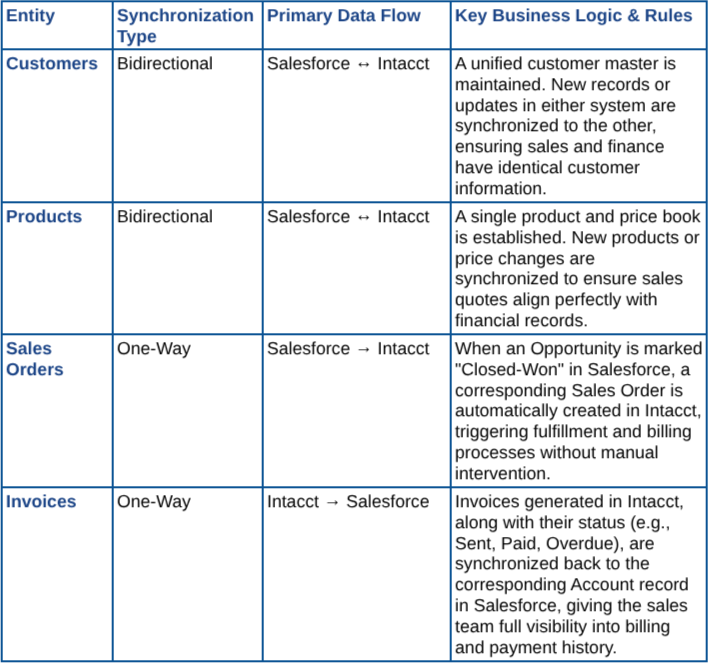
The foundational step in breaking down the data silos was to establish a single, unified master record for both customers and products. A bidirectional synchronization was configured for these entities. This meant that any new customer account created or updated in Salesforce was automatically created or updated in Sage Intacct, and vice versa. Similarly, the product catalog and associated price books were synchronized between the two systems. This ensured that the sales team was always building quotes and opportunities using accurate, finance-approved product information and pricing. It also guaranteed that the finance team was invoicing the correct legal entity with verified billing information, thereby eliminating one of the most common sources of data discrepancies and invoice disputes. This alignment on master data created a shared “dictionary” for the organization’s most critical assets, compelling a level of cross-departmental agreement that had not previously existed.
Sales Order Flow: From Opportunity to Financial Record (Salesforce to Intacct)
To automate the handoff from sales to finance, a one-way data flow was established for sales orders. The workflow was configured so that when a sales representative marked an Opportunity in Salesforce to the “Closed-Won” stage, the integration automatically triggered an action. It would gather all relevant data from the Opportunity—the customer account, the specific products and quantities, and the final negotiated pricing—and push this information to Sage Intacct to create a new, corresponding Sales Order record. This single, automated action replaced the entire manual process of exporting, emailing, and re-keying data. It instantly initiated the fulfillment, revenue recognition, and invoicing processes within the financial system, dramatically accelerating the start of the order-to-cash cycle.
Invoice & Payment Visibility: Empowering Sales with Financial Data (Intacct to Salesforce)
To close the loop and provide sales with crucial financial context, a reverse data flow was configured. As the finance team generated invoices, sent them to customers, and recorded payments within Sage Intacct, the status of these invoices was synchronized back to Salesforce. This information was populated in a custom object linked to the corresponding Account record, making it easily accessible to the sales and service teams. This provided sales representatives with real-time visibility into a customer’s complete billing and payment history. They could now confidently answer customer queries, identify overdue accounts that required a follow-up, and have more strategic conversations about the overall financial health of the relationship, all without ever leaving the Salesforce interface.
The table below provides a structured summary of the integration’s core logic, illustrating how each data flow was designed to support a specific business objective.
Executing the Integration: Key Methodological Steps
The successful deployment of the integration required a disciplined approach to data management, from establishing an initial baseline to defining the rules for the ongoing data lifecycle.
Initial Data Synchronization: Establishing a Clean and Complete Baseline
Before the real-time synchronization could be activated, it was necessary to perform an initial data migration to establish a consistent and complete baseline across both systems. This process involved a standard Extract, Transform, Load (ETL) methodology. Existing Customer and Product data was extracted from both Salesforce and Sage Intacct. This data was then cleansed to remove duplicates, correct inconsistencies, and standardize formats. Finally, the clean, mapped data was loaded to create a unified set of master records that would serve as the foundation for the integration.
A key strategic decision was made during this phase to not migrate historical Sales Orders from Salesforce to Intacct. The client determined that since these transactions had already been manually created and processed in Intacct, the significant effort, cost, and risk associated with a complex historical transactional data migration outweighed the potential benefits. This pragmatic approach allowed the project to focus on perfecting the automated workflow for all future business, ensuring a faster time-to-value and containing the overall scope and complexity of the implementation. This decision prioritized future agility over historical perfection, a trade-off that accelerated the project’s success.
Managing the Data Lifecycle: A “Flagging” Approach to Deletions
A critical aspect of the integration design was the handling of deleted records. Instead of using “hard deletes,” which permanently remove a record from the database, the solution was configured to use a “soft delete” methodology. In this model, when a record is deleted in one of the source systems (for example, a product is discontinued), it is not erased in the target system. Instead, a specific field, such as a checkbox labeled is_deleted or is_inactive, is updated to “true”.
This approach was chosen for several crucial reasons related to governance and data integrity. A hard delete effectively makes a record vanish, which is unacceptable in a financial context where a complete and auditable history of all transactions is required. By flagging records as deleted, the system preserves a permanent, immutable business ledger. This ensures a complete audit trail for financial compliance, helps in resolving potential disputes (e.g., proving that a sales order was created and later canceled), and prevents the accidental breaking of referential integrity, where deleting a customer record could orphan historical invoices associated with it. This mature approach to data management elevated the integration from a simple data-moving tool to a system that enforces robust data governance and preserves the historical integrity of the company’s business records.
Section 3: The Results – Unlocking Strategic Value Through Integration
The implementation of the Salesforce and Sage Intacct integration delivered a range of transformative results, moving beyond simple technical connectivity to generate tangible, high-impact business value. The outcomes were evident in enhanced operational efficiency, a more unified and holistic view of the business, and measurable improvements in financial performance and customer satisfaction.
Achieving Operational Excellence and Enhanced Productivity
The most immediate and profound impact of the integration was the complete automation and subsequent acceleration of the company’s core commercial-to-financial workflow.
Automating and Accelerating the Order-to-Cash Workflow
By creating a direct link from a “Closed-Won” opportunity in Salesforce to a sales order in Intacct, the integration dramatically shortened the Order-to-Cash (O2C) cycle. The manual delays that previously existed between a deal closing and an invoice being generated were entirely eliminated. With a single click in Salesforce, the entire billing and revenue recognition process was automatically triggered in Intacct. This newfound speed in invoicing led to a significant reduction in Days Sales Outstanding (DSO), as customers received their bills faster, which in turn accelerated cash collections and improved the company’s overall cash flow position. The O2C process, once a linear and fragmented series of handoffs, was transformed into a continuous and transparent feedback loop, where a sales action instantly prompted a financial action, and the result of that financial action was fed back to inform the next sales engagement.
Eliminating Redundant Data Entry and Associated Errors
The automation of data flow between the two systems completely eradicated the need for manual, duplicate data entry. This delivered a significant return in terms of employee productivity. Analysis of similar projects shows that finance teams can reclaim 15-20 hours per month that were previously consumed by manual reconciliation tasks. This reclaimed time allowed skilled financial and administrative staff to shift their focus from low-value clerical work to higher-value strategic activities, such as financial analysis, forecasting, and process improvement.
Furthermore, the elimination of manual entry led to a near-total reduction in the data errors that had plagued the previous workflow. With data flowing systematically, the risk of typos, incorrect entries, and other human errors was minimized. This resulted in more accurate financial statements, a dramatic reduction in costly billing disputes, and greater overall confidence in the integrity of the company’s financial data.
Forging a Unified 360-Degree View of the Business
The integration dissolved the walls between the sales and finance departments, creating a shared data environment that provided unprecedented, real-time visibility across the entire customer lifecycle.
Empowering Sales Teams with Real-Time Financial Insights
With real-time invoice and payment status data now visible directly within the Salesforce Account record, the sales team was empowered with a level of financial insight they never had before. Representatives no longer needed to interrupt their workflow to contact the finance department for basic updates on a customer’s account. They could proactively manage their customer relationships with a full understanding of their financial standing. This enabled them to have more informed conversations, assist in collections for overdue accounts, and identify financially healthy clients who might be prime candidates for upselling opportunities. This visibility fostered a greater sense of ownership over the entire commercial relationship, transforming sales representatives from simple deal closers into strategic account managers.
Providing Finance with Immediate Commercial Context for Forecasting
Simultaneously, the finance team gained direct, real-time visibility into the sales pipeline within Salesforce. They were no longer dependent on periodic, and often outdated, spreadsheet exports from the sales team to understand future revenue streams. This live view of the sales funnel allowed for significantly more accurate and timely revenue forecasting and cash flow analysis. The finance team could now model future financial performance based on the current probability of deals closing, enabling more agile and data-driven strategic planning.
Driving Measurable Business Outcomes
The operational and visibility improvements translated directly into measurable enhancements in key business performance areas, laying a scalable foundation for future growth.
Improved Financial Reporting Accuracy and Timeliness
The seamless and automated flow of data between the sales and financial systems created a single, trusted source of truth for all revenue-related activities. This data integrity greatly accelerated the month-end and quarter-end closing processes. Financial reports were not only generated faster but were also more accurate, giving the company’s leadership team a higher degree of confidence in the data underpinning their strategic decisions. This foundation of trusted, real-time data allowed the business to become more agile, enabling faster and more confident decisions regarding investments, resource allocation, and market strategy.
Enhanced Customer Satisfaction and Strategic Account Management
The unified 360-degree view of the customer—combining the history of sales and service interactions from Salesforce with the complete order and payment history from Intacct—enabled a more personalized, efficient, and responsive customer experience. When customers called with inquiries, any employee with access to the record could see the full context of their relationship with the company, leading to faster issue resolution and a more seamless service experience. This deeper understanding of the customer journey strengthened relationships and was a key driver in improving customer retention and increasing lifetime value.
Building a Scalable Foundation for Future Growth
Perhaps the most significant long-term benefit of the integration is the creation of a highly scalable operational platform. The automated workflows are designed to handle a significant increase in transaction volume without requiring a proportional increase in administrative or financial headcount. As the business continues to grow and acquire new customers, the integrated system can efficiently process the additional orders, invoices, and payments. This provides a robust and elastic foundation that actively supports, rather than hinders, the company’s future expansion plans, ensuring that growth remains profitable and manageable. The value of this integration compounds over time, creating a virtuous cycle where high-quality data fuels the strategic agility needed for sustained success.
Conclusion: From Operational Friction to a Cohesive, Data-Driven Enterprise
The journey of the national IT services provider from a state of fragmented operations to a unified enterprise illustrates a critical lesson for all growing companies. The initial condition—characterized by disconnected systems, data mistrust, manual inefficiency, and interdepartmental friction—is a common and potent inhibitor of scale. The reliance on manual processes created a drag on productivity, while the lack of a single source of truth eroded data integrity and hampered strategic decision-making.
The Salesforce and Sage Intacct integration, executed by CloudStreet, was far more than a technical project connecting two databases. It was a strategic business transformation that fundamentally re-engineered the company’s core commercial and financial processes. By automating the flow of information from the initial sales quote to the final cash collection, the solution eliminated costly inefficiencies, accelerated the order-to-cash cycle, and provided unprecedented, real-time visibility across the organization. This created a cohesive operational engine where sales and finance could collaborate effectively, armed with shared, trusted data.
Ultimately, this strategic investment yielded compounding returns that resonated throughout the business. It unlocked significant gains in productivity, enhanced the accuracy and timeliness of business intelligence, and directly improved customer satisfaction. Most importantly, it established a scalable and resilient foundation capable of supporting the company’s long-term growth ambitions. In today’s competitive landscape, the ability to connect the disparate parts of a business into a single, cohesive, and data-driven enterprise is not a luxury; it is a prerequisite for achieving sustainable growth and market leadership.
Category
Discover insights that drive results - explore out latest blog posts now
10 AI Skills Your Business Needs to Master in 2026
It is officially 2026, and the "AI hype" phase is [...]

The Hidden ROI of Unified Commerce: Why B2B + B2C on One Platform Wins
Category: Blog If you’re running a medium-to-large business, you probably [...]
Outgrowing Shopify? Why Enterprise Leaders are Migrating to Salesforce Commerce Cloud (SFCC)
Let’s be real for a second: Shopify is a fantastic [...]